
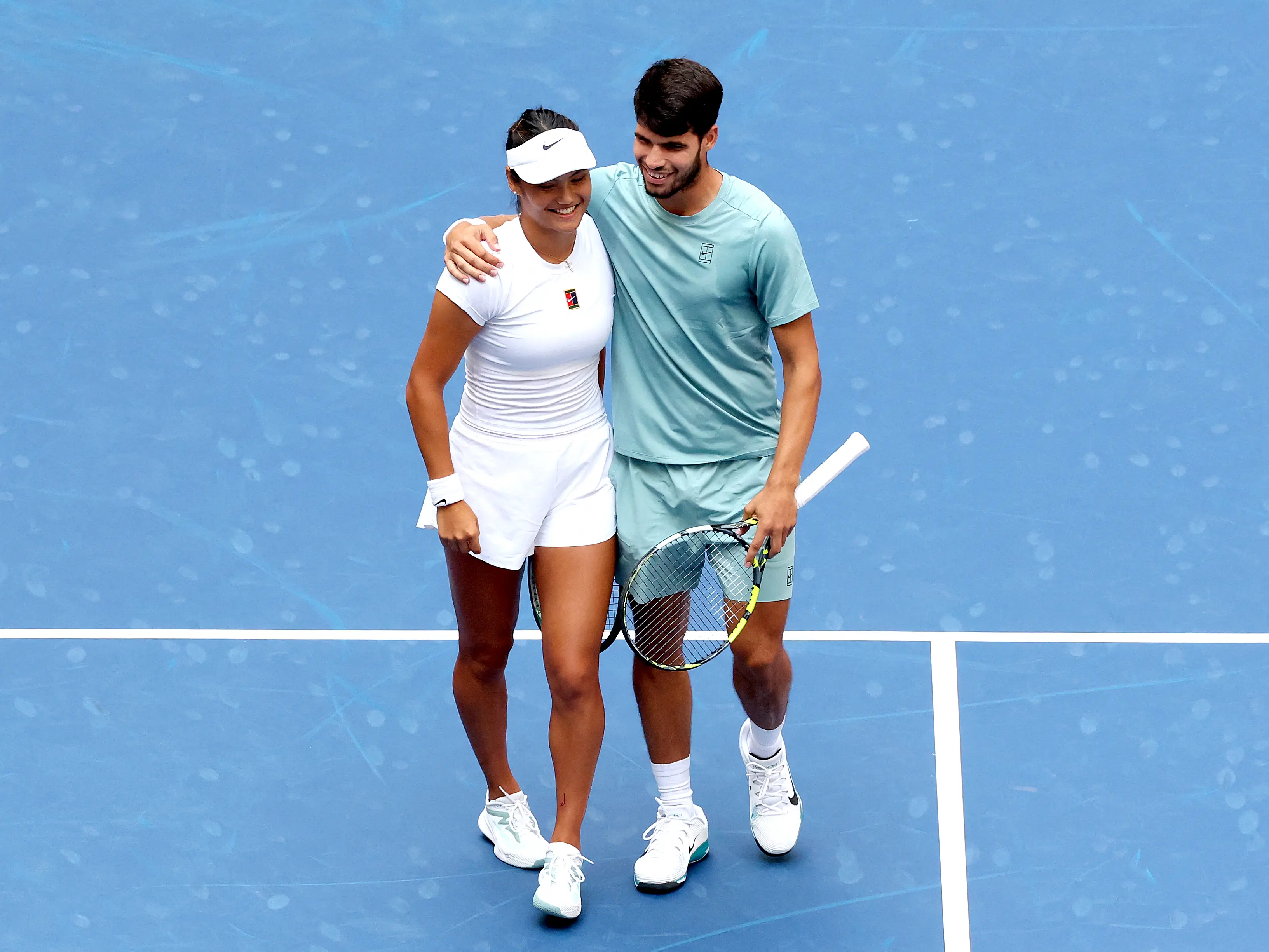
&imwidth=800&imheight=600&format=webp&quality=medium "Carlos Alcaraz, Emma Raducanu, Jessica Pegula and others — Did star power save mixed doubles at the US Open?")
For years, mixed doubles at the Grand Slams has lived in the shadows. Tucked away on outer courts, with sparse crowds and modest prize money, it often felt like a polite afterthought rather than a true showcase. The 2025 US Open decided to flip that script — and in doing so, turned a forgotten format into one of the most talked-about events of the fortnight. This wasn’t the mixed doubles of old. Instead of meandering matches played in empty corners of the Billie Jean King Tennis Center, the tournament condensed the action into a two-day sprint, slotted during Fan Week when attention is at its peak. Short sets, no-advantage scoring, and match tiebreaks were designed to guarantee drama and keep the pace brisk. And then came the real hook: a $1 million prize for the winners — a figure that instantly catapulted the event into prime-time relevance.
Star power arrives
It wasn’t just the money. The draw looked like something dreamed up in a fan’s imagination. Carlos Alcaraz and Emma Raducanu stepping onto court as partners, Jessica Pegula testing her doubles chops, and even veterans like Venus Williams mixing it up with the next generation. Names that usually command Ashe Stadium for gruelling best-of-five marathons were now part of a quick-fire doubles shootout, and the crowds responded. The stands filled, the buzz spread online, and for the first time in a long time, mixed doubles felt like a showpiece.

And yet, tennis has a way of humbling hype. While the stars brought the spotlight, it was the doubles specialists who brought the substance. Andrea Vavassori and Sara Errani, seasoned Italian campaigners with reflexes honed at the net, carved their way through the field and ultimately defended their title. Their victory wasn’t just a win on the scoreboard; it was a statement — that chemistry, positioning, and instinct still trump pure celebrity.
Success or stunt?
Trending Stories
)
‘Kill all in the name of...’: FBI arrests 21-year-old over alleged ISIS-inspired mass-casualty attack plot
)
Space mines, lasers & robotic arms: Lt Gen Pannu decodes US disclosure of weapons in space
)
Bitter Zelensky snubs Trump for playing politics with Ukraine war | Gravitas
)
Passengers scream as Iran flight suffers mid-air scare: Boeing 737 shakes violently after take-off | VIDEO
)
US fires up to 70 interceptors against Iran attack on Jordan, putting supplies under pressure
)
India’s imports from Russia jump 57% in five months; China remains top import source
)
‘US military task force aiding Saudi Arabia forces with intel, planning support’: Official
)
OpenAI boss Sam Altman repeats AI 'slow down' call, says world 'right to be afraid'
)
Top military commanders from US, Israel, and 7 Arab nations held secret meeting on Iran War
)
Sydney Sweeney defends provocative ad choice, the internet is still not impressed
)
'Definitely feel bad for yourself': Kuldeep Yadav opens up on India Test snubs
)
Ex-India all-rounder Yuvraj Singh wants India to avoid 'massive changes' before ODI World Cup 2027
)
Ed Sheeran’s US tour loses all support acts after Macklemore’s removal | Controversy explained
)
China's property crisis deepens as investment plunges nearly 20%
)
Messi set to play in farewell match on October 6 in Argentina vs Benin friendly
)
2,200 people donate Rs 1.5 crore for 'docile' Georgia donkey 'HeeHaw' shot dead by police officer
)
Putin-linked Russian oligarch, Melania links: Why Trump skipped his son’s Bahamas wedding bash?
)
800 million years old - Scientists discover 'fingerprints' of supercontinent Gondwana in ancient rocks
)
Saudi turns to Israel for intelligence help as Houthi attacks intensify: Report
)
Trump's name cannot return to Kennedy Center, US judge rules
)
Water equivalent to two Pacific Oceans could be stashed 2,900 km inside Earth
)
1,200 Indian and US troops begin high-altitude and desert drills
)
Ex-CIA officer caught with gold bars worth $40 million seeks plea deal | Gravitas
&im=FitAndFill=(700,400))
New OTT releases this week (September 14-20, 2026): Lust Stories 3, Waiting Hai, Irumudi- 5 new titles coming on Netflix, Prime Video and more
)
Trump's Iran war faces fresh House rebuke; 7 Republicans join Democrats in push to end conflict ahead of midterms
)
US Treasury yields cross 5% as Scott Bessent warns of ‘global issues’ impacting bonds
)
Who is Kalyan Bainsla, accused in the Gurugram hit-and-run case involving woman biker?
)
Saudi Arabia discovers 110 million tonnes of Uranium-rich ore in Madinah region
)
'Now Trump is copying us': Shivakumar links US $5,000 plan to Congress guarantees
)
Los Angeles helicopter crash: At least three dead, several injured; NTSB to investigate
)
West Bengal IPS officer Bushra Bano transferred after objections to ‘Assalamualaikum’, ‘Inshallah’
)
India summons top Pakistan diplomat after Pak Navy ship collides with Indian warship at high seas
)
Spanish officer sent home from NATO base over affair with 'Russian spy' | Gravitas
)
Saudi Arabia accuses Houthis of drone attack on Mecca, first-ever red alert in Islam's holiest site sparks panic
)
'Like a thug you are using agency to go after..': Kash Patel grilled by Senate Democrats over FBI firings, journalist investigations and hiring policy
Was it a success? In terms of attention, absolutely. Crowds flocked, broadcasters leaned in, and social media lit up with clips of unlikely pairings and rapid-fire rallies. For a format often dismissed as filler, it was a breakthrough. But success comes with caveats. Doubles specialists voiced frustration at being sidelined, their usual spots handed to marquee singles players. Purists worried about whether gimmicks like short sets and oversized prize money diluted the spirit of the sport. The divide was clear: what thrilled audiences wasn’t necessarily embraced by those who grind week-in, week-out on the doubles circuit.
What the US Open proved, however, is that there is an appetite for mixed doubles when it is packaged boldly. In an era when tennis is constantly seeking ways to engage younger audiences, the experiment offered a glimpse of what the sport could look like: faster, starrier, louder. Whether the other majors follow suit remains to be seen, but one thing is certain — mixed doubles is no longer invisible.

