Tagore and the story of three national anthems of India, Bangladesh and Sri Lanka

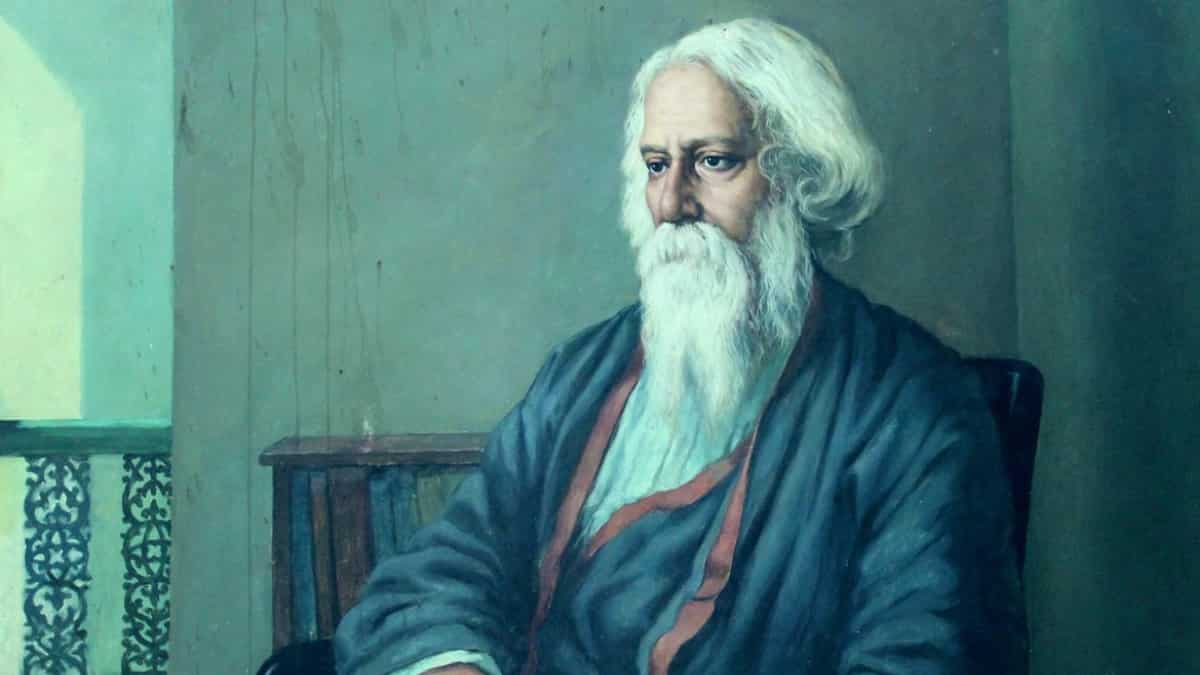
Rabindranath Tagore
When Sheikh Hasina fled her country on August 5 to seek safe haven in India, Bangladeshis burned down their own history that their ancestors literally built with blood.
Many statues of Sheikh Mujibur Rahman, once lovingly called Bangabandhu, were vandalized and smashed to ashes of the dead history of Bangladesh. All of this because Rahman was affiliated with the Awami League (Sheikh Hasina’s political party) and of coursewas the father of Hasina, the ousted Prime Minister —but, in all hooliganism, people in Bangladesh seem to forget that Rahman was also the Father of the Nation.
With Bangladesh’s interim government unable to come to terms with the reality of appetitive aggression against minorities in the country, some radical voices are finding vocal grounds amidst all the confusion.

In a recent bid to feign that Bangladesh has nothing to do with its Bengali ethnicity, former military officer Abdullahi Amaan Azmi argued that the anthem 'Amar Sonar Bangla' is a relic of the past and doesn't reflect the identity of an independent Bangladesh.
Azmi, son of former Jamaat-e-Islami leader Ghulam Azam, argued that the national anthem written by Rabindranath Tagore, associated with the Bengal partition, does not align with the essence of a liberated Bangladesh.
)
Trump 2.0: Dark days ahead for America’s ‘imperial presidency’
66 years of the Indus Waters Treaty: How India and Pakistan settled a bitter river dispute
)
Trump defends AI amid growing alarm, announces new 'AI force' and promises an 'AI czar'
)
9 women found dead near Johannesburg: South Africans rally, demand 'enough' to femicide
&im=FitAndFill=(700,400))
How many F-35s does Britain, Japan and Israel have?
)
‘Will go to any extent’: Pakistan vows to defend Saudi Arabia amid Houthi attacks
)
Nigeria: Protesters take to the streets, police fire shots
)
Raphinha hat-trick powers Barcelona to 3-1 win over Sevilla in La Liga
)
US-Iran war: Tehran draws red lines — seven demands before any peace talks
)
Cochin shipyard starts building Indian Navy's next-gen missile vessels
&im=FitAndFill=(700,400))
Meet top 5 Indian batters with fastest T20I centuries
)
Harry Brook targets long reign at top of T20I rankings after Sri Lanka sweep
)
Brigitte Bardot’s private collection set for Paris auction; key items and prices revealed
)
Pak: A series of counter terrorism operations in Khyber Pakhtunkhwa
)
Iran sets 7 conditions to end war with US: What are Tehran’s demands?
)
Pentagon revives mandatory testosterone testing for male troops aged 30 and above
)
Russia extends ban on Western food imports for two more years in extended sanctions countermeasure
)
Flying cars in UAE: Ras Al Khaimah signs deal with Chinese company to test new transport
&im=FitAndFill=(700,400))
Ananya Panday to Sharvari: 5 actresses serving major princess vibes
)
Africa is splitting, and a lot sooner than estimated, giving way to a new ocean
)
Iran rebuilding nuclear facilities? New satellite images show Tehran may be rapidly restoring bombed Parchin base
)
FACT CHECK: Why did PM Modi ask Xi ‘is it okay’ at BRICS Summit? New video reveals...
)
Trump announces ‘AI Force’ as debate grows over AI risks and regulation
)
Tirupati Laddu ghee adulterated with chemicals, says ED, supplier arrested
)
The Verdict | When precision fails: US commits war crime in Minab school strike, UN finds
)
Trump bans CNN, MS NOW and Politico from White House over ‘FAKE NEWS’
)
Mark Carney mimics Trump in hilarious moment over C$70 billion clean-energy investment; room erupts in laughter
)
Gaza under attack: Health chief's son killed in IDF strikes
)
Russia holds first parliamentary elections since the beginning of the Ukraine war
)
China may have gained access to US's classified F-35 jets; parts meant for repairs diverted to Hong Kong, sparking Pentagon inquiry
)
Reacher star Alan Ritchson opens up about alleged blackmail, suicide attempt during difficult period
&im=FitAndFill=(700,400))
‘Not the US or China’: These are the countries leading the world in arable land
)
How did an Australian river with 500 crocodiles pass the Olympic test? Here's how
)
Ed Sheeran addresses Macklemore's removal, Gaza conflict during Philadelphia concert: 'I cannot hide how I feel'
)
Arvind Kejriwal, family members, Delhi CM Rekha Gupta get SIR notices
)
"How can an anthem created to unite the two Bengals become the national anthem of an independent Bangladesh?" he asked, claiming, "This anthem was imposed on us by India in 1971."
Here’s a little history of how Bengali language and Tagore hold a shared connection in the sub-continent.
Rabindranath Tagore and story of three national anthems of India, Bangladesh and Sri Lanka
Rabindranath Tagore wrote the national anthems of two countries, India and Bangladesh. But he also deeply influenced the words and music of a third, the Lankan national anthem, ‘Sri Lanka Matha’.
The union of sorts of the three national anthems were first witnessed during the Cricket World Cup 2011, which was also the year of Tagore’s 150th birth celebration. It was rare to see an international sports event beginning and ending with players of different nationalities crooning anthems written by the same man- the Nobel laureate Rabindranath Tagore.
Also Read |Bangladesh's interim government lifts ban on Jamaat-e-Islami
The sporting event kicked off with 'Amar Shonar Bangla' and 'Jana Gana Mana' as the first match was between Bangladesh and India on 19 February 2011 in Dhaka.
In the finals in Mumbai, again India’s anthem was played while the Sri Lankan team sang ‘Sri Lanka Mathaa’, which also has the Tagore stamp.
The anthem was written and composed by Ananda Samarakoon, around 1939-40, while he was Tagore’s disciple at Visva-Bharati University. Samarakoon’s first Santiniketan stint ended after six months but it was inspiring enough for him to return and begin the first traditions of a unique Sinhalese music.
Watch |Bangladesh unrest: What's future of Hindus in Bangladesh?
Some believe that Tagore worked on the musicwhile Samarakoon wrote the lyrics, but Tagore being directly involved in the creation of the song has been denied by some historians like Indian Lipi Ghosh and Sri Lankan Sandagomi Coperahewa.
After returning to Sri Lanka (Ceylon), Samarakoon taught music at Mahinda College, Galle. The song, which was then known as "Namo Namo Mata", was first sung by students at Mahinda College. After it was sung by the choir from Musaeus College, Colombo at a public event it became hugely popular in Ceylon and was widely played on radio.
‘Amar Sonar Bangla’
'Amar Sonar Bangla', the national anthem of Bangladesh is an ode to Mother Bengal, the lyrics of which were written by Tagore. The melody was derived from Baul singer Gagan Harkara's 'Ami Kothay Pabo Tare.'The modern instrumental rendition was arranged by Bangladeshi musician Samar Das.
The song was written in 1905 during the first partition of Bengal, when the ruling British Empire had an undivided province of Bengal Presidency split into two parts- along communal lines. This action by the British was claimed to have been politically motivated and hence many songs were written to rekindle the unified spirit of Bengal.
The lyrics first appeared in the September issues of Bongodorshon and Baul simultaneously, in 1905. Indira Devi, Tagore's niece, jotted down the musical notation hearing it from Tagore himself.
The first ten lines of the original poem constitute the most commonly sung version of Bangladesh's national anthem, adopted in 1971 during the Bangladesh Liberation War.
‘Jana Gana Mana’
It was originally composed as 'Bharoto Bhagyo Bidhata' in Bengali on 11 December 1911. The first stanza of the song Bharoto Bhagyo Bidhata was adopted by the Constituent Assembly of India as the National Anthem on 24 January 1950.
The poem was composed in a literary register of the Bengali language called Sadhu Bhasha, which is heavily Sanskritised.
If put forward succinctly, the anthem conveys the spirit of pluralism or the concept of 'unity in diversity', which lies at the core of India's cultural heritage.
Bangladesh interim govt to avoid 'controversy'
Religious Affairs Adviser AFM Khalid Hossain reassured the public that the Muhammad Yunus-led administration would not engage in any actions that would fuel unnecessary "controversy." He said regarding Azmi's comment on Bangladesh's national anthem.
He said the government "will not do anything to create controversy".
(With inputs from agencies)