WATCH | SpaceX catches Starship spacecraft midair for first time after 22-hour orbital flight

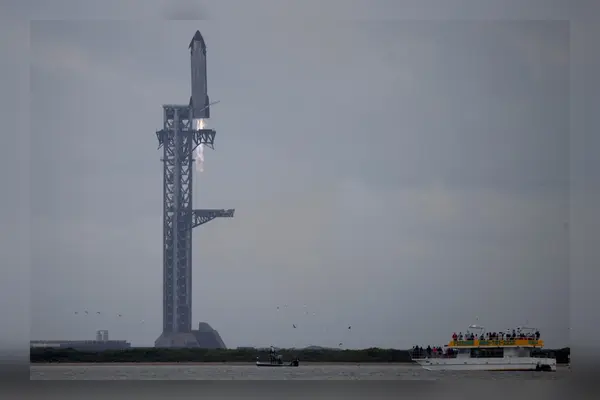
SpaceX's Starship upper-stage vessel descends towards the mechanical tower catch at Starbase in Boca Chica, Texas on November 14, 2026. Photograph: (AFP)
SpaceX makes history as giant mechanical arms catch Starship after a 22-hour orbital flight. However, the Super Heavy booster explodes during its failed recovery attempt.
SpaceX on Saturday successfully caught its Starship spacecraft using giant mechanical arms at its launch tower in Texas, marking the first successful midair recovery of the spacecraft after an orbital flight lasting more than 22 hours. The achievement is a significant step in Elon Musk’s efforts to develop a fully reusable rocket system, although the company failed to recover the rocket's Super Heavy booster.
Starship returned to SpaceX’s Starbase facility a day after its launch, descending through clouds before reigniting its engines to position itself upright. The spacecraft was then secured by the launch tower's giant mechanical arms, known as Mechazilla. Its engines shut down following the catch, leaving it suspended above the ground.
SpaceX shared footage of the recovery on social media, writing: “Mechazilla catches Starship! Congratulations to the entire SpaceX team on this incredible achievement!”
“Can you believe it?” SpaceX commentator Dan Huot said during the broadcast. “Look at her! Baby, she’s back!”
NASA administrator Jared Isaacman also welcomed the development, describing it as “almost magic” and saying the achievement was making “more believers by the day”.
Starship completes 14 orbits, deploys 26 satellites
Trending Stories


The 407-foot (124-metre) rocket lifted off from Starbase in Texas on Friday afternoon. Following successful separation of its two stages, the upper-stage spacecraft continued into orbit and deployed 26 advanced Starlink satellites.
Starship subsequently completed 14 orbits at an altitude of approximately 260-265 kilometres, spending more than 22 hours in space. This was a significant improvement over its previous mission, during which it completed only one to two laps around Earth.
However, the Super Heavy booster failed to complete its return manoeuvre. SpaceX official Kate Tice said its engines stopped firing earlier than expected. The booster’s guidance system detected that it was out of position and diverted it towards the Gulf of Mexico, where it was destroyed. Engineers are investigating the failure.
Full rocket reusability remains a challenge
Saturday’s recovery demonstrated that Starship can return from orbit and be caught at its launch tower. However, SpaceX has yet to recover both stages during a single mission. The spacecraft’s heat shield, consisting of black hexagonal tiles designed to withstand extreme temperatures during atmospheric re-entry, also requires further development.
Musk wants Starship to operate like a commercial aircraft, completing repeated journeys with minimal refurbishment. The rocket is central to SpaceX’s plans for expanding its Starlink satellite network, developing orbital data centres and eventually sending humans to Mars.
NASA is also relying on Starship as a lunar lander for its Artemis programme, with the spacecraft expected to transport astronauts to the Moon later this decade. SpaceX is also preparing to begin Starship launches from Florida's Kennedy Space Centre in the coming months.

