Sulfuric acid-laden Venusian clouds reveal potential for extraterrestrial life: New study

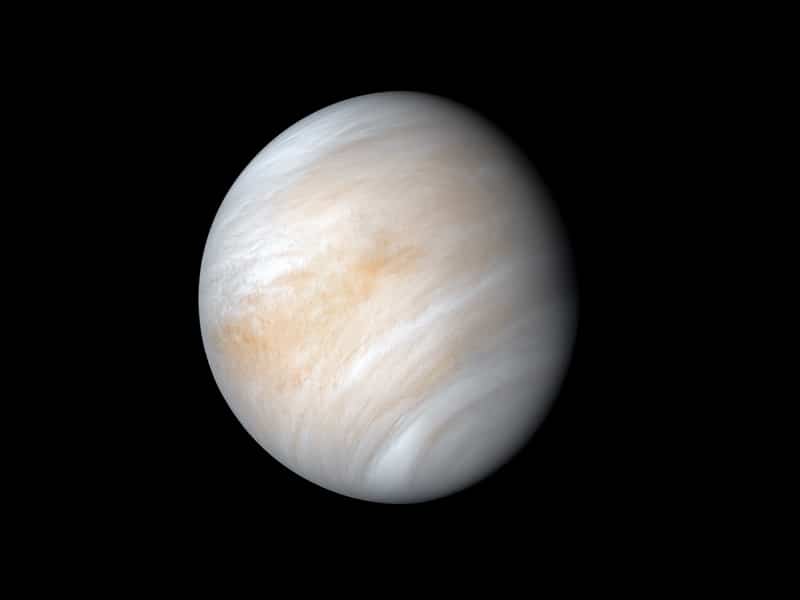
Venus
Scientists have long questioned the habitability of Venus, focusing not on its scorching 700K surface but on the cloud layers at 48-60 km altitudes where temperatures mimic Earth. Conventional wisdom suggested that the sulfuric acid in Venus' clouds would thwart any potential for life.
However, a groundbreaking study examined 20 biogenic amino acids within the range of Venus' cloud sulfuric acid concentrations and temperatures.
Astonishingly, 19 of the tested amino acids remained unreactive or underwent only side chain modifications after four weeks. The pivotal revelation is that the amino acid backbone remains intact even in concentrated sulfuric acid, expanding the scope of potential biologically relevant molecules.

Also Read |Want to fly your name to Moon? Here's how NASA campaigncanhelp
The findings mark a pivotal moment and now this new study calls for a new branch in astrobiology and organic chemistry.
Janusz Pętkowski, a research affiliate at MIT, said, "Life needs some sort of liquid medium to function, but does it always have to be water?"
)
What’s in a name? Trump’s 'Lake America' move gets a tit-for-tat response from Canada
)
Trump gifts Xi a bald eagle sculpture at White House dinner: Here’s what it symbolises
)
‘Not just a local tragedy’: Nepal PM Shah warns UN of growing climate threat, says Nepal floods were 'a warning to the world'
)
CNN, Politico and MS NOW back in White House after judge blocks Trump’s media ban
)
Farhan, who went viral for AK47 celebration vs India in Asia Cup, hopes to lead Pakistan beyond Asian Games
)
US judge questions Trump’s decision to ban CNN, MS NOW and Politico from White House
)
'We would all be dead': Netanyahu defends decision to strike Iran's nuclear facilities in his UN speech
)
IIT Bombay CCTV footage emerges: Sahil Wakode seen looking at phone in examination hall
)
Welcome actor Mushtaq Khan dies at 56 after battling cancer
)
Trump's welcome to Xi demonstrates 'attraction' to dictators: Chuck Schumer
)
Nations League: Germany draw on Klopp debut; Portugal, Norway win
)
WION Iconic Tourism Summit 2026: Union Minister Shekhawat on 'experiential travel', peace diplomacy
)
Scientists detect first radio signals directly from faraway planet
)
A seven-day roadmap? Iran proposes plan to end war, reopen Strait of Hormuz and resume nuclear talks
)
China to test supersonic jet that moves at Mach 2, double the speed of sound
)
Xi Jinping's 'special plane' vs Trump's Air Force One: What's the difference?
)
UNGA 2026: Israeli PM attacks Britain, France for past colonialism
)
West Indies coach Sammy looking at India series as opportunity to finetune ahead of ODI World Cup 2027 qualifiers
)
‘We’ve never gotten along better’: Trump praises Xi, jokes about White House ballroom at high-stakes state dinner
)
Nearly half of young people trust AI over humans to check facts, major study finds
)
'Partners rather than rivals': Xi Jinping's first message after landing in US for Trump summit
)
Yemen called Trump for US military support in fight against Houthis: Official
)
2,000-foot tube, laser tests and more: China builds towns to expand nuclear arsenal, satellite images show
)
Meet Adrian Abraham: 9-year-old Indian-origin guitar prodigy aiming for a Guinness World Record
)
US faces fresh cost crunch as mortgage rates hit 7%, oil tops $107 and gas prices surge
)
Trump-Xi state dinner 2026: Who is invited? Full guest list of tech CEOs, business leaders and officials
)
'Blockbuster' nor'easter develops an eye similar to hurricanes as warnings are issued
)
Alarming video emerges as landslide damages houses in Sikkim’s Rimbi village. Watch
)
'Making history': Xi Jinping praises Trump as US-China leaders dine at White House
)
Australian PM Anthony Albanese calls OpenAI AI incident 'unacceptable' after restricted data access
)
'What kind of confession is this?': Pakistan PM Shehbaz Sharif’s 'terrorists would be roaming New York' remark goes viral, raises alarm online. Watch
&im=FitAndFill=(700,400))
Netanyahu at UN: Mass walkout, attack on Mamdani and Iran threats | In Pics
)
'We do not wish to continue. It's America that must choose': Iran president Pezeshkian calls on US to end war
)
WION Iconic Tourism Summit: How local tourism MSMEs must upskill for AI integration
)
Bollywood mourns Mushtaq Khan: Sunny Deol, Rajpal Yadav and others pay tribute
)
EC appointment law: Why is the 2023 act controversial, and what happens next? WION explains
)
Who is Lt-Gen Nauman Mahmood, Pakistan's first secretary general of Makkah Defence Alliance?
)
Israeli envoy to US Yechiel Leiter’s son critically injured in West Bank ramming attack
)
'Fund people, not bombs': Hundreds take to New York streets as Netanyahu delivers speech at UN; dozens arrested
The study, featured in a special collection of "Venues" research papers in Astrobiology, underscored the stability of amino acids in concentrated sulfuric acid. Amino acids are crucial building blocks for proteins, essential components for life as we understand it.
Also Read |ISRO prepares for crucial manoeuvre of Aditya-L1 solar probe
Pętkowski and his colleagues state in their paper, titled "Stability of 20 Biogenic Amino Acids in Concentrated Sulfuric Acid: Implications for the Habitability of Venus' Clouds," that the findings broaden the range of biologically relevant molecules in a biochemistry based on a concentrated sulfuric acid solvent.
Watch |Japan Earthquake: Losses to touch $6.4 billion, death toll climbs to 98
Pętkowski points out the importance of understanding basic chemistry in potential alternative solvents."Therefore, it is important to understand the basic chemistry that happens in such potential alternative solvents for life, to assess if complex organic chemistry could form in them, be stable and soluble. On Earth, water is a dominant liquid, but other liquid solvents are also present in our solar system," he reportedly told Space.com.
(With inputs from agencies)