Study based on Chinese rover data finds Martian climate drastically changed 400,000 years ago

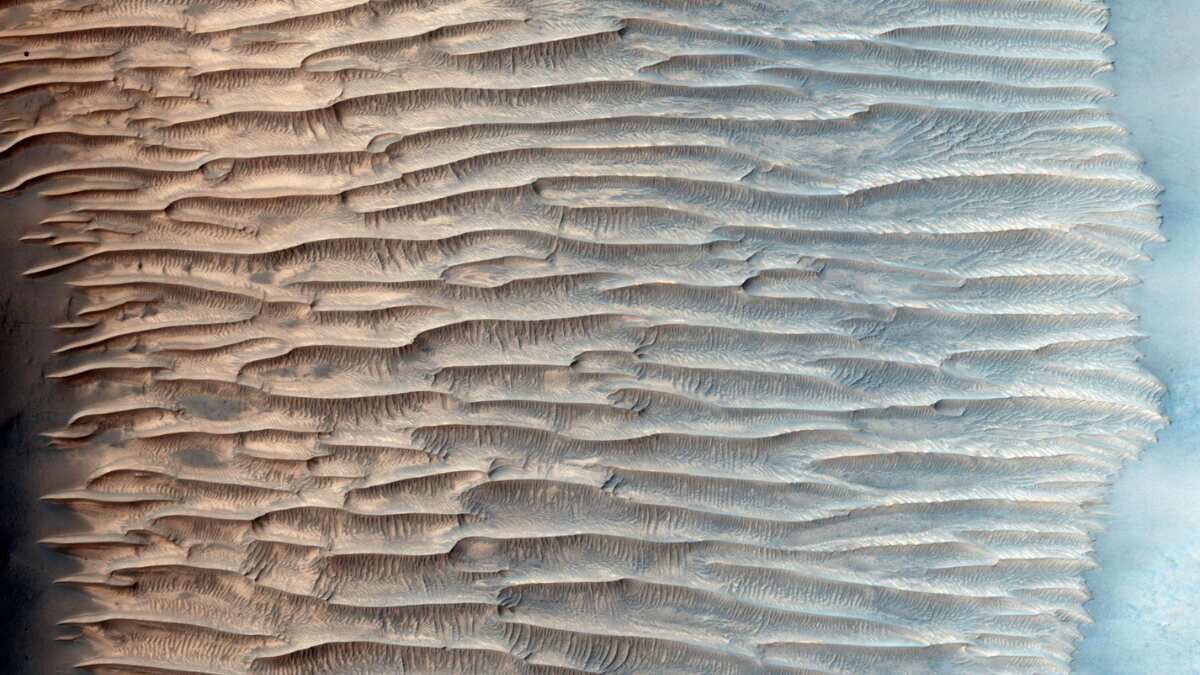
Martian surface
A study based on the data collected by China’s Zhurong Mars rover shows evidence that the planet underwent a major shift around 400,000 years ago which also coincides with the end of the last glacial period. The study was published in the journal, Nature, last week.
What was the research about?
The study was conducted by a team of scientists from the National Astronomical Observatories, Institute of Geology and Geophysics and Institute of Tibetan Plateau Research of the Chinese Academy of Sciences in collaboration with Brown University, United States.

The researchers used the Mars rover’s instruments as well as high-resolution observations from the Chinese Tianwen-1 Mars orbiter to study the large sand dunes near where Zhurong landed around two years ago.
The team of scientists led by Li Chunlai from the National Astronomical Observatories studied the surface structure and chemical composition of Martian dunes to determine their age as well as wind directions at different locations near the Chinese Mars rover.
While previous studies suggested that the Martian climate changed over the years, it had been difficult to directly measure and sample the geological formations on Mars which limited the scientists’ ability to better understand the planet’s climate processes.
)
Mushtaq Khan dies at 56: When Welcome actor opened up about his salary for iconic role Ballu
)
US Supreme Court backs Trump administration's use of SAVE database to check voter citizenship
)
Heart of the Beast review: Brad Pitt leads a gripping tale of survival and loyalty
)
Outrage erupts after 3-year-old is married to 60-year-old man in Pakistan, link to her sister's murder being probed
)
Pakistan deploys over 20,000 security personnel as PTI vows march for Imran Khan's release
)
Asian Games: Shooting spree continues as India win silver in women’s 50m rifle 3P team event
)
‘Not just a local tragedy’: Nepal PM Shah warns UN of growing climate threat, says Nepal floods were 'a warning to the world'
)
OpenAI AI Agents hacked 4 websites before Hugging Face, researchers reveal
)
Pentagon quietly adds 37 wounded troops to Iran war tally without explaining when or how
)
Asian Games 2026: India women’s kabaddi team edge Iran 37-34 to clinch 3rd gold medal
)
Saudi Arabia still harbours intent to develop nuclear weapons, reveals US intelligence: Report
&im=FitAndFill=(700,400))
New Friday OTT releases (September 25, 2026): Don’t Be Shy, Hunkkaar: The Roar, Mango Pachcha- 6 movies and TV shows on Netflix, Prime Video and more
)
Yemen's war escalates: Saudi-backed leader calls for general mobilisation against the Houthis
)
‘Attack on Mecca a red line for Pakistan’: Shehbaz Sharif warns Houthis at UN
)
Tesla is preparing something big for Optimus: new Gen 3 models surface in app
)
Did Hitler kill his niece Geli Raubal? Newly found records reopen a 95-year-old mystery
)
Indian diplomat Petal Gahlot raises deteriorating situation in Pakistan-occupied Kashmir in right of reply at UN
)
Nigeria Navy moves to boost oil security, tackle crude theft and infrastructure threats
)
Scientists detect first radio signals directly from faraway planet
)
‘It is all possible’: Putin weighs next steps on Ukraine talks, rules out Europe conflict
)
10,000 gather in support of 87-year-old forcefully evicted from home of 71 years
)
India flags brutal violence in Pak-occupied Jammu Kashmir
)
Trump rejects Iran's 7-day ceasefire proposal as US weighs renewed bombing after midterms: Report
)
Gaza's war turned environmental damage into second crisis
)
Saudi oil exports surge despite Iran war
)
Trump-Xi summit wrap: Big pageantry, Iran talks, few major developments and more meetings planned
)
'Making history': Xi Jinping praises Trump as US-China leaders dine at White House
)
India's UN Envoy slams Pakistan: 'They claim security by day, terrorism by night'
)
Jay-Z rape case: Accuser says allegations were false, never met rapper
)
Myanmar training camp case: US national, 6 Ukrainians allowed to meet their families abroad
)
Trump-Xi summit: Xi wraps up us visit with 21-gun salute as Trump, Xi lock in 'strategic stability'
)
'FIRST LOOK from inside Noah’s Ark': Researchers share video from inside mysterious mound in Turkey
)
Cindy Crawford’s son Presley Gerber cremated as death probe continues
)
India's insurance regulator overhauls policies
)
WATCH | As Shehbaz Sharif claims Pakistan’s ‘victory’ during 2025 conflict, Indian diplomat R Srinivas laughs at UN
)
‘Goal is to win it’: Virat Kohli confirms 2027 ODI World Cup will be his final tournament for India
)
'A terrorist country is asking me that question?': Jaishankar hits back at Pakistani journalist at UN; flags attacks on commercial shipping
)
US court backs Pentagon's decision to exclude Anthropic over Claude AI restrictions
The phenomenon of the crescent shape of dunes eroding over hundreds of thousand years and long dark ridges, called transverse aeolian ridges (TARs) which form on top of those dune fields, has been observed all across Mars at lower mid-latitudes.
However, it was the absence of a general atmospheric circulation, which describes the direction of the winds, and scientists have been unable to explain how these features were formed.
Therefore, the study is said to have been designed in a way which would integrate rover-scale data of dune formations and weather conditions, which would confirm the change in the prevailing wind direction with the close of the last ice age as well as improve general circulation models.
Li’s team used high-resolution orbital cameras as well as Zhurong rover’s terrain and multispectral cameras, surface composition analysers and meteorological measuring instruments whichhelped them obtain ‘in situ data’ (data collected adjacent to the measuring instrument) directly from the Martian surface.
What did the scientists find?
The researchers used the orbital data from Tianwen-1 and observed 2,262 bright dunes across Mars and based on the number of craters which might have struck the top of dunes, estimated that they were formed sometime between 2.1 million and 400,000 years ago.
These dates coincide with the start and end of Mars’ last major ice age. The research team has attributed the change in the angle of the rotational axis of Mars to the planet’s exit from the most recent ice age.
The current geological era on Mars is known as the Amazonian epoch, which began 3.55 and 1.8 billion years ago and continues to this day; it is also said to be marked by a number of impacts over that time.
“Understanding the Amazonian climate is essential to explain the current Martian landscape, volatile matter reservoirs and atmospheric state, and to relate these current observations and active processes to models of the ancient climate of Mars,” said Li, in a statement.
He added, “Observations of the current climate of Mars can help refine physical models of Martian climate and landscape evolution, and even form new paradigms.”
Li also said that they will continue to study both Amazonian and present-day climate in a bid “to promote the knowledge regarding the last two billion years of Martian climate history, including its environment and processes.”
WATCH WION LIVE HERE
You can now write for wionews.com and be a part of the community. Share your stories and opinions with us here.