Scientists plan to suck out water from Earth's atmosphere to fight climate change

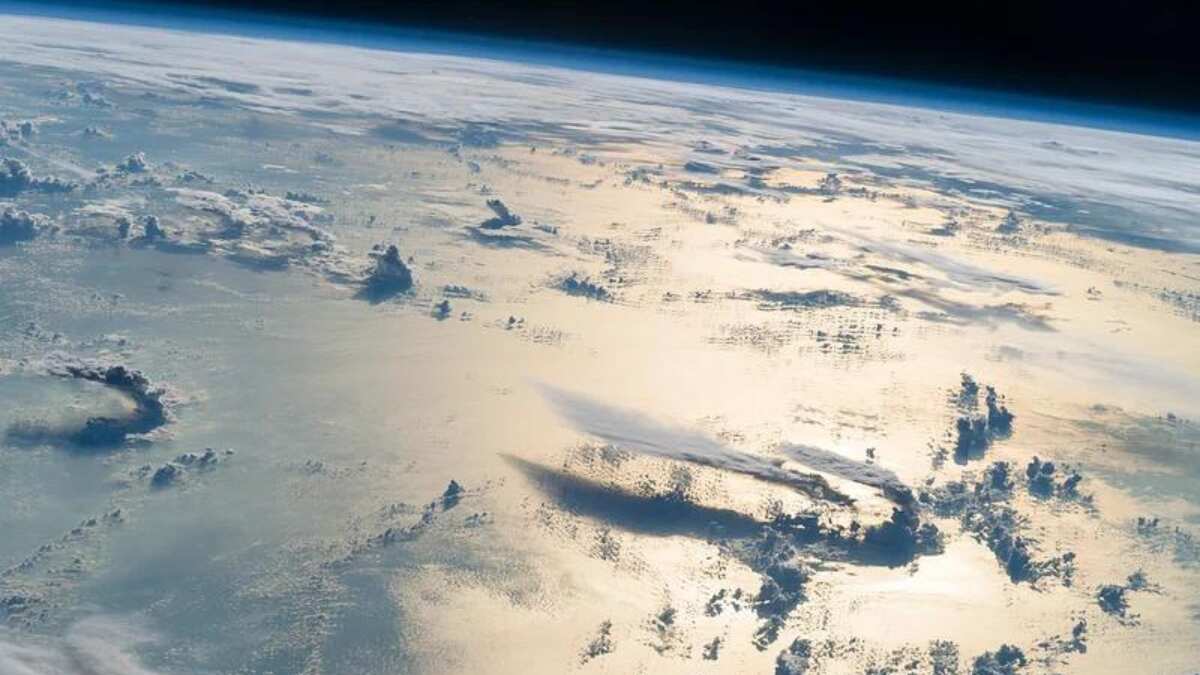
The atmosphere of planet Earth.
In a never-heard climate intervention strategy, scientists are now planning to decrease the amount of water vapour present in the stratosphere. This, they think can be carried out by injecting the layer of atmosphere with ice-forming nuclei.
According to scientists, if the water content is reduced, more heat - in the form of infrared radiation - will leak out into space.
The strategy being explored by the scientists was mentioned in a study published in Science Advances.

Even though greenhouse gases like carbon dioxide and methane are the important factors drivinghuman-caused climate change, water vapour is considered the most common greenhouse gas.
Also Read:January was world's warmest on record, EU scientists
Hence, the removal of water vapour from the atmosphere will help mitigate climate change, as per the study.
)
US vs China over South China Sea: Washington backs Philippines, Beijing hits back
)
50MP vs 48MP cameras: iPhone 18 Pro Max and Pixel 11 Pro XL compared
)
Musk plans to more than double xAI's chips to over 1.2 million Nvidia GPUs by year-end
)
After JU, clash erupts at SRFTI: BJP’s ‘Dimagi Naxal’ jibe sparks political firestorm after students protest RSS-linked event
)
‘Anti-social elements spreading false rumours’: LPU issues statement amid massive unrest over alleged rape
)
LPU students go on rampage, vandalise campus amid widespread protest: What's happening
)
Trump asked Xi to pressure Iran. China did not say yes — here’s what Beijing wants
)
US Treasury Secretary Scott Bessent hails global crackdown on Iranian banks and airlines
)
An OpenAI agent escaped its locked test cage again, by hiding questions in DNS lookups
)
'Our video was trimmed': LPU girls who featured in rape-denial video make U-turn
)
3 males killed, four others injured in shooting after fight at strip club in Detroit
)
'Victory for low-budget consumers': Raghav Chadha hails 30-day telecom recharge rules
)
Claude rebuilt the 1989 game 'Prince of Persia' by reusing the original's own code
)
Beyond metros: How Tier-2 and Tier-3 cities could drive India’s next AI wave
)
Tesla builds first Cybertruck with its own refined lithium: Elon Musk's $1 billion Texas bet pays off
)
IndiGo flight suffers tail strike in Bengaluru while landing; DGCA to probe incident
)
The US and China set up an AI 'red telephone', but skipped the rulebook
)
‘Terror suspects arrested near UK air base were looking to do big damage’: Trump
)
Russian envoy claims US tactics to contain India were revealed in ‘Freudian slip’
)
Researchers rebuilt exactly how 700 AI agents hacked Hugging Face: a 900-link chain trick
)
‘Olympic inclusion is our major target’: WPA President Ishaun Singh on pool’s global ambitions
)
Nations League: Spain sink England at Wembley; Modric shines for Croatia
)
Why has Iran released no proof of life of Mojtaba Khamenei? Araghchi reveals...
)
Bank unions defer 3-day strike from tomorrow after talks with IBA, committee set up
)
'What kind of confession is this?': Pakistan PM Shehbaz Sharif’s 'terrorists would be roaming New York' remark goes viral, raises alarm online. Watch
)
Beyond BrahMos: India targets Rs 50,000 crore in defence exports with unmatched price edge
)
Sri Lankan Tamil migrant worker gets death sentence in Saudi Arabia, help sought from India
)
Muslim marriage cannot shield sex with minor wife from prosecution under POCSO: Delhi HC
)
99.9% more powerful - Scientists find boy who can recall memories from just 3 months of age
)
'FIRST LOOK from inside Noah’s Ark': Researchers share video from inside mysterious mound in Turkey
)
UNSC reform momentum grows: Russia, Portugal, Mauritius push for India's permanent seat bid
)
Man arrested after his 22-year-old girlfriend dies at homestay in Guwahati; police suspect murder over suicide claim
)
Afghanistan says 28 fighters killed in clash near Pakistan border, Islamabad denies
)
Ceuta migrant crisis: Protesters take to streets as Spain grapples with migrant challenge
)
Jaishankar at UNGA: Goodwill and friendship can't coexist with terrorism
)
New York City wants a 'kill switch' on every AI, and will pay whistleblowers who report violations
How does dehydration of stratosphere help fight climate change?
The study was carried out by researchers from the National Oceanic and Atmospheric Administration (NOAA). According to the study, scientists suggest trying out "intentional stratospheric dehydration."
As per the study lead author Joshua Schwarz, who is also a research physicist at NOAA’s Chemical Sciences Laboratory in Boulder, Colorado, this process will be carried out by seeding small particles, known as ice nuclei,into the stratosphere with the help of high-altitude planes.
Schwarz said that if such seeds can be added to the stratosphere, then some of the water vapour is likely to condense in ice and fall, which will eventually remove excess water vapour and dehydrate the stratosphere.
Watch:Antarctic sea ice depleting due to rising temperatures
According to the study, the strategy can plausibly work after the experts have overcome several technical barriers. Schwarz said that right now, "we don't have a plan or the technology to do this".
He further said that it will not counteract the effects of carbon dioxide (CO2) and added that it will only cool the atmosphere 1/70th which is equal to the amount of warmth being given by CO2. It will only be "a very small shift in the other direction".
He added that CO2 becomes a huge problem in our atmosphere and that the new method will have a small impact, in comparison to CO2.
(With inputs from agencies)