Researchers using James Webb to probe eternal sunrises and sunsets on distant world

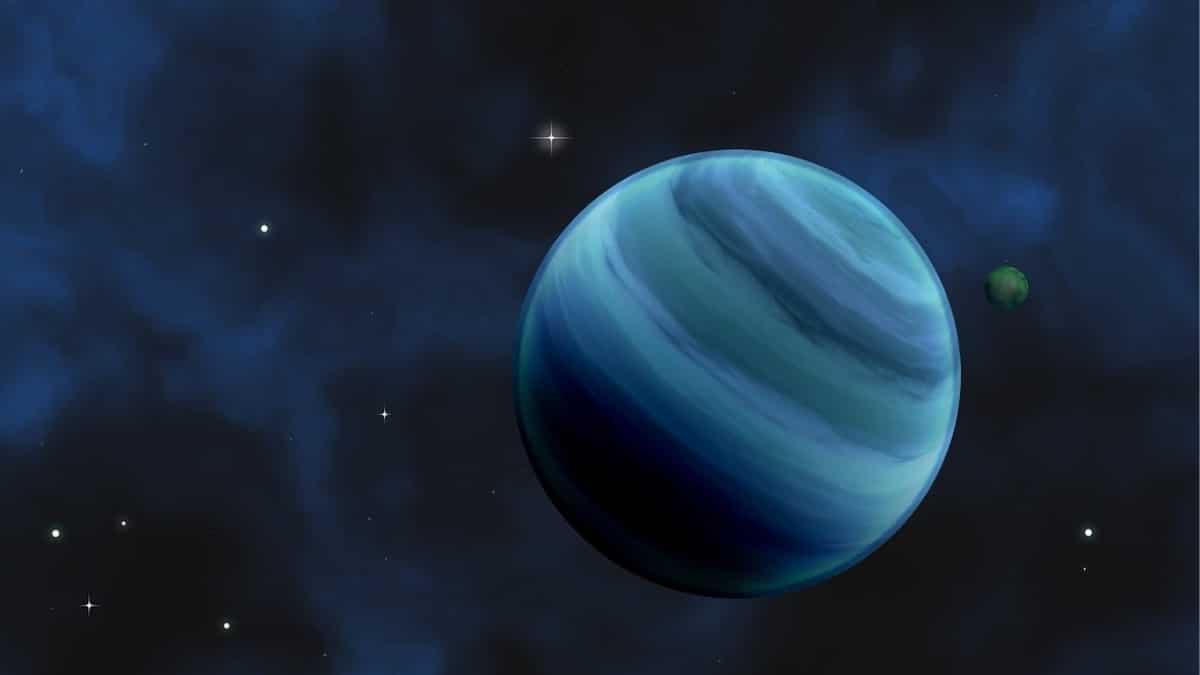
Exoplanet
An exoplanet has differences between its eternal morning and eternal evening atmosphere - this model was previously predicted and researchers have finally confirmed it using the James Webb Space Telescope.
Researchers are talking about WASP-39 b, which is a gas giant exoplanet that orbits a G-type star. The mass WASP-39 b is 0.28 Jupiter and it takes 4.1 days to complete one orbit of its star, NASA revealed. WASP-39 b has a similar mass to Saturn. It orbits a star about 700 light-years away from Earth.
The discovery of WASP-39 b was announced in 2011 and in July 2022, it became the first exoplanet to be studied by NASA's James Webb Space Telescope, which is the largest, most powerful telescope ever launched into space.

Also read:Scientists find underground cave on Moon that could be prime location for future lunar base
Researchers have established that WASP-39 b is tidally locked to its parent star, which means it has a constant dayside and a constant nightside. One side of the planet is always exposed to its star, while the other is always covered in darkness.
NASA in its reports said that astronomers confirmed a temperature difference between the eternal morning and eternal evening on WASP-39 b using Webb's NIRSpec (Near-Infrared Spectrograph).
)
The Early Spring is proof not everyone can talk about their real feelings, and it is perfectly OK
)
UN votes to ‘correct the map’ as India backs fairer world view
)
Nigerian Navy discovers 99,000 litres of suspected stolen, illegally refined products as it intensifies anti-crude oil theft operations
)
Who is Aditi Paudel? 17-year-old becomes Japan's first literacy ambassador
)
Bengaluru: Officials find 40 kg expired chilli at chairman's club
)
Jaishankar rejects trade link to ending Ukraine war
)
Israeli strikes on Lebanon kill three, injure 23 despite truce
)
Alpine glacier was covered with sheep wool sheets to prevent melting. It worked
)
South Korea mulls deploying military assets to Strait of Hormuz
)
World's fifth-largest economy, British army can't afford to train
)
Breaking | Vance takes the podium: First White House briefing since Leavitt's exit
)
Taiwan raises 'concerns' over China's missile test
)
BRICS 2026: $1 trillion sovereign capital set to converge in Delhi for first iBRICS Summit
)
What is Iran's Pickaxe Mountain that Trump has again threatened to bomb?
)
UN votes to correct world map that visually shrank Africa for 450 years
)
Former NewJeans member Danielle launches YouTube channel, hints at new solo journey
)
Bangladesh batter Towhid Hridoy creates history with 350 not out in South Africa
)
Brendan Fraser’s transformation fuels The Mummy 4 excitement as fans welcome back Rick O’Connell
&im=FitAndFill=(700,400))
Krishna Janmashtami 2026: From Dhaniya Panjiri to Makhana Kheer- 5 best sweet dishes perfect for celebrating Lord Krishna’s birth
)
Donald Trump plans to travel to Ireland on Qatari-donated jet amid security concerns
)
Nazi-looted art to return to Jewish heirs
)
Eight killed in Kerala’s Thrissur after car rams into lorry parked on highway
&im=FitAndFill=(700,400))
Why Russian fighter jets use bulky, low-pressure tyres compared to US jets
)
FBI-wanted fraud accused arrested in Jalandhar over $600,000 scam
&im=FitAndFill=(700,400))
Why US tanks weigh over 20 tons more than Russian tanks
&im=FitAndFill=(700,400))
New Friday OTT releases (September 4, 2026): GDN, Dhamaal 4, Jagamae Sangeetham- Watch 6 new movies and TV shows on Netflix, Prime Video and more
)
Killing the Himalayas slowly: Human urine is melting a glacier on Mount Everest
The astronomers found that evening appeared hotter by about 200 degrees Celsius and there is evidence for different cloud cover, with the "forever morning portion of the planet being likely cloudier than the evening".
Alsoread:NASA shares stunning images of a space get-away captured by Webb and Chandra
As quoted by nasa.gov, Néstor Espinoza, who is an exoplanet researcher at the Space Telescope Science Institute and lead author on the study, said,"WASP-39 b has become a sort of benchmark planet in studying the atmosphere of exoplanets with Webb."
"It has an inflated, puffy atmosphere, so the signal coming from starlight filtered through the planet’s atmosphere is quite strong," Espinoza added.
The complete day/night boundary is represented by the previously published Webb spectra of the atmosphere of WASP-39b, which showed the presence of carbon dioxide, sulphur dioxide, water vapour and sodium. But there was no detailed attempt to differentiate between one side and the other.
However, the day/night boundary is now divided into two semicircles, one from the evening and one from the morning, by the new methodology, which constructs two distinct spectra from the terminator region.
Also read:Our sun is sending mysterious radio signals for decades. NASA plans to find the exact source
"Data reveals the evening as significantly hotter, a searing 1,450 degrees Fahrenheit (800 degrees Celsius), and the morning a relatively cooler 1,150 degrees Fahrenheit (600 degrees Celsius)," NASA said in its report.
"It's really stunning that we are able to parse this small difference out, and it’s only possible due Webb's sensitivity across near-infrared wavelengths and its extremely stable photometric sensors," said Espinoza.
"Any tiny movement in the instrument or with the observatory while collecting data would have severely limited our ability to make this detection. It must be extraordinarily precise, and Webb is just that," he added.
The findings were published on Monday (Jul 15) in Nature, titled, "Inhomogeneous terminators on the exoplanet WASP-39 b".
(With inputs from agencies)