NASA plans to launch three rockets into the solar eclipse shadow next week. Here’s why

Rocket Launch
Parts of the US, Canada and Mexico will thrust into darkness as the Moon glides completely covering the Sun, marking a total solar eclipse on April 8.
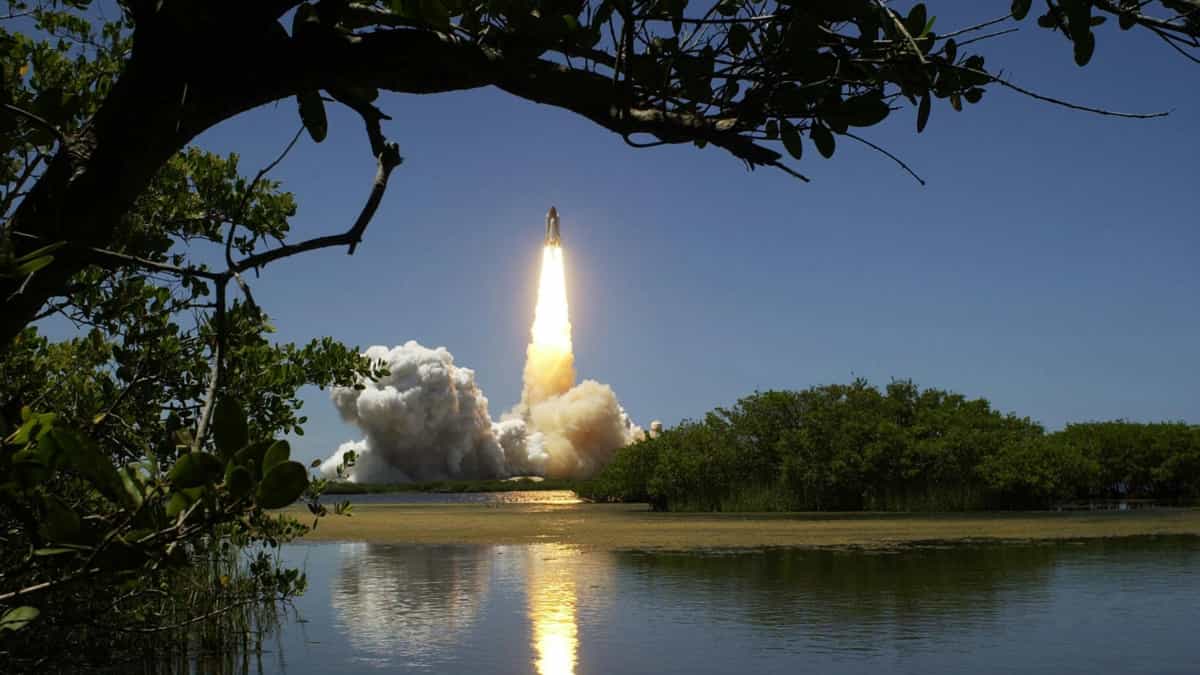
While millions of spectators are excited, NASA engineers in Virginia plan to make the most of the few minutes of darkness by launching rockets straight into the eclipse's shadow, LiveScience reported.

These launches have a crucial science goal besides the cool factor. They will enable the scientists to understand how the sudden drop in sunlight impacts Earth's blanket of air.
The swift transition from day to night during the eclipse causes sudden temperature drops. It also tricks animals into engaging in nighttime behaviours.
However, scientists know little about how these brief moments of darkness affect the boundary between our planet's upper and lower atmosphere, called the ionosphere. The ionosphere extends between 55 to 310 miles (90 to 500 kilometres) above the planet's surface.
)
What’s in a name? Trump’s 'Lake America' move gets a tit-for-tat response from Canada
)
Outrage erupts after 3-year-old is married to 60-year-old man in Pakistan, link to her sister's murder being probed
)
Trump gifts Xi a bald eagle sculpture at White House dinner: Here’s what it symbolises
)
‘Not just a local tragedy’: Nepal PM Shah warns UN of growing climate threat, says Nepal floods were 'a warning to the world'
)
Farhan, who went viral for AK47 celebration vs India in Asia Cup, hopes to lead Pakistan beyond Asian Games
)
CNN, Politico and MS NOW back in White House after judge blocks Trump’s media ban
)
India-New Zealand FTA is ‘an expression of trust’, NZ High Commissioner Patrick John Rata says
Don't Be Shy movie review: A frothy coming-of-age tale that is too shy to experiment
)
Park Ji Hyun makes history as first Korean actress nominated for International Emmy
)
Tesla is preparing something big for Optimus: new Gen 3 models surface in app
)
Bias or safety concerns? Bengaluru CEO says firm will not hire men from UP, Bihar, Rajasthan, MP. Here's why
)
Trump's welcome to Xi demonstrates 'attraction' to dictators: Chuck Schumer
)
Nations League: Germany draw on Klopp debut; Portugal, Norway win
)
WION Iconic Tourism Summit 2026: Union Minister Shekhawat on 'experiential travel', peace diplomacy
)
Scientists detect first radio signals directly from faraway planet
)
A seven-day roadmap? Iran proposes plan to end war, reopen Strait of Hormuz and resume nuclear talks
)
The Vvaan Review: This Ekta Kapoor's Tulsi Virani-coded world can't be saved by Sidharth Malhotra and Tamannaah Bhatia
)
China to test supersonic jet that moves at Mach 2, double the speed of sound
)
Xi Jinping's 'special plane' vs Trump's Air Force One: What's the difference?
)
UNGA 2026: Israeli PM attacks Britain, France for past colonialism
)
Ruckus in J&K Assembly over statehood resolution; BJP leaders enter well of house
)
West Indies coach Sammy looking at India series as opportunity to finetune ahead of ODI World Cup 2027 qualifiers
)
‘We’ve never gotten along better’: Trump praises Xi, jokes about White House ballroom at high-stakes state dinner
)
Air India pilot suspended after failing pre-flight alcohol test on Zurich-Delhi route
)
Yemen called Trump for US military support in fight against Houthis: Official
)
Meet Adrian Abraham: 9-year-old Indian-origin guitar prodigy aiming for a Guinness World Record
)
US faces fresh cost crunch as mortgage rates hit 7%, oil tops $107 and gas prices surge
)
'Blockbuster' nor'easter develops an eye similar to hurricanes as warnings are issued
)
WATCH: Pak PM Shehbaz Sharif refuses to answer on Hafeez Sayeed, walks away
)
OpenAI is building AI to fight cyber threats: What GPT-6 Cyber means for security
)
'Making history': Xi Jinping praises Trump as US-China leaders dine at White House
)
'What kind of confession is this?': Pakistan PM Shehbaz Sharif’s 'terrorists would be roaming New York' remark goes viral, raises alarm online. Watch
&im=FitAndFill=(700,400))
Netanyahu at UN: Mass walkout, attack on Mamdani and Iran threats | In Pics
)
'We do not wish to continue. It's America that must choose': Iran president Pezeshkian calls on US to end war
)
Bollywood mourns Mushtaq Khan: Sunny Deol, Rajpal Yadav and others pay tribute
)
Myanmar training camp case: US national, 6 Ukrainians allowed to meet their families abroad
)
'FIRST LOOK from inside Noah’s Ark': Researchers share video from inside mysterious mound in Turkey
)
'Fund people, not bombs': Hundreds take to New York streets as Netanyahu delivers speech at UN; dozens arrested
)
Susan Sarandon and Hannah Einbinder detained by NYPD outside UN Headquarters
)
ALSO READ |Mars may have hosted life for millions of years longer than previously thought
In the ionosphere, ultraviolet radiation from the Sun drives away electrons from atoms, creating electrically charged particles that puff up the upper atmosphere abundantly. During sunset, these ions recombine into neutral atoms, thinning out the charged particles. However, they are ripped away again the next morning.
"If you think of the ionosphere as a pond with some gentle ripples on it, the eclipse is like a motorboat that suddenly rips through the water," Aroh Barjatya, a professor of engineering and physics at Embry-Riddle Aeronautical University, said in a 2023 NASA article. "It creates a wake immediately underneath and behind it, and then the water level momentarily goes up as it rushes back in," he added.
NASA engineers expect to gather enough data to predict such disturbances, which interfere with radio and satellite communications. They will launch three rockets from Wallops Flight Facility on Wallops Island, Virginia. The Moon will block only 81.4 per cent of the sun's light at this facility. However, the team expects to use the temporary dimming.
The same research team performed a similar experiment during last October's partial "ring of fire" solar eclipse when the Moon blocked a maximum of 90 per cent of the Sun's light.
The experiment revealed that the drop in sunlight caused disturbances capable of impacting radio and satellite communications, highlighting the need for improved capability to anticipate them.
"We are super excited to relaunch [the rockets] during the total eclipse, to see if the perturbations start at the same altitude and if their magnitude and scale remain the same," Barjatya concluded in a NASA statement.
(With inputs from agencies)