JWST has clicked a 'ghostly' space object

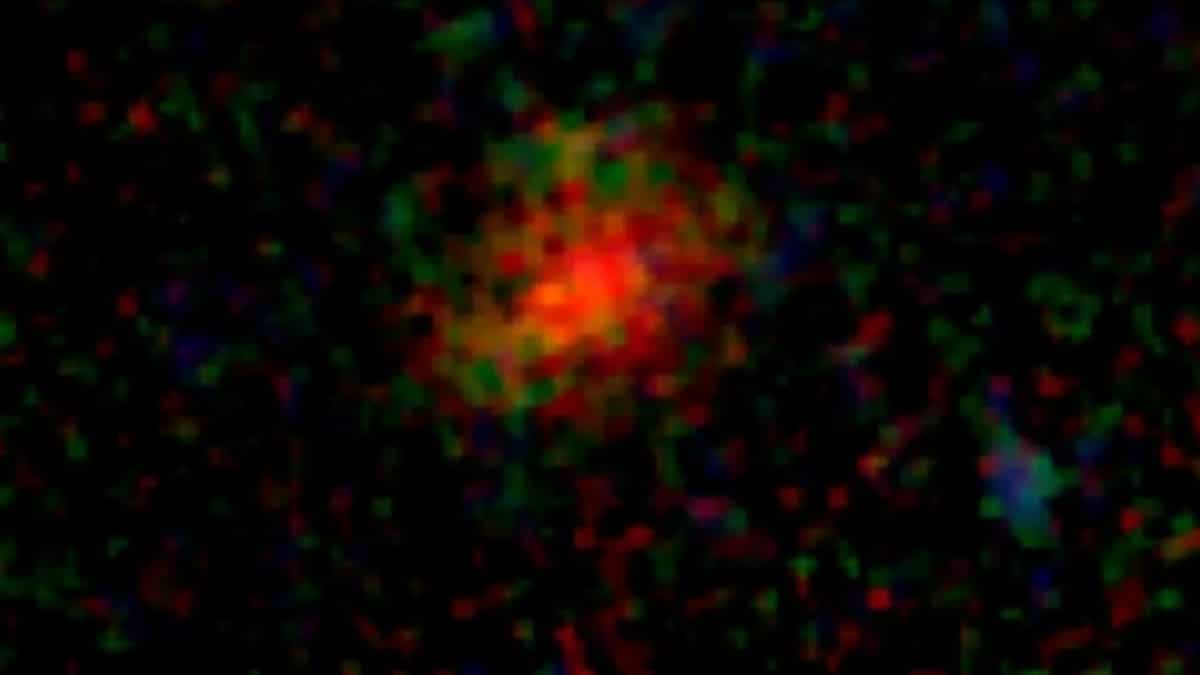
Ghost galaxy
The James Webb Telescope, since its launch, has been humanity's most advanced 'eye in the sky'. The Hubble Space Telescope is still working and sending us images of the universe yes, but the addition of the James Webb Space Telescope has enabled us to view the universe in literally a new light.
The JWST has now clicked AzTECC71. This is a dusty star-forming galaxy. It is part of the early universe.
Although light has an incredible speed of about 300,000 kilometres per hour, the universe is so big that even light takes millions of years to reach us from very distant corners of space. And the fun thing is, the more we look farther into the universe, the more we look into the past.

Watch | James Webb Space Telescope detects carbon on Jupiter's icy moon Europa
Before this, we could see AzTECC71 as a glowing blob in space through our ground-based telescopes. The galaxy then vanished from images taken by the Hubble Space Telescope. Now it has reappeared in images captured by JWST.
&imwidth=180&imheight=135&format=webp&quality=medium)
US midterms 2026: What polls and prediction markets indicate about Congress
&imwidth=180&imheight=135&format=webp&quality=medium)
Ilhan Omar breaks silence over alleged marriage to her brother; Trump thinks it's 'really good answer'
&imwidth=180&imheight=135&format=webp&quality=medium)
From Agni-V to Project Kusha: How are India’s indigenous missile systems and defence shield reshaping modern warfare
&imwidth=180&imheight=135&format=webp&quality=medium)
Will Rohit and Kohli play ODI World Cup 2027? BCCI president Manhas says board 'not in a position to comment'
&imwidth=180&imheight=135&format=webp&quality=medium)
‘I caution the president...’: Trump’s ex-press secretary warns after Zacharia’s exit
&imwidth=180&imheight=135&format=webp&quality=medium)
Diljit Dosanjh's Oct 30 Delhi show hits roadblock, Delhi Police denies permission
&imwidth=180&imheight=135&format=webp&quality=medium)
'It's a crime not to see this scene': Tehran puts Trump 'behind bars'
&imwidth=180&imheight=135&format=webp&quality=medium)
Kolkata airport: CISF detects ₹1.13 crore in US dollars hidden in bags of 2 Bangkok-bound passengers
&imwidth=180&imheight=135&format=webp&quality=medium)
China's dancing robot turns violent bodyguard, lifts cars and fights intruders - Watch
&imwidth=180&imheight=135&format=webp&quality=medium)
Rafale Marine fighter begins flight trials in Goa ahead of Indian Navy induction
&imwidth=180&imheight=135&format=webp&quality=medium)
Priyanka Chopra celebrates Dussehra 2026 with Nick Jonas and daughter Malti Marie | See pics
&imwidth=180&imheight=135&format=webp&quality=medium)
Feds obtain DNA evidence that could prove Ilhan Omar married her brother: Report
&imwidth=180&imheight=135&format=webp&quality=medium)
US to get 850 F-35 stealth fighter jets under 10-year Pentagon-Lockheed deal
&imwidth=180&imheight=135&format=webp&quality=medium)
Meta slapped with $25 billion fine in New Mexico over Facebook data practices, company plans appeal
&im=FitAndFill=(700,400)&imwidth=180&imheight=135&format=webp&quality=medium)
New OTT releases this week (October 19-25, 2026): Gajab Raat to Chaar Yaar-8 titles to watch during Dussehra week on Netflix, Prime Video and more
&imwidth=180&imheight=135&format=webp&quality=medium)
16-foot doomsday fish in Chile triggers fears that the next earthquake is coming
&imwidth=180&imheight=135&format=webp&quality=medium)
Viral video shows cross falling on Colombia priest, no official confirmation | WATCH
&imwidth=180&imheight=135&format=webp&quality=medium)
US midterms 2026: Trump's approval rating hits record low as Democrats gain ground
&imwidth=180&imheight=135&format=webp&quality=medium)
Why websites around the world are suddenly going offline? What you need to know about PHP
&imwidth=180&imheight=135&format=webp&quality=medium)
Ranbir Kapoor apologises for Dussehra speech slip, clarifies remark at Ramayana event
&imwidth=180&imheight=135&format=webp&quality=medium)
Australia police arrest former national 100m champ Jake Doran for alleged child abuse
&imwidth=180&imheight=135&format=webp&quality=medium)
'Father of all bombs' vs 'mother of all bombs': Iran threatens US with new weapon as Trump hints at MOAB strike
&imwidth=180&imheight=135&format=webp&quality=medium)
Are the US and Israel preparing for another major attack on Iran? Here's what report claims
&imwidth=180&imheight=135&format=webp&quality=medium)
'You are a dummy, you are a stupid person': Trump loses temper with CNN, ABC reporters after questions about Russia sanctions
&imwidth=180&imheight=135&format=webp&quality=medium)
WATCH: Woman IPS officer fires several rounds of AK-47, ignites debate online
&imwidth=180&imheight=135&format=webp&quality=medium)
'Gyanu must go': CJP's Saurav Das, Ashutosh Ranka after release, despite Jantar Mantar protest undertaking
&imwidth=180&imheight=135&format=webp&quality=medium)
EU probes Booking.com under Digital Services Act
&imwidth=180&imheight=135&format=webp&quality=medium)
US-Iran war: Bibi, Trump gamble on new Iran war to save themselves in polls
&imwidth=180&imheight=135&format=webp&quality=medium)
Pakistan signs another defence pact even as Makkah Alliance shows no teeth. This time, it's with Qatar, Indonesia, Turkey
Observation points to new conclusions
AzTECC71 has been classified as a dusty, star-forming galaxy. This means that the galaxy is fast forming stars but is covered by a sort of dusty veil. The image that we have got is from about 1 billion years from the Big Bang.
It was thought previously that such galaxies were rare in the early years of the life of the universe. But it is now being suggested that they are more common than were thought before.
Also Read | NASA sidesteps ban by US, appeals researchers to gather moon samples from China
“This thing is a real monster,” said Jed McKinney, a postdoctoral researcher at The University of Texas at Austin. McKinney was quoted by SciTechDaily.
Also Read | Andromeda Galaxy will make its brightest appearance this week. Here's how to watch it.
“Even though it looks like a little blob, it’s actually forming hundreds of new stars every year. And the fact that even something that extreme is barely visible in the most sensitive imaging from our newest telescope is so exciting to me. It’s potentially telling us there’s a whole population of galaxies that have been hiding from us.”
If the conclusion drawn from the observations is accurate, it would mean that the universe, in its younger days, was much dustier than initially thought.
As reported by SciTechDaily, the study has been published inThe Astrophysical Journal.
(With input from agencies)