It’s official! Maisie's Galaxy is one of the earliest known galaxies

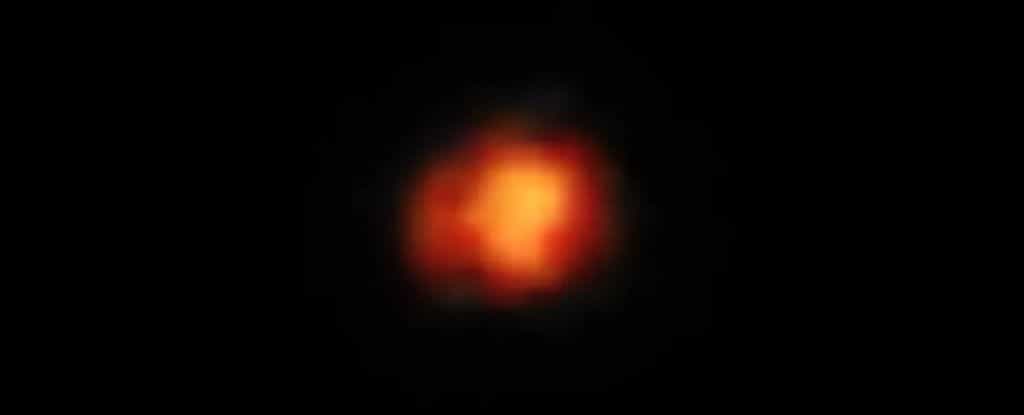
Maisie's Galaxy
The launch of the James Webb Space Telescope (JWST) has helped scientists unravel the myriad mysteries of the universe. Astronomers have been ableto witness some of the rare cosmological events that shape the understanding of the cosmos.
Now, thanks to JWST, astronomers have been able to establish one of the earlier galaxies known in the universe.
Called the Maisie's Galaxy, it is said to have formed about 390 million years after the Big Bang. For reference, the universe as a whole is about 13.77 billion years old.

Maisie’s Galaxy was named after the daughter of the project’s principal investigator, Steven Finkelstein, an astronomer at the University of Texas at Austin.
The image was first taken in June 2022 as part of the Cosmic Evolution Early Release Science Survey (CEERS), and it was recently confirmed that the galaxy that was detected last summer is in fact among the earliest ever found.
“The exciting thing about Maisie's galaxy is that it was one of the first distant galaxies identified by JWST, and of that set, it's the first to actually be spectroscopically confirmed," Steven Finkelstein said.
)
'We do not wish to continue. It's America that must choose': Iran president Pezeshkian calls on US to end war
)
Ram Mandir donation theft case: Trust gets clean chit, Champat Rai made prosecution witness; 70,000-page charge sheet filed
)
US faces fresh cost crunch as mortgage rates hit 7%, oil tops $107 and gas prices surge
)
Yemen called Trump for US military support in fight against Houthis: Official
)
Welcome actor Mushtaq Khan dies at 56 after battling cancer
)
Meet Adrian Abraham: 9-year-old Indian-origin guitar prodigy aiming for a Guinness World Record
)
Scientists detect first radio signals directly from faraway planet
)
Trump's welcome to Xi demonstrates 'attraction' to dictators: Chuck Schumer
)
China to test supersonic jet that moves at Mach 2, double the speed of sound
)
CNN, Politico and MS NOW back in White House after judge blocks Trump’s media ban
)
US judge questions Trump’s decision to ban CNN, MS NOW and Politico from White House
)
WION Iconic Tourism Summit 2026: Union Minister Shekhawat on 'experiential travel', peace diplomacy
)
Trump gifts Xi a bald eagle sculpture at White House dinner: Here’s what it symbolises
)
Australian PM Anthony Albanese calls OpenAI AI incident 'unacceptable' after restricted data access
&im=FitAndFill=(700,400))
Netanyahu at UN: Mass walkout, attack on Mamdani and Iran threats | In Pics
)
‘We’ve never gotten along better’: Trump praises Xi, jokes about White House ballroom at high-stakes state dinner
)
EC appointment law: Why is the 2023 act controversial, and what happens next? WION explains
)
'AI got into my speech': Prince Harry jokes after teleprompter failure at event in New York
)
What’s in a name? Trump’s 'Lake America' move gets a tit-for-tat response from Canada
)
Cyclone Arnab: Landfall expected before midnight tomorrow as IMD issues orange alerts across six states
)
Trump’s Board of Peace unveils $2.45bn Gaza plan,66 projects: But where’s the money?
)
'Making history': Xi Jinping praises Trump as US-China leaders dine at White House
)
WION Iconic Tourism Summit: Is India's travel boom outrunning its airports, airlines and hotels?
)
'We would all be dead': Netanyahu defends decision to strike Iran's nuclear facilities in his UN speech
)
Who is Lt-Gen Nauman Mahmood, Pakistan's first secretary general of Makkah Defence Alliance?
)
‘Not just a local tragedy’: Nepal PM Shah warns UN of growing climate threat, says Nepal floods were 'a warning to the world'
)
Israeli envoy to US Yechiel Leiter’s son critically injured in West Bank ramming attack
)
2,000-foot tube, laser tests and more: China builds towns to expand nuclear arsenal, satellite images show
)
'What kind of confession is this?': Pakistan PM Shehbaz Sharif’s 'terrorists would be roaming New York' remark goes viral, raises alarm online. Watch
)
WION Iconic Tourism Summit: How local tourism MSMEs must upskill for AI integration
)
Nations League: Germany draw on Klopp debut; Portugal, Norway win
)
'Partners rather than rivals': Xi Jinping's first message after landing in US for Trump summit
)
'Fund people, not bombs': Hundreds take to New York streets as Netanyahu delivers speech at UN; dozens arrested
)
Mumbai Indians appoint Luke Williams as head coach for Women’s Premier League
)
IIT Bombay CCTV footage emerges: Sahil Wakode seen looking at phone in examination hall
)
Russia likely to target Spain, France and Italy in drone attacks, warns CIA: Report
)
WATCH | China President Xi Jinping lands in US as Trump greets him ahead of high-stakes summit
)
Trump-Xi state dinner 2026: Who is invited? Full guest list of tech CEOs, business leaders and officials
)
A seven-day roadmap? Iran proposes plan to end war, reopen Strait of Hormuz and resume nuclear talks
)
What’s on the menu? Inside Trump’s lavish White House state dinner for Xi
)
Xi Jinping's 'special plane' vs Trump's Air Force One: What's the difference?
It is touted to be one of the four earliest confirmed galaxies observed.
The latest analysis was led by Pablo Arrabal Haro, a postdoctoral research associate at the National Science Foundation's National Optical-Infrared Astronomy Research Laboratory.
Astronomersevaluating 10 other galaxies
The CEERS team is currently evaluating about 10 other galaxies that might be from an era even earlier than Maisie's.
It is not easy to determine the timeframe of galaxies in the early universe as it is expanding at an accelerating rate.
Most objects that are outside of our galaxy appear to be receding and takea bit of time to figure out.
Hence to calculatehow old it is, astronomersmeasure its redshift—the amount that its colour has been shifted due to its motion away from us.
Since we live in an expanding universe, the farther back in time we look, the higher an object's redshift.
Also read |ISRO shares first images of Aditya-L1 satellite ahead of India's first-ever mission to study the Sun
The estimates of redshifts were based on photometry, the brightness of light in images using a small number of wide-frequency filters.
Those estimates were made using data collected by CEERS during its originally allotted time for the telescope's first observing season.
"This was a kind of weird case," Finkelstein said. "Of the many tens of high redshift candidates that have been observed spectroscopically, this is the only instance of the true redshift being much less than our initial guess."
WATCH WION LIVE HERE