A dead star in our galaxy is emitting radiation never witnessed before!

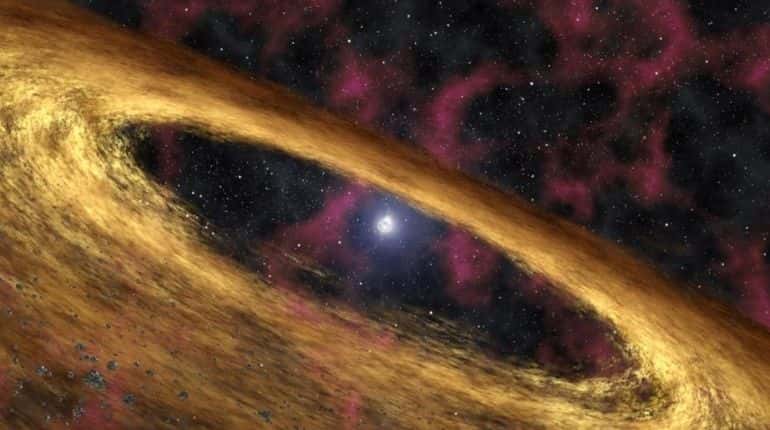
This artist's concept obtained from NASA 06 April 2006, depicts a type of dead star called a pulsar and the surrounding disk of rubble discovered by NASA's Spitzer Space Telescope. The pulsar, called 4U 0142+61, was once a massive star until about 100,000
Stars have an expiry date and die out like all entities in the universe. Everything in the universe, including our sun will become non-functional at one point in the future.
When they die, they go out with a large explosion which is called a “supernova”. Stars usually collapse due to the weight of gravity when they run out of fuel, which produces a strong explosion. Additionally, some stars simply morph into a black hole. These are the two ways for stars to go out.

Most stars, after completing their life cycle simply become white dwarfs, which refers to the core of what once used to be a star. Astronomers claim that the core material is the key ingredient in all living forms.
"INTEGRAL discovery of a burst with associated radio emission from the magnetar SGR 1935+2154”, which studied and recorded this data, by S Mereghetti et al was recently published in the Astrophysical Journal Letters.
Dead light?
)
Oxford United's new clothing line featured 'United 93' phase
)
Pentagon revives mandatory testosterone testing for male troops aged 30 and above
)
Mark Carney mimics Trump in hilarious moment over C$70 billion clean-energy investment; room erupts in laughter
)
Iran rebuilding nuclear facilities? New satellite images show Tehran may be rapidly restoring bombed Parchin base
)
It's a girl! Deepika Padukone and Ranveer Singh welcome their second child
)
FACT CHECK: Why did PM Modi ask Xi ‘is it okay’ at BRICS Summit? New video reveals...
)
Putin: European leaders using war rhetoric to save falling ratings
)
China may have gained access to US's classified F-35 jets; parts meant for repairs diverted to Hong Kong, sparking Pentagon inquiry
)
Arvind Kejriwal, family members, Delhi CM Rekha Gupta get SIR notices
)
Cochin shipyard starts building Indian Navy's next-gen missile vessels
)
Claude led 26% of Anthropic's AI R&D work
)
Brigitte Bardot’s private collection set for Paris auction; key items and prices revealed
)
Why Ranveer Singh’s Dhurandhar missed India’s Oscar entry; FFI jury member reveals what happened
)
How did an Australian river with 500 crocodiles pass the Olympic test? Here's how
)
‘Will go to any extent’: Pakistan vows to defend Saudi Arabia amid Houthi attacks
&im=FitAndFill=(700,400))
Ananya Panday to Sharvari: 5 actresses serving major princess vibes
66 years of the Indus Waters Treaty: How India and Pakistan settled a bitter river dispute
)
The Verdict | When precision fails: US commits war crime in Minab school strike, UN finds
Russia attacks Ukraine with 174 drones, kills 8; 2 vessels hit in Black Sea
)
Trump signs Russia sanctions bill into law, targets Moscow’s energy sector
)
Pak: A series of counter terrorism operations in Khyber Pakhtunkhwa
)
Ajit Agarkar’s future as chief selector to be decided at right time, says BCCI secretary
)
Flying cars in UAE: Ras Al Khaimah signs deal with Chinese company to test new transport
)
Reacher star Alan Ritchson opens up about alleged blackmail, suicide attempt during difficult period
)
Africa is splitting, and a lot sooner than estimated, giving way to a new ocean
)
Trump bans CNN, MS NOW and Politico from White House over ‘FAKE NEWS’
)
Trump 2.0: Dark days ahead for America’s ‘imperial presidency’
)
New brain discovery could aid neurological disease studies
&im=FitAndFill=(700,400))
How many F-35s does Britain, Japan and Israel have?
)
Tirupati Laddu ghee adulterated with chemicals, says ED, supplier arrested
)
IIT Bombay student dies by suicide, was caught seeking AI help during exams
)
Trump extends H-1B visa's $100,000 fee until September 2027: What it means for Indians?
)
Russia holds first parliamentary elections since the beginning of the Ukraine war
&im=FitAndFill=(700,400))
Meet top 5 Indian batters with fastest T20I centuries
)
Extreme warming in Indian Ocean added 695 billion tons of ice to Antarctica ice sheet
)
)
Recently, a collaboration of telescope based research across the globe found that a dead star is emitting an unusual combination of radiation in the Milky Way galaxy. This has never been witnessed before.

The radiation involves two phenomena: magnetars and Fast Radio Bursts. The former refers to remains of stars which is home to the world’s most intense magnetic fields. Once active, the magnetars emit radiation harbouring high amounts of energy, which mostly last shorter than a second but produce more light than our sun!
Also read:Earth's magnetic poles may be flipping by 10° each year, way more than previously thought!
Fast Radio Bursts refers to waves that appear and disappear. These mostly last for lesser than a few milliseconds. These were first discovered in 2007. After disappearing, these are barely spotted again.
Until now, no such burst was detected in our galaxy!
In the month of April, scientists discovered something uncanny. A magnetar which was already logged six years ago suddenly showed signs of activity again. Its official name is “SGR 1935+2154”. However, as opposed to a usual magnetar, it was emitting radio waves alongside x-rays.
In essence, this may hold answers to the unsolved mysteries of magnetars and FRBs. Until this year, radio waves never emerged from a magnetar, or at least not on record.
The finding was confirmed across different space stations on the globe. This serves as the first basis for any scientific link between magnetars and FRBs, which were earlier seen as separate entities.
Scientists had, for a long time suspected that Fast Radio Bursts emerge from magnetars, which are also likely to be responsible for explosions that emit a large amount of light.