A new crop of lost continents might change the way we draw the world map

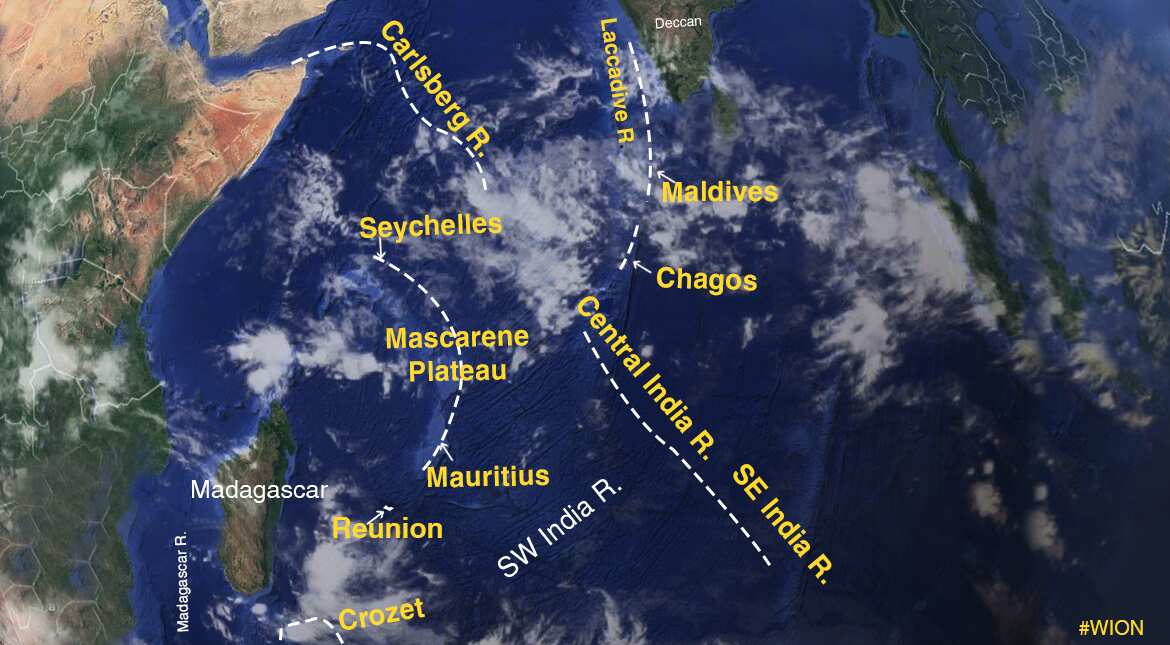
Traces of Mauritia (Representational map)
Mauritia, Zealandia are the two newest additions to 'lost and found' continents
The world might change as we know it, with this discovery.
Geologists are working to uncover hidden pieces of land under water and it is suggested that there might be two new continents to the already existing list of seven. Geologists who have found evidence to support their existence, have named them Mauritiaand Zealandia, in two separate discoveries.
The first continentMauritia,is in the Indian Ocean, beneath the island of Mauritius’ inactive volcanoes. Dr. Lewis D. Ashwal, geologist atUniversity of the Witwatersrand, Johannesburg, in South Africa, published the study on Mauritia in a journal titled Nature Communications.Buried under several layers of volcanic material under the seabed, the fragments of what could have been a continent, is Mauritia.

 Traces of Mauritia (Representational map) (WION)
In the research paper he was cited, “It’s a continent in the geological sense, not in the geographical one. It would be better to refer to Mauritia as a continental fragment or microcontinent rather than as a lost continent.”
While researching, Dr. Ashwal found sparkly minerals called zircon on the island nation of Mauritius.Zircon contains radioactive material that allows geologists to easily date it back to billions of years.It was then found that Mauritius is resting on a land that has existed for more than three billion years, much older than any oceanic crust. According to the study, a volcanic eruption from the Earth’s mantle pushed zircon flakesfrom the crust onto the surface of the island.
)
What’s in a name? Trump’s 'Lake America' move gets a tit-for-tat response from Canada
)
US judge questions Trump’s decision to ban CNN, MS NOW and Politico from White House
)
Trump and Xi Jinping: Timeline of key meetings and major agreements
)
Italy hit by floods in the north, drought in the south
)
'We would all be dead': Netanyahu defends decision to strike Iran's nuclear facilities in his UN speech
)
Mumbai Indians appoint Luke Williams as head coach for Women’s Premier League
)
'There will be elections': Venezuela's interim leader Delcy Rodriguez makes big announcement at UN
)
IIT Bombay CCTV footage emerges: Sahil Wakode seen looking at phone in examination hall
)
Welcome actor Mushtaq Khan dies at 56 after battling cancer
)
Shah Rukh Khan is India's richest actor, Amitabh Bachchan is second: Hurun List 2026
)
WION Iconic Tourism Summit 2026: Union Minister Shekhawat on 'experiential travel', peace diplomacy
)
250-pound WWII bomb found in Falmouth harbour in England
)
Property registration becomes faster, convenient as model sub-registrar offices open in Maharashtra
)
'AI got into my speech': Prince Harry jokes after teleprompter failure at event in New York
)
Asian Games 2026: Seema breaks 16-year drought for India in women’s 10,000m with historic bronze
)
Scientists detect first radio signals directly from faraway planet
)
What’s on the menu? Inside Trump’s lavish White House state dinner for Xi
)
China to test supersonic jet that moves at Mach 2, double the speed of sound
)
Xi Jinping's 'special plane' vs Trump's Air Force One: What's the difference?
)
Forget the smartphone: This tiny gadget could be Meta’s answer to the post-smartphone era
)
Hours before Xi-Trump meeting, US announces visa curbs targeting birth tourism: What is it?
)
'Partners rather than rivals': Xi Jinping's first message after landing in US for Trump summit
)
WION Iconic Tourism Summit: Is India's travel boom outrunning its airports, airlines and hotels?
)
2,000-foot tube, laser tests and more: China builds towns to expand nuclear arsenal, satellite images show
)
Meet Adrian Abraham: 9-year-old Indian-origin guitar prodigy aiming for a Guinness World Record
)
Winter coat, gloves in September? Trump’s Xi welcome sparks social media buzz
)
Trump-Xi state dinner 2026: Who is invited? Full guest list of tech CEOs, business leaders and officials
)
Who is Peng Liyuan? Xi Jinping's singer wife and China's most visible First Lady
)
Australian PM Anthony Albanese calls OpenAI AI incident 'unacceptable' after restricted data access
)
'What kind of confession is this?': Pakistan PM Shehbaz Sharif’s 'terrorists would be roaming New York' remark goes viral, raises alarm online. Watch
)
Russia likely to target Spain, France and Italy in drone attacks, warns CIA: Report
)
WION Iconic Tourism Summit: How local tourism MSMEs must upskill for AI integration
)
Trump’s Board of Peace unveils $2.45bn Gaza plan,66 projects: But where’s the money?
)
‘Both will lose in confrontation’: Xi says US and China should ‘coexist in peace’
)
For the first time, the UN Security Council sat US and Chinese AI makers at the same table
)
EC appointment law: Why is the 2023 act controversial, and what happens next? WION explains
)
Israeli envoy to US Yechiel Leiter’s son critically injured in West Bank ramming attack
)
WATCH | China President Xi Jinping lands in US as Trump greets him ahead of high-stakes summit
)
Report: UK using ground-based system to jam hostile satellites
Zealandia is the second continent recently found. According to a report published in thejournal of the Geological Society of America, this lost continentislocated on thesouthwest Pacific Ocean, surrounding the current land mass of New Zealand and its adjoining islands. Submerged under the Pacific Ocean, it is about half the size of the present Australian continent.
 Traces of Zealandia (Representational map) (WION)
Earlier thought to be fragmented, the latestsatellite-based gravity maps of the ancient seafloor show that the entire region is a whole ancient continent. Geologists in the previous century hadfound granite from sub-antarctic islands near New Zealand and metaphormic rocks on New Caledonia that were indicative of continental geology. Most thus believe that had there been advanced technology back then, Zealandiawould have been identified as one of Earth's continents.
Zealandia is a geological continent rather than a micro-continent or continental fragment, according to the study.In lieuto geo-political arrangements, some parts of ZealandiapredominantlyNew Zealand is grouped under Oceania. The areaincludesthe Australian continent, New Zealand and various islands in the Pacific Ocean that are not included in the seven-continent model.
Several geologists have given Zealandia the status of a continent but there is no official recognition by the New Zealand government. If included, itwould be the world’s eighthand smallest continent.
(WION)

