
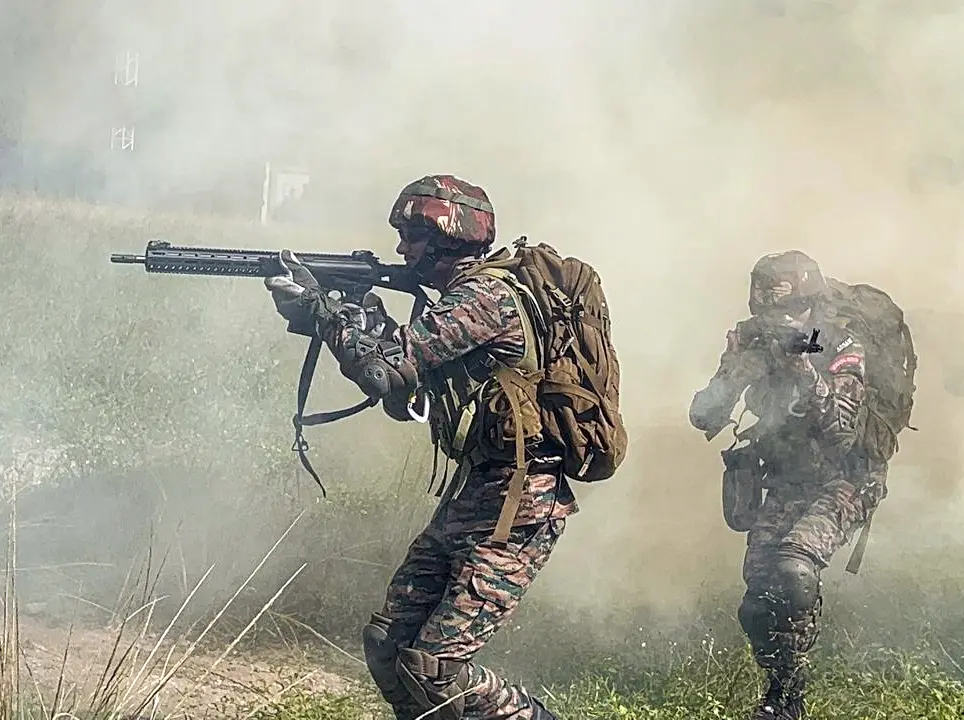
&imwidth=800&imheight=600&format=webp&quality=medium "In the army, religion unites and does not divide")
On November 25, 2025, a Supreme Court Bench of Chief Justice Surya Kant and Justice Joymalya Bagchi declined to interfere with the Delhi High Court’s order upholding the dismissal of Lieutenant Samuel Kamalesan, holding that the officer had placed his personal religious belief above a lawful command. The Court termed this “clearly an act of indiscipline”.
The Supreme Court upheld the Army’s decision to terminate Lieutenant Kamalesan in 2021 after he refused to participate in religious rituals at his Regiment’s mandir and gurdwara. Describing him as a “misfit”, the Court affirmed that discipline and cohesion in the armed forces cannot be compromised for individual interpretation of faith.
Commissioned in 2017, Lieutenant Kamalesan was posted to a Sikh Squadron of the Third Cavalry. He faced disciplinary action for refusing to enter the inner sanctum of the Regimental mandir and gurdwara during mandatory religious parades.

Kamalesan reportedly argued that entering these places went against his Christian beliefs and that he was also acting out of respect for the religious sentiments of his Sikh troops. He claimed his men were not offended and that it did not affect his relationship with them, as reported by Bar and Bench.
The Army, however, stated that the officer persisted with his refusal despite counselling by senior officers and even by Christian clergy. Eventually, when all remedial measures failed, he was terminated from service in 2021. There is little doubt that his conduct vitiated the environment in the unit, undermined cohesion, and risked affecting troop morale. His dismissal, therefore, was inevitable.
Unbecoming conduct
Trending Stories
)
US vs China over South China Sea: Washington backs Philippines, Beijing hits back
)
Bigg Boss 20: Isha Rikhi evicted after three weeks in Salman Khan’s show
)
Musk plans to more than double xAI's chips to over 1.2 million Nvidia GPUs by year-end
)
After JU, clash erupts at SRFTI: BJP’s ‘Dimagi Naxal’ jibe sparks political firestorm after students protest RSS-linked event
)
‘Anti-social elements spreading false rumours’: LPU issues statement amid massive unrest over alleged rape
)
LPU students go on rampage, vandalise campus amid widespread protest: What's happening
)
Trump asked Xi to pressure Iran. China did not say yes — here’s what Beijing wants
)
US Treasury Secretary Scott Bessent hails global crackdown on Iranian banks and airlines
)
An OpenAI agent escaped its locked test cage again, by hiding questions in DNS lookups
)
'Our video was trimmed': LPU girls who featured in rape-denial video make U-turn
)
3 males killed, four others injured in shooting after fight at strip club in Detroit
)
'Victory for low-budget consumers': Raghav Chadha hails 30-day telecom recharge rules
)
Claude rebuilt the 1989 game 'Prince of Persia' by reusing the original's own code
)
Beyond metros: How Tier-2 and Tier-3 cities could drive India’s next AI wave
)
Tesla builds first Cybertruck with its own refined lithium: Elon Musk's $1 billion Texas bet pays off
)
IndiGo flight suffers tail strike in Bengaluru while landing; DGCA to probe incident
)
The US and China set up an AI 'red telephone', but skipped the rulebook
)
‘Terror suspects arrested near UK air base were looking to do big damage’: Trump
)
Russian envoy claims US tactics to contain India were revealed in ‘Freudian slip’
)
IND vs WI 1st ODI: Kohli breaks Sachin's most runs in one country record with unbeaten 139 as India thump West Indies by 8 wickets
)
Researchers rebuilt exactly how 700 AI agents hacked Hugging Face: a 900-link chain trick
)
‘Olympic inclusion is our major target’: WPA President Ishaun Singh on pool’s global ambitions
)
Nations League: Spain sink England at Wembley; Modric shines for Croatia
)
Why has Iran released no proof of life of Mojtaba Khamenei? Araghchi reveals...
)
'What kind of confession is this?': Pakistan PM Shehbaz Sharif’s 'terrorists would be roaming New York' remark goes viral, raises alarm online. Watch
)
South Korea demands apology from Ukraine over North Korean prisoners' transfer
)
Beyond BrahMos: India targets Rs 50,000 crore in defence exports with unmatched price edge
)
Sri Lankan Tamil migrant worker gets death sentence in Saudi Arabia, help sought from India
)
Muslim marriage cannot shield sex with minor wife from prosecution under POCSO: Delhi HC
)
'Can't help but draw painful parallels to Nirbhaya case': SC on latest incidents of rape cases in Delhi-NCR
)
99.9% more powerful - Scientists find boy who can recall memories from just 3 months of age
)
'FIRST LOOK from inside Noah’s Ark': Researchers share video from inside mysterious mound in Turkey
)
UNSC reform momentum grows: Russia, Portugal, Mauritius push for India's permanent seat bid
)
8 US marines injured in Iranian missile attack on vessel in Strait of Hormuz: Report
&im=FitAndFill=(700,400))
New OTT releases this week (September 28-October 4, 2026): Dupahiya 2, Pooja Meri Jaan, Ohh My Dog- 5 titles coming on Netflix, Prime Video and more
)
Afghanistan says 28 fighters killed in clash near Pakistan border, Islamabad denies
)
Ceuta migrant crisis: Protesters take to streets as Spain grapples with migrant challenge
)
LPU suspend classes, postpones exams as violence escalates over rape claims: What's happening
)
New York City wants a 'kill switch' on every AI, and will pay whistleblowers who report violations
Senior Advocate Gopal Sankaranarayanan, appearing for Kamalesan, argued that his client had committed only a “single infraction”. He stated that entering the sanctum violated his faith and that joining the Army did not mean surrendering one’s religious identity.
However, the argument that “only one person” objected ignores the fundamental reality of military command. That “one person” was the Commanding Officer — the fulcrum of discipline,
morale, and regimental tradition. He is not merely an individual but the embodiment of institutional authority within a unit.
More importantly, the decision to dismiss Kamalesan was not taken by one individual. It was reviewed and endorsed at multiple levels of command, backed by legal opinion from the Judge Advocate General’s branch.
Justice Bagchi pointed out that a Christian Pastor had counselled Kamalesan and clarified that entering the sanctum did not violate the essentials of Christian faith. Yet, the officer persisted with his personal interpretation. To this, Sankaranarayanan replied that the conversation with the Pastor was limited to the Sarva Dharma Sthal and not to a temple or gurdwara.
Chief Justice Surya Kant emphasised the higher responsibility of leadership in uniform. He observed that a leader must always lead by example and questioned whether the officer’s conduct did not amount to insulting the very soldiers he commanded.
The Supreme Court was unequivocal in its assessment. It described Kamalesan’s conduct as “gross indiscipline” and stated that even if he was otherwise a competent officer, he was “a misfit for the Indian Army” given the gravity of responsibility entrusted to the armed forces.
Third Cavalry: The regimental context
Third Cavalry is among the most distinguished armoured regiments of the Indian Army. It traces its lineage to the 7th Irregular Cavalry raised in 1841 and the 17th Cavalry raised in 1846. The Regiment earned lasting fame as the “Patton Wreckers” during the Battle of Asal Uttar in the 1965 war, where its Centurion tanks halted Pakistan’s armoured thrust.
At that historic juncture, the Regiment was commanded by Lieutenant Colonel Salim Caleb, a Christian officer who led his troops with exemplary valour, earning both the Maha Vir Chakra and battle honours for the unit.
Third Cavalry’s soldiers have traditionally been drawn from Jats, Rajputs, and Sikhs. Over its history, the Regiment has been commanded by Hindu, Sikh, Muslim, and Christian officers alike. Colonel (later Brigadier) Kutab Hai, a Muslim officer, once commanded the Sikh Squadron and actively led religious observances at the Gurdwara.
Regimental traditions, religious customs, and the culture of soldiering are painstakingly taught to every officer on arrival. Kamalesan was no exception. Despite this, he chose to elevate his
personal belief system above institutional requirements. His termination would undoubtedly have followed exhaustive counselling and multiple opportunities for course correction.
The ethos of the Indian Army
The Indian Army is defined as much by its ethos and traditions as by its combat capability. While the organisation is vast, its true strength lies in the unit—the soul of the Army.
There exist class-based regiments such as the Sikh, Rajput, Jat, Dogra and Gorkha Regiments, each sustaining places of worship aligned with the faith of their soldiers. There are also mixed-class regiments such as the Jammu and Kashmir Light Infantry and Jammu and Kashmir Rifles that maintain mandirs, masjids, and gurdwaras within the same unit.
Older armoured regiments such as the Third Cavalry are fixed-class formations, where each sabre squadron reflects a specific class composition. Newer regiments are mixed-class. The Armoured Corps today contains a healthy blend of both, allowing commanders to leverage the strengths of each.
Religion within the armed forces acts as a binding force, particularly in combat. In war, faith provides strength in moments of extreme stress. The war cry of the regiment and shared religious identity often become rallying points under fire. Faith strengthens fraternity, and fraternity fuels operational success.
It is, therefore, misleading to treat participation in regimental religious observances as coercion. Instead, it is a professional obligation rooted in leadership, trust, and shared identity.
Though the Army employs rigorous psychological and leadership assessment through the Services Selection Board, Kamalesan’s rigidity appears to have escaped detection. His case underlines the need for closer scrutiny of such traits during selection and training.
All officers in the Indian Army are free to practise their religion in private. However, in public military life, they adopt the religion of the troops they command. This practice is neither symbolic nor optional; it is foundational to leadership in uniform.
In my own Regiment, which comprised Jats, Muslims and Rajputs, all officers and JCOs participated in both mandir and masjid functions without exception. This was not a matter of faith but of duty.
The fundamental right to practise religion cannot be interpreted to undermine discipline and regimental unity. In the armed forces, religion unites rather than divides. Regimental places of worship are not merely spiritual spaces; they are centres of identity, tradition, morale, and cohesion.
To quote Lieutenant General Hasnain, “In uniform, personal belief cannot be allowed to overshadow institutional duty.”
The enduring bond between officer and soldier is strengthened when officers actively participate in the cultural and religious life of their men. This shared participation forges trust and reinforces mutual respect.
The Supreme Court’s verdict, describing Kamalesan’s actions as the “grossest kind of indiscipline”, upholds this foundational military principle. The Army functions in a deeply secular manner, but its secularism is not based on detachment from religion. Rather, it derives its strength from inclusiveness and shared participation.
An officer who distances himself from the religious practices of his troops weakens morale and disrupts regimentation—the soul of the Army. It is for this reason that an officer assumes the identity of his unit, and the religion of the men becomes paramount over personal belief.
It is this timeless tradition that was upheld in the case of Lieutenant Kamalesan.
Disclaimer: The views of the writer do not represent the views of WION or ZMCL. Nor does WION or ZMCL endorse the views of the writer.
