

&imwidth=800&imheight=600&format=webp&quality=medium "Davos 2026 is also about US-China rivalry in geopolitics, trade and tech. And China is quietly winning")
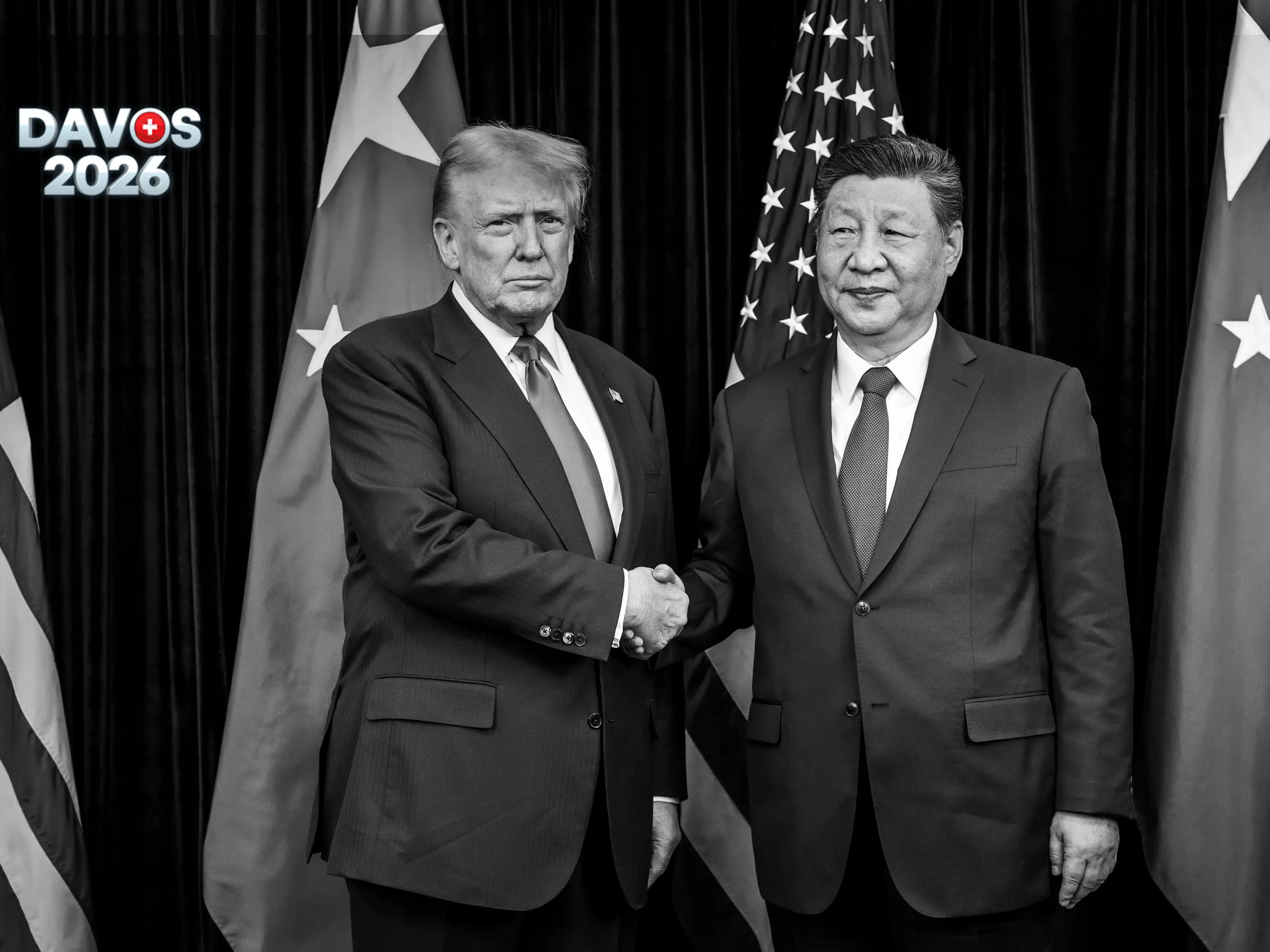
At the start of the World Economic Forum 2026 in Davos, China warned the international community against return to the 'law of the jungle'. Donald Trump might want to make WEF all about himself and America, but the US president might take note of the quiet progress made by China in all areas of competition: trade, technology, warfare and climate. One recurring story in the current world order is the increasing territorial ambitions of both nations, one which assumes American supremacy and exceptionalism, and the other stressing a multipolar world. China’s slowly warming relations with European nations, Canada, India and the Arab world sharply contrast with the renewed conflict-mongering of Trump, from Greenland to Iran and further afield. Trump wants to thrust America into the centre of everything, be it the pursuit of peace in Gaza or the technology-trade rivalries involving semiconductors. But it appears China is smiling as Trump destroys alliances and friendships that took American leaders decades to build. Here is how the rivalry is shaping up.
World Economic Forum: An annual 'do' turns into a crisis meeting
Geopolitical tensions and trade and tariff wars form the backdrop for this year’s WEF, taking place on January 19–23, under the theme "A Spirit of Dialogue" with the aim of fostering cooperation amid global fractures. The WEF’s Global Risks Report 2026 identified geoeconomic - not geopolitical- confrontation as the most significant short-term threat to global stability. This includes the use of sanctions, tariffs, export controls and trade restrictions as instruments of state power. Most of it actually applies to the Trump administration.
Cooperative mechanisms are crumbling, and multilateralism is in retreat. China–US rivalries are at the core of this global uncertainty.
The WEF's session names are also ominous. One is titled "Is the World at a Breaking Point?", an example of the forum's shift from optimism to panic-mode realism. That's because trade, technology and finance are increasingly being weaponised in a global order where economic tools are central to strategic influence.
Trade, a new frontline pitting America against China
Trending Stories
&imwidth=180&imheight=135&format=webp&quality=medium)
US charges two former FBI officials with lying to Congress about Hunter Biden probes. 'Politically motivated' Trump grievance or something else?
&imwidth=180&imheight=135&format=webp&quality=medium)
Tu Hai Meri Kiran film review: Sonakshi Sinha and Zaheer Iqbal's thriller gets tangled in its own twists
&imwidth=180&imheight=135&format=webp&quality=medium)
IND vs NZ 2nd T20I: Shreyas Iyer on brink of breaking Rohit Sharma’s record
&imwidth=180&imheight=135&format=webp&quality=medium)
Did Neha Bora call for Bangladesh-like GenZ protest, 'anarchy' in India? WION Fact-checks viral claim
&imwidth=180&imheight=135&format=webp&quality=medium)
Will the US attack Iran this weekend? Trump's envoy says, 'absolutely'
&imwidth=180&imheight=135&format=webp&quality=medium)
Global cybersecurity alert: PHP flaws trigger website shutdowns as hack attempts surge into millions
&imwidth=180&imheight=135&format=webp&quality=medium)
US Navy, Marine Corps boards defy Trump's transgender military ban, vote to retain troops
&imwidth=180&imheight=135&format=webp&quality=medium)
Fauzi teaser out: Prabhas takes on the British Empire in patriotic avatar | Watch
&imwidth=180&imheight=135&format=webp&quality=medium)
Viral video shows cross falling on Colombia priest, no official confirmation | WATCH
&imwidth=180&imheight=135&format=webp&quality=medium)
Google Fitbit Air’s new health guardian feature tracks trends: How it works
&imwidth=180&imheight=135&format=webp&quality=medium)
'You’re a horrible little reporter, aren’t you?': Trump snaps at NBC reporter questioning his support for Ramaswamy's campaign ad
&imwidth=180&imheight=135&format=webp&quality=medium)
'Black triangle' UFO flying at 1,800mph spotted over sensitive US site: Latest Trump admin UFO file dump
&imwidth=180&imheight=135&format=webp&quality=medium)
'My name has always been Ilhan Omar': Congresswoman hits back at Trump, calls him a 'creep'
&imwidth=180&imheight=135&format=webp&quality=medium)
Nairobi building collapse: Several feared trapped after 16-storey structure crumbles; rescue operation underway
&imwidth=180&imheight=135&format=webp&quality=medium)
Chemical warehouse explosion in Mexico: Several injured in multiple blasts, 1,000 evacuated in León
&imwidth=180&imheight=135&format=webp&quality=medium)
AI deepfakes are spreading online: Why is removing them so difficult?
&imwidth=180&imheight=135&format=webp&quality=medium)
US midterms 2026: Trump revises Canada tariffs as Susan Collins faces tight re-election race in Maine
&imwidth=180&imheight=135&format=webp&quality=medium)
Anthropic security chief issues grim cyberattack warning: ‘It’s going to get a lot worse’
&im=FitAndFill=(700,400)&imwidth=180&imheight=135&format=webp&quality=medium)
How smart robots and AI assemble vehicles in 20 hours
&imwidth=180&imheight=135&format=webp&quality=medium)
Pakistan airline PIA unveils new crew uniforms, faces online criticism
&imwidth=180&imheight=135&format=webp&quality=medium)
IND-W vs ZIM-W, 1st ODI: Rawal, Charani star in India’s nine-wicket win over Zimbabwe
&imwidth=180&imheight=135&format=webp&quality=medium)
Emmanuel Macron calls Paris suburb shooting a 'racist terrorist attack' after one killed, several injured
&imwidth=180&imheight=135&format=webp&quality=medium)
Gravitas | US attack could trigger WW III: Russian planes in Tehran, Israeli jets, US warships in action
&imwidth=180&imheight=135&format=webp&quality=medium)
Horrific video shows the moment 18-year-old fell to her death from Mexico amusement park ride
&imwidth=180&imheight=135&format=webp&quality=medium)
China's dancing robot turns violent bodyguard, lifts cars and fights intruders - Watch
&imwidth=180&imheight=135&format=webp&quality=medium)
US midterms 2026: Viral video claims Lindsey Graham paid underage men for sex; clip released weeks before his sister's Senate race
&imwidth=180&imheight=135&format=webp&quality=medium)
First Lady Melania Trump secures ceasefire between Russia, Ukraine in Oleshky: White House
&im=FitAndFill=(700,400)&imwidth=180&imheight=135&format=webp&quality=medium)
New Friday OTT releases (October 23, 2026): Gajab Raat, Dorothy, Chaar Yaar- Watch these 6 new movies and TV shows on Netflix, Prime Video and more
&imwidth=180&imheight=135&format=webp&quality=medium)
French Open: PV Sindhu storms into final with win over Hina Akechi
&imwidth=180&imheight=135&format=webp&quality=medium)
'Already tired of his 9-to-5': Baby born with a moustache becomes internet sensation, video goes viral | Watch
&imwidth=180&imheight=135&format=webp&quality=medium)
India-China face-off continues near Arunachal’s Taksing, reveals ITBP chief in first official confirmation of tensions
&imwidth=180&imheight=135&format=webp&quality=medium)
Negotiators from Ukraine, Russia, United States to meet in Abu Dhabi: Zelensky
&imwidth=180&imheight=135&format=webp&quality=medium)
Farooq Abdullah says Pakistan’s raising of Kashmir issue keeps pressure on Delhi
&imwidth=180&imheight=135&format=webp&quality=medium)
Massive 7.2 magnitude quake off Vanuatu triggers tsunami warning for coasts within 300 km
China is working hard to appear as a stable and predictable trade partner, and has had a record $1.2 trillion trade surplus in 2025 as evidence. Vice-Premier He Lifeng highlighted China’s role in defending globalisation, touting the Belt and Road Initiative (BRI) as a tool for global stability and investment. Remember, only a few years ago, there was a lot of pessimism about BRI.
US actions, on the other hand, prioritised protectionism and unilateral action under Trump’s so-called "Donroe doctrine".
Tariffs, export controls on high-tech items like chips, and trade restrictions are framed as necessary to counter China’s industrial dominance. This approach risks the US being seen as a "bully".
Both US allies and emerging powers are now exploring independent or China-aligned strategies.
Global trade, which used to be largely immune to geopolitical tensions, is now fragmenting into geopolitical zones. This is leading several companies to adopt the "China +1" supply-chain strategy, hedging by diversifying production to India, South-East Asia, Mexico and Europe. India, Brazil and Gulf states are seeking more autonomy in global relations, but still face pressure from the US in the form of tariffs, sanctions or disincentives, making some of them tilt more towards China.
Also read: WEF Davos 2026 opens without founder after whistleblower flags 'financial and ethical misconduct'
Technology rivalry to the forefront: AI race, semiconductors
Perhaps the fiercest arena of US–China competition is technology. AI acceleration and industrial innovation are dominating the Davos discussions. While the US has leadership in frontier AI research, proprietary ecosystems and advanced semiconductors, it is also employing export controls on critical chips to stay at the top of the race. But China enjoys advantages in scaling, deployment and industrial ecosystems. It is already leading the world in electric vehicles, renewable energy, robotics, 5G infrastructure and batteries. China has perfected this through decades of state-backed strategic investment, process knowledge and ferocious market competition.
Low electricity costs in China, at $0.04–0.08/kWh, enable massive AI computing deployment compared to $0.15/kWh in the US. State-backed industrial policy and alternative chip quests position China to compete effectively despite US export restrictions.
China vs US: A tussle between hegemony and multipolarity
Davos 2026 reflects a broader power struggle over global governance, with China and the US at the two ends of the spectrum. China challenges US dominance in covert, overt or subtle manners, advocating a multipolar world through the Global Development Initiative and leadership in AI and clean energy standards. This is an approach that developing nations, particularly in regions like Africa, appear to embrace. China continues to be one of the key contributors to global GDP growth, more than 22 per cent of the total as per some estimates for 2026.
The US, on the other hand, appears to be operating in chaos, controlled or otherwise. Under Trump, it is showing inconsistent diplomacy, reliance on sanctions, and choreographed rhetoric regarding actual conflicts and wars.
Under such leadership, globalisation is fragmenting, and companies and nations are navigating these dual blocs or adopting hedging strategies.
Disclaimer: The writer's views do not represent those of WION or ZMCL. Nor does WION or ZMCL endorse the views of the writer.

