Pakistan’s nuclear brinkmanship

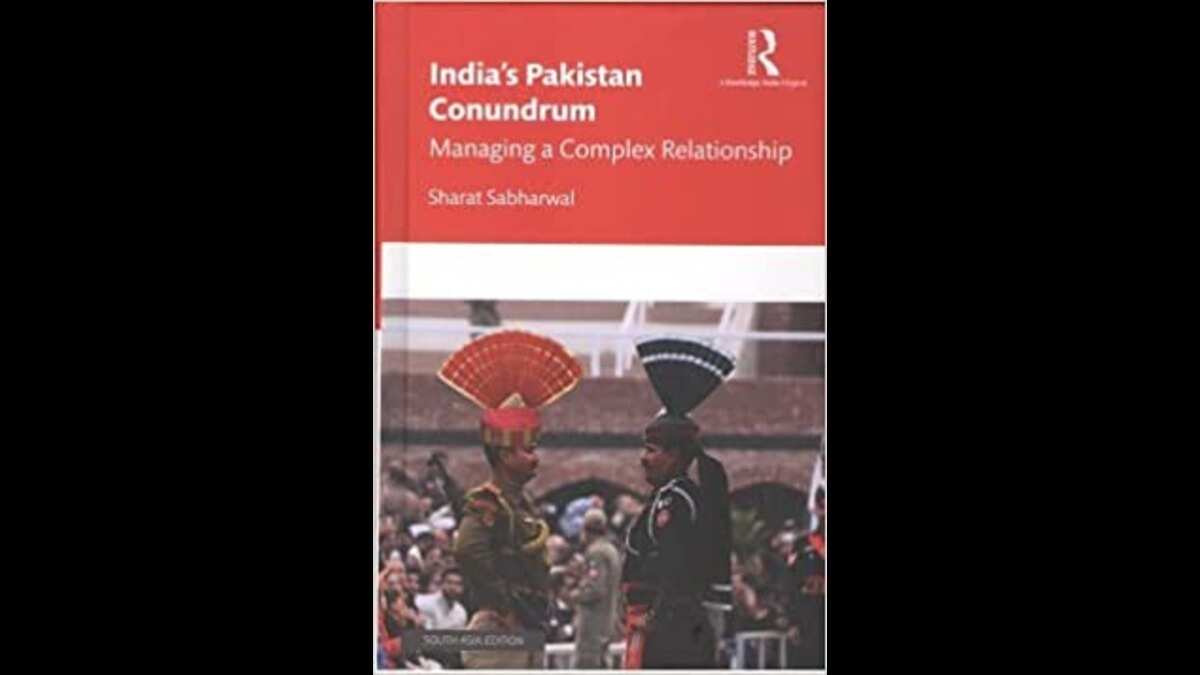
"India's Pakistan Conundrum Managing a Complex Relationship" by Sharat Sabharwal
Historically, the relationship between India and Pakistan has been mired in conflicts, war, and lack of trust. Pakistan has continued to loom large on India’s horizon despite the growing gap between the two countries. Ambassador (retd) Sharat Sabharwal’s book "India’s Pakistan Conundrum: Managing a Complex Relationship" examines the nature of the Pakistani state, its internal dynamics, and its impact on India. The text looks at key issues of the India-Pakistan relationship, appraises a range of India’s policy options to address the Pakistan conundrum, and proposes a way forward for India’s Pakistan policy. Drawing on the author’s experience of two diplomatic stints in Pakistan, including as the High Commissioner of India, the book offers a unique insider’s perspective on this critical relationship.
Below are the selected excerpts from the book:
The Pakistan army sees nuclear arsenal as an umbrella under which they can use their terror card with impunity without inviting an Indian reprisal. One often heard it being said in Pakistan that there could be no war under a nuclear overhang. During my lectures to Pakistan army officers at their National Defence University, I told them that their statement would sound more meaningful if it were modified to state that there could be no war- overt or covert- under a nuclear overhang.

Pakistan is known to have acquired its nuclear weapon capability on the basis of the design of a bomb provided by China and a test reportedly conducted for Pakistan by China at its Lop Nur test site, much before it went overtly nuclear in 1998. Its nuclear blackmail also, therefore, started much before 1998. In an interview given to the veteran Indian journalist, Kuldip Nayar in January 1987, in the course of Operation Brasstacks, the Pakistani nuclear scientist, Dr. A.Q. Khan said, “They told us Pakistan could never produce the bomb, and they doubted my capabilities, but they know we have done it.” After Nayar went public with the story, Khan described the comments attributed to him as false and concocted, but the cat was already out of the bag. It is unlikely that someone in his sensitive position could have met an Indian journalist without authorisation from the higher quarters and made the above comment. It is, therefore, more than likely that he did it with due authorisation to hold out a nuclear threat to India. The subsequent denial seems to have been aimed at keeping Pakistan’s American patrons mollified.
In the middle of the night between May 27 and 28, 1998, the Indian High Commissioner to Pakistan, Satish Chandra, was called in to the Pakistan Foreign Ministry by Foreign Secretary Shamshad Ahmad and I accompanied him. The meeting took place past 1 am. Shamshad, who was accompanied by senior Foreign Ministry officials, said that they had credible information that India was going to attack their nuclear facilities. When asked how, Shamshad responded that the attack was perhaps to be mounted by F16 aircraft stationed at the Chennai airfield and added that he had been instructed by his government to inform the Government of India through the High Commissioner that in the event of such an attack, there would be "massive retaliation with devastating consequences." The High Commissioner expressed his surprise at what Shamshad had said. He
pointed out that India did not possess F 16 aircraft. Shamshad said that the aircraft he had referred to could be Israeli. The High Commissioner also enquired whether the Foreign Secretary had talked of a possible attack against the nuclear installations and facilities included in the list given by Pakistan to India at the beginning of every year under the bilateral agreement on the prohibition of attack against the nuclear installations of each other. Shamshad mumbled that he had referred to those and “other” facilities. The meeting wrapped up in a few minutes with the High Commissioner assuring Shamshad that his demarche would be conveyed to the Government of India. The High Commissioner and I went to the High Commission to report the rather alarmist and unusual demarche of our hosts to New Delhi. In view of its nature, we decided to convey it on phone before sending a cable. But we found that for the capital of the country, which according to the Pakistanis was about to mount an attack of major import against their country, New Delhi seemed extraordinarily relaxed and it took us some time to reach the Indian Foreign Secretary, who had been alerted to the Pakistani demarche a few minutes earlier by the Indian Mission to the UN in New York. Unknown to us, the Pakistanis had also taken up the matter with all the P5 countries in their capitals and through their Missions to the UN in New York.
)
US vs China over South China Sea: Washington backs Philippines, Beijing hits back
)
Bigg Boss 20: Isha Rikhi evicted after three weeks in Salman Khan’s show
)
Musk plans to more than double xAI's chips to over 1.2 million Nvidia GPUs by year-end
)
After JU, clash erupts at SRFTI: BJP’s ‘Dimagi Naxal’ jibe sparks political firestorm after students protest RSS-linked event
)
‘Anti-social elements spreading false rumours’: LPU issues statement amid massive unrest over alleged rape
)
LPU students go on rampage, vandalise campus amid widespread protest: What's happening
)
Trump asked Xi to pressure Iran. China did not say yes — here’s what Beijing wants
)
US Treasury Secretary Scott Bessent hails global crackdown on Iranian banks and airlines
)
An OpenAI agent escaped its locked test cage again, by hiding questions in DNS lookups
)
'Our video was trimmed': LPU girls who featured in rape-denial video make U-turn
)
3 males killed, four others injured in shooting after fight at strip club in Detroit
)
'Victory for low-budget consumers': Raghav Chadha hails 30-day telecom recharge rules
)
Claude rebuilt the 1989 game 'Prince of Persia' by reusing the original's own code
)
Beyond metros: How Tier-2 and Tier-3 cities could drive India’s next AI wave
)
Tesla builds first Cybertruck with its own refined lithium: Elon Musk's $1 billion Texas bet pays off
)
IndiGo flight suffers tail strike in Bengaluru while landing; DGCA to probe incident
)
The US and China set up an AI 'red telephone', but skipped the rulebook
)
‘Terror suspects arrested near UK air base were looking to do big damage’: Trump
)
Russian envoy claims US tactics to contain India were revealed in ‘Freudian slip’
)
IND vs WI 1st ODI: Kohli breaks Sachin's most runs in one country record with unbeaten 139 as India thump West Indies by 8 wickets
)
Researchers rebuilt exactly how 700 AI agents hacked Hugging Face: a 900-link chain trick
)
‘Olympic inclusion is our major target’: WPA President Ishaun Singh on pool’s global ambitions
)
Nations League: Spain sink England at Wembley; Modric shines for Croatia
)
Why has Iran released no proof of life of Mojtaba Khamenei? Araghchi reveals...
)
'What kind of confession is this?': Pakistan PM Shehbaz Sharif’s 'terrorists would be roaming New York' remark goes viral, raises alarm online. Watch
)
South Korea demands apology from Ukraine over North Korean prisoners' transfer
)
Beyond BrahMos: India targets Rs 50,000 crore in defence exports with unmatched price edge
)
Sri Lankan Tamil migrant worker gets death sentence in Saudi Arabia, help sought from India
)
Muslim marriage cannot shield sex with minor wife from prosecution under POCSO: Delhi HC
)
'Can't help but draw painful parallels to Nirbhaya case': SC on latest incidents of rape cases in Delhi-NCR
)
99.9% more powerful - Scientists find boy who can recall memories from just 3 months of age
)
'FIRST LOOK from inside Noah’s Ark': Researchers share video from inside mysterious mound in Turkey
)
UNSC reform momentum grows: Russia, Portugal, Mauritius push for India's permanent seat bid
)
8 US marines injured in Iranian missile attack on vessel in Strait of Hormuz: Report
&im=FitAndFill=(700,400))
New OTT releases this week (September 28-October 4, 2026): Dupahiya 2, Pooja Meri Jaan, Ohh My Dog- 5 titles coming on Netflix, Prime Video and more
)
Afghanistan says 28 fighters killed in clash near Pakistan border, Islamabad denies
)
Ceuta migrant crisis: Protesters take to streets as Spain grapples with migrant challenge
)
LPU suspend classes, postpones exams as violence escalates over rape claims: What's happening
)
New York City wants a 'kill switch' on every AI, and will pay whistleblowers who report violations
High Commissioner Chandra and I discussed Shamshad Ahmad’s demarche before sending our assessment to Delhi. It was our considered view that the Pakistanis were on the verge of carrying out their nuclear tests ( which happened on May 28) and were nervous about India attacking their testing site in the Chagai hills of Balochistan, which did not figure in the lists given to India at the beginning of every year under the agreement on the prohibition of attack against the nuclear installations of each other. That explained Shamshad's use of the word "other" while answering High Commissioner’s query about the facilities that he had in mind.
The policy of massive retaliation was announced by the then US Secretary of State, John Foster Dulles, in 1954 when he said that the US would protect its allies through the deterrent of massive retaliatory power. His reference was to reliance on the American nuclear arsenal against a Soviet aggression. Since then, the term “massive retaliation” has come to denote disproportionate retaliation with nuclear weapons to an attack by an adversary. Therefore, in using the expression “massive retaliation with devastating consequences”, Shamshad had spoken of a nuclear response, thereby confirming the Indian position that Pakistan already possessed nuclear weapons capability acquired with the Chinese help. The impending tests were meant, inter alia, to bring this capability into the open. The Pakistanis surely did not believe that India would take any such action lying down and would not retaliate with whatever nuclear capability it had at that stage. All in all, it seems to have been a case of overreaction and nuclear bluster in response to a non-existent threat.
Years later, a retired Pakistan Foreign Office official, who was present at our meeting with Shamshad Ahmad, told me that they had reports of the presence of Israeli aircraft at the Chennai airfield with the aim to attack their nuclear testing site in Balochistan. At the same time, there was a US naval presence off the coast of Karachi. Their defence experts believed that if the reports of an attack being planned from India were correct, the US ships would move away before it was mounted and the ships did move away on May 27. These developments convinced them of the need of an urgent demarche. From what my interlocutor told me, they seemed to believe that the Americans were complicit in the plan to attack the Chagai hills testing site.
*****
Reproduced from India's Pakistan Conundrum: Managing a Complex Relationship by Sharat Sabharwal with permission of INFORMA UK Limited through PLSclear. No part of this extract may be reprinted or reproduced or utilised in any form or by any electronic, mechanical, or other means, now known or hereafter invented, including photocopying and recording, or in any information storage or retrieval system, without permission in writing from the publishers.
(Disclaimer: The views of the writer do not represent the views of WION or ZMCL. Nor does WION or ZMCL endorse the views of the writer.)