Emerging change in Japan

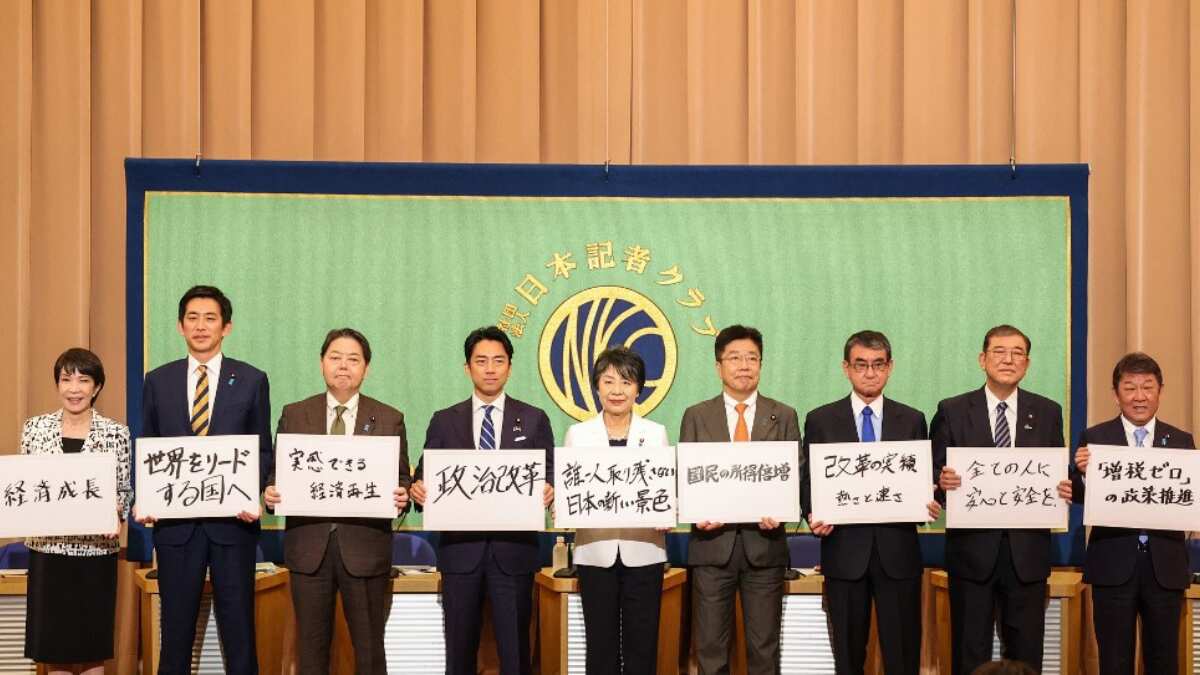
Candidates for Japan’s ruling Liberal Democratic Party’s (LDP) presidential election.
A most interesting election for the leadership of Japan’s ruling Liberal Democratic Party (LDP) is underway. This will be held on 27 September.
This comes at the end of the three-year term of Fumio Kishida, the president of the LDP. The LDP President becomes the leader of the party in parliament, and since it is in a majority there, he becomes the Prime Minister.
This is the first time that the LDP elections are being held without the presence of Shinzo Abe, who had an overarching influence and a large faction which dominated the politics of the LDP. It is also the first time since Kishida tried to dissolve the LDP factions in an effort to reform the LDP’s internal politics and prevent illegal funding, which was embarrassing the party.

Nine candidates are now in the fray for the presidential election. This is a large number because there is no particular faction backing anybody directly, it seems like a free-for-all. Such a large number have not contested the LDP Presidency since 1966. Nevertheless, three political heavyweights have a say in how the results of this election will possibly emerge. These are current prime minister Fumio Kishida, the previous Prime Minister Yoshihide Suga, and the current LDP vice president, Taro Aso.
In the initial round of voting, the 367 LDP parliamentarians each have a vote. They are matched by a vote from 367 ordinary party members. If nobody gets a majority, then the top two would have a runoff election where the vote of the MPs now counts for more. This is because each one of them would still have a vote, but the remaining votes would come as one from each LDP organization in each of Japan's 47 prefectures. At that stage, faction loyalties and role of leaders come into play because back scratching among parliamentarians and their mentors plays a bigger role among MPs and party leaders from the prefectures.
As per current polls, by Nikkei and TV Tokyo held on 15 September, former LDP Secretary General, Shigeru Ishiba, who is also a former defence minister, is leading among ordinary pro-LDP Voters. However, he is often not in sync with the party leaders or their factions. He is closely followed by the more charismatic former Environment Minister, Shinjiro Koizumi, whose father was a well-known Prime Minister, and at 43 is the youngest candidate.
)
US vs China over South China Sea: Washington backs Philippines, Beijing hits back
)
Bigg Boss 20: Isha Rikhi evicted after three weeks in Salman Khan’s show
)
Musk plans to more than double xAI's chips to over 1.2 million Nvidia GPUs by year-end
)
After JU, clash erupts at SRFTI: BJP’s ‘Dimagi Naxal’ jibe sparks political firestorm after students protest RSS-linked event
)
‘Anti-social elements spreading false rumours’: LPU issues statement amid massive unrest over alleged rape
)
LPU students go on rampage, vandalise campus amid widespread protest: What's happening
)
Trump asked Xi to pressure Iran. China did not say yes — here’s what Beijing wants
)
US Treasury Secretary Scott Bessent hails global crackdown on Iranian banks and airlines
)
An OpenAI agent escaped its locked test cage again, by hiding questions in DNS lookups
)
'Our video was trimmed': LPU girls who featured in rape-denial video make U-turn
)
3 males killed, four others injured in shooting after fight at strip club in Detroit
)
'Victory for low-budget consumers': Raghav Chadha hails 30-day telecom recharge rules
)
Claude rebuilt the 1989 game 'Prince of Persia' by reusing the original's own code
)
Beyond metros: How Tier-2 and Tier-3 cities could drive India’s next AI wave
)
Tesla builds first Cybertruck with its own refined lithium: Elon Musk's $1 billion Texas bet pays off
)
IndiGo flight suffers tail strike in Bengaluru while landing; DGCA to probe incident
)
The US and China set up an AI 'red telephone', but skipped the rulebook
)
‘Terror suspects arrested near UK air base were looking to do big damage’: Trump
)
Russian envoy claims US tactics to contain India were revealed in ‘Freudian slip’
)
IND vs WI 1st ODI: Kohli breaks Sachin's most runs in one country record with unbeaten 139 as India thump West Indies by 8 wickets
)
Researchers rebuilt exactly how 700 AI agents hacked Hugging Face: a 900-link chain trick
)
‘Olympic inclusion is our major target’: WPA President Ishaun Singh on pool’s global ambitions
)
Nations League: Spain sink England at Wembley; Modric shines for Croatia
)
Why has Iran released no proof of life of Mojtaba Khamenei? Araghchi reveals...
)
'What kind of confession is this?': Pakistan PM Shehbaz Sharif’s 'terrorists would be roaming New York' remark goes viral, raises alarm online. Watch
)
South Korea demands apology from Ukraine over North Korean prisoners' transfer
)
Beyond BrahMos: India targets Rs 50,000 crore in defence exports with unmatched price edge
)
Sri Lankan Tamil migrant worker gets death sentence in Saudi Arabia, help sought from India
)
Muslim marriage cannot shield sex with minor wife from prosecution under POCSO: Delhi HC
)
'Can't help but draw painful parallels to Nirbhaya case': SC on latest incidents of rape cases in Delhi-NCR
)
99.9% more powerful - Scientists find boy who can recall memories from just 3 months of age
)
'FIRST LOOK from inside Noah’s Ark': Researchers share video from inside mysterious mound in Turkey
)
UNSC reform momentum grows: Russia, Portugal, Mauritius push for India's permanent seat bid
)
8 US marines injured in Iranian missile attack on vessel in Strait of Hormuz: Report
&im=FitAndFill=(700,400))
New OTT releases this week (September 28-October 4, 2026): Dupahiya 2, Pooja Meri Jaan, Ohh My Dog- 5 titles coming on Netflix, Prime Video and more
)
Afghanistan says 28 fighters killed in clash near Pakistan border, Islamabad denies
)
Ceuta migrant crisis: Protesters take to streets as Spain grapples with migrant challenge
)
LPU suspend classes, postpones exams as violence escalates over rape claims: What's happening
)
New York City wants a 'kill switch' on every AI, and will pay whistleblowers who report violations
In third place at the moment, is a lady candidate Sanae Takaichi, a former economic security minister who was backed by Abe the last time around. These three are the leading candidates. The remaining six,including Foreign Minister Yoko Kamikawa from Kishida's faction, as well as Chief Cabinet Secretary Yoshimasa Hayashi, also from his faction, are in the running, but not doing as well as the others.
Ishiba is leading with 26% an increase of 8% since the last such poll in August 2024.He is followed by Koizumi, at 20%, down by 3%. Other candidates include Sanae Takaichi, minister for economic security, at third at 16%, followed by Foreign Minister Yoko Kamikawa at 6%, Digital Transformation Minister Taro Kono at 5% and Chief Cabinet Secretary Yoshimasa Hayashi at 5%. Support for Takaichi and Hayashi increased by 5 and 3 % Other candidates are Takayuki Kobayashi, former minister for economic security, at 3%, LDP Secretary-General Toshimitsu Motegi at 2% and former Chief Cabinet Secretary Katsunobu Kato at 1%. The popularity of non-factionleaders is higher in these polls, but will it hold when the MPs vote for the candidates?
The three leading candidates are not the favourites of Taro Aso, who hopes that Kono, currently languishing, will do better and enter the final runoff. He will have trouble if it is a Koizumi versus Ishiba runoff. Taro Aso may actually prefer Takaichi to either of the other two, and hope that she makes it if his own candidate does not.
Prime Minister Kishida’s choices are also uneven. He is not keeping any of the three leading candidates on his negative list, even though he has faced criticism from them in the past. He is more worried that a victory for Koizumi would enhance the stature of Suga, which would mean a diminishing of Kishida’s post-election stature. Some commentators believe that if Koizumi was to win, Suga would get a high position, either in government or the party, and would have greater influence on government policy.
Therefore, part of the Kishida and Aso’s dislike for Koizumi is because they want to keep Suga under check.
While this jockeying goes on, the popular support for the Kishida cabinet further decreased by 1% from the August survey to 27%. Its disapproval rating also fell similarly to 65%.
The LDP is finding it hard to move from its patronage system of factions. These were in disarray when Abe was assassinated and a non-factional Suga succeeded him but could not last. Kishida was elected by factional adjustments. Kishida lamented the LDP was in its "gravest condition since its foundation" in 1955, drowning in a tsunami of funding scandals.
The people are seeing cleaner politics which responds better to their concerns in the survey the issues of importance to them in the leadership polls, include “inflation measures" chosen by 34%, followed by "pensions" and "the economy in general" at 32% each, and "measures related to child rearing, education and the low birth rate" at 29%. These are the concerns Japanese people have.
Kishida will yet represent Japan at the Quad Summit in Delaware on 22 September. It will be his and Bidens last Quad Summit as well. For the G20 and EAS Summits, Japan is likely to be represented by its new leader in October.
In foreign policy, issues which will face the next PM are managing and enhancing relations with the U.S. which is Japan's security shield and most important relationship. The US itself is having a momentous Presidential election. The impact on how the USforeign policy may alter is a challenge that the new PM will need to reckon with. The threat of China and its more cohesive exercise in the region with Russia, the North Korean challenge, the developments in Taiwan and to keep up the momentum with South Korea will all be important
The Indo-Pacific in general and India in particular will continue to draw Japanese interest. It is the turn of PM Modi to visit Japan for the bilateral summit and this may happen in 2025 after PM Modi meets the new leader on the sidelines of the EAS or the G20 Summits.