
&imwidth=800&imheight=600&format=webp&quality=medium "WION Exclusive | Was it a data error, miscommunication, or malfunction? Former pilot and training captain weighs in on possible reasons")
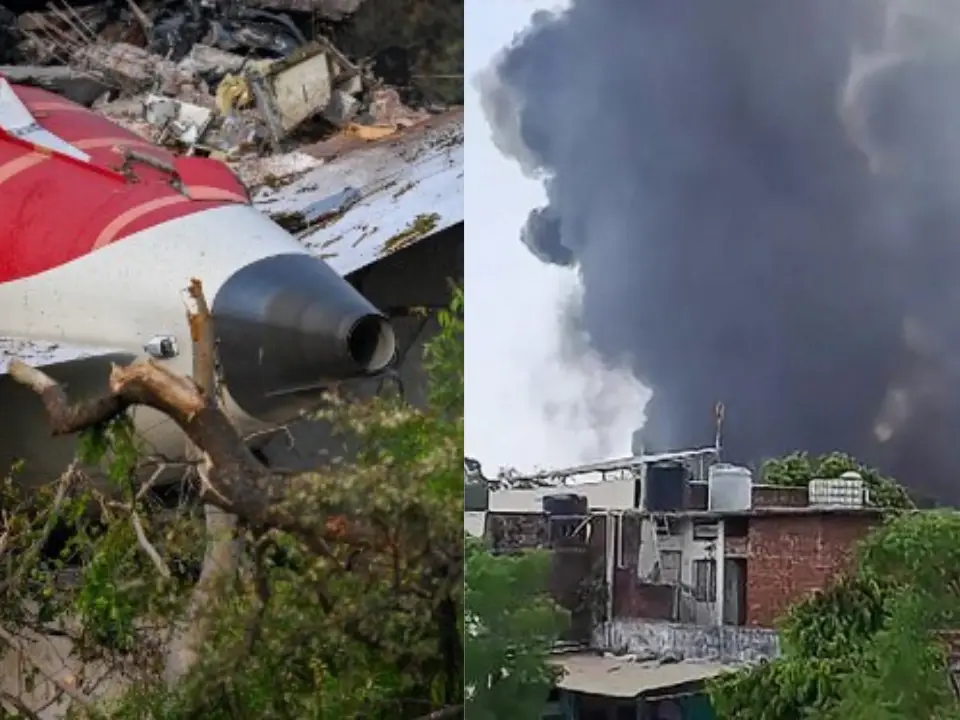
It was meant to be a routine flight. Instead, it became one of the most haunting tragedies in recent Indian aviation memory. Shortly after take-off from Ahmedabad airport, Air India flight AI171 plunged from the skies, leaving behind wreckage, grief—and a trail of unanswered questions.
The pilot’s last words were stark and chilling: “Mayday, Mayday, Mayday.” That was all. No follow-up. No elaboration. Silence, then impact.
As investigators sift through the data and debris, a broader aviation community is asking: What happened in those final seconds? Could the crash have been avoided? And what does it tell us about the pressure’s pilots face when machines malfunction and margins vanish?

To make sense of the tragedy, WION spoke exclusively to former captain and training captain SK Pillai, with decades of experience in cockpit emergencies and pilot instruction. The former captain discusses and explains possible factors that can lead to disasters like these.
His breakdown offers a window into a world where decisions are made faster than thought—and where a single misstep can turn an aircraft into a falling object.
The final transmission: ‘Mayday’ and then nothing
Trending Stories
)
US vs China over South China Sea: Washington backs Philippines, Beijing hits back
)
Election Commission on 'damage control' : What do nine new decisions mean?
)
UK police arrest several under explosives act near air base used by US forces
)
‘Anti-social elements spreading false rumours’: LPU issues statement amid massive unrest over alleged rape
)
LPU students go on rampage, vandalise campus amid widespread protest: What's happening
)
OpenAI AI Agents hacked 4 websites before Hugging Face, researchers reveal
)
US Treasury Secretary Scott Bessent hails global crackdown on Iranian banks and airlines
&im=FitAndFill=(700,400))
New Friday OTT releases (September 25, 2026): Don’t Be Shy, Hunkkaar: The Roar, Mango Pachcha- 6 movies and TV shows on Netflix, Prime Video and more
)
Asian Games 2026: India face Afghanistan in quarterfinal on Sep 28; Pakistan clash with Hong Kong
)
‘Attack on Mecca a red line for Pakistan’: Shehbaz Sharif warns Houthis at UN
)
WATCH | Delhi minister Parvesh Verma slaps man during road inspection – Here’s what happened
)
'Countries far from conflict are penalised': Jaishankar calls for Gulf peace, seafarer safety at UN
)
Bigg Boss 20: Salman Khan schools Rhiti Tiwari over Qazi Touqeer clash, compares her to Dolly Bindra
)
Gunmen kill 27 in two separate mass shootings in South Africa
&im=FitAndFill=(700,400))
Humanoid robots to virtual worlds! Korean sci-fi dramas to watch: Are You Human Too?, Memories of the Alhambra and more
)
IND vs WI 1st ODI: Naman Dhir debuts as India bowl first in Trivandrum; check playing XIs
)
Nations League: Spain sink England at Wembley; Modric shines for Croatia
)
Two men die of suspected chemical exposure inside public toilet in Mumbai
)
Trump-Xi summit wrap: Big pageantry, Iran talks, few major developments and more meetings planned
)
‘Could kill billions...’: Bill Gates backs calls to slow AI development amid fears of catastrophe
)
Bollywood x K-pop crossover! LE SSERAFIM’s Kazuha charms fans with Shah Rukh Khan’s ‘Chammak Challo’ steps
)
US-Iran war: Trump rejects Iran's Hormuz proposal, reports suggest talks expected next week
)
Jaishankar at UNGA: Goodwill and friendship can't coexist with terrorism
)
Sri Lankan Tamil migrant worker gets death sentence in Saudi Arabia, help sought from India
)
'FIRST LOOK from inside Noah’s Ark': Researchers share video from inside mysterious mound in Turkey
)
UNSC reform momentum grows: Russia, Portugal, Mauritius push for India's permanent seat bid
)
WATCH | As Shehbaz Sharif claims Pakistan’s ‘victory’ during 2025 conflict, Indian diplomat R Srinivas laughs at UN
)
Ceuta migrant crisis: Protesters take to streets as Spain grapples with migrant challenge
)
Ramayana: Yash’s Ravana gets first official poster from Nitesh Tiwari’s epic
)
'A terrorist country is asking me that question?': Jaishankar hits back at Pakistani journalist at UN; flags attacks on commercial shipping
)
Russia will achieve Ukraine war aims; Europe doing everything to block peace talks: Lavrov at UN
According to air traffic control logs, the pilot of the flight managed to transmit just one short distress call. It was formal and urgent: “Mayday, Mayday, Mayday”—the internationally recognised radio transmission for emergency situations.
But what stood out to experts wasn’t just what was said—it was what wasn’t. “A Mayday call means the pilot is facing a life-threatening emergency,” says Pillai. “Normally, pilots follow this with details of their situation and intentions, but in this case, there was hardly any time.”
The lack of a follow-up message strongly suggests the pilot was already overwhelmed—perhaps battling for control, diagnosing a problem, or trying to manage the plane’s trajectory in those final moments.
“In an emergency, your first duty is to fly the airplane,” Pillai explains. “You have to get control of the aircraft, see where it’s going, and determine your desired trajectory. Communication comes later.”
Aviation’s central mystery: Why didn’t the plane climb?
The plane, according to radar data, reached just about 625 feet above the ground before beginning a fatal descent. This raises one of the most baffling questions in the investigation: Why couldn’t the aircraft climb?
While structural failure or sabotage has not been ruled out, Pillai in his personal opinion feels there are possibilities of errors while loading data. “The probability of both engines failing simultaneously is one in many millions,” he says.
He noted that video footage taken just before the crash showed no signs of smoke or fire, making a bird strike unlikely.
The hidden threat: Incorrect take-off data
Every pilot, before take-off, inputs crucial parameters into the flight management system—details like aircraft weight, runway condition, temperature, and wind speed. From this, the aircraft computes three critical speeds.
If these calculations are wrong—especially weight—the result can be devastating. “If incorrect data is entered—for example, underestimating the aircraft’s weight—the computer may set insufficient thrust, leading to a sluggish take-off or inability to climb,” explains Pillai.
He references the 2009 near-disaster of an Emirates flight 407, from Auckland to Dubai with a stopover in Melbourne.
The Australian Transport Safety Bureau (ATSB) led the investigation into the accident,
focusing on three key questions: How the first officer came to enter an incorrect aircraft weight, why the error went undetected prior to take-off, and why the flight crew failed to notice the unusually slow acceleration until nearly the entire 3.6-kilometre (12,000-foot) runway had been used.
“If the computer thinks the plane is lighter than it actually is, it won’t command enough power. You’ll lift off sluggishly, maybe not at all.”
Human factors: When team dynamics go awry
The cockpit is a place of hierarchy—but also of shared responsibility. A seasoned captain working with a less experienced first officer may create an imbalance that affects safety.
“An experienced pilot can multitask and set a fast pace, but if the co-pilot is less experienced and fails to double-check, errors can creep in,” Pillai notes.
In critical moments, a failure to cross-verify aircraft weight, flap settings can reduce acceleration and climb rate—eating into safety margins rapidly. Failure to cross check, can lead to an errors in calculating the take off run required and climb performance.
“If the weight is incorrect, the plane may not accelerate or climb as expected, using up more runway and reducing safety margins,” he said.
Landing gear, flaps—and the danger of mistakes
Among the anomalies being examined is the suggestion that the landing gear was never retracted. Normally, gear-up selection happens shortly after take-off.
“After reaching 35 to 50 feet, you select the landing gear up,” says Pillai. “If this isn’t done, it could be due to preoccupation with an emergency—or by mistake moving the flaps lever instead of the gear lever.”
This isn’t just theoretical. He recounts a past tragedy caused by a similar mistake where the flap lever was moved instead of the gear lever, thereby reducing speed and increasing drag
How simulators keep pilots prepared for the worst
Modern commercial aviation is built on precision, preparedness, and constant practice—especially for those in the cockpit. Pillai says that no matter how experienced a pilot is, continuous training is non-negotiable.
“Every pilot, right down to the time he retires—whether he’s a seasoned training captain with 30,000 hours or a newcomer with just 500—has to undergo mandatory simulator training every six months.”
These aren't just routine refreshers. The simulator sessions replicate a wide range of
emergency scenarios: engine failures, hydraulic losses, electrical faults, bird strikes, and even complex weather conditions.
“Almost any emergency that you can think of—that can happen on an airplane—is simulated and practiced. Because in reality, many pilots may never experience a single major emergency in their entire career,” he explains.
Despite that rarity, preparedness is key. That's why proficiency checks are held after every simulator session. Pilots must pass these checks to keep their licenses valid and remain eligible to fly.
“It’s not optional. If a pilot doesn’t clear the check, they don’t go back to line flying,” the former captain stresses.
Beyond simulator evaluations, pilots are subject to other regular in-flight assessments such as route checks. “Practically every three months, there’s some form of check or clearance. The system is designed to ensure pilots stay sharp—not just technically, but also in decision-making under pressure."

