Putin India visit: 'India's economy is world's fastest growing economy', says Russia President Vladimir Putin

&imwidth=600&imheight=450&format=webp&quality=medium "Putin India visit: 'India's economy is world's fastest growing economy', says Russia President Vladimir Putin")
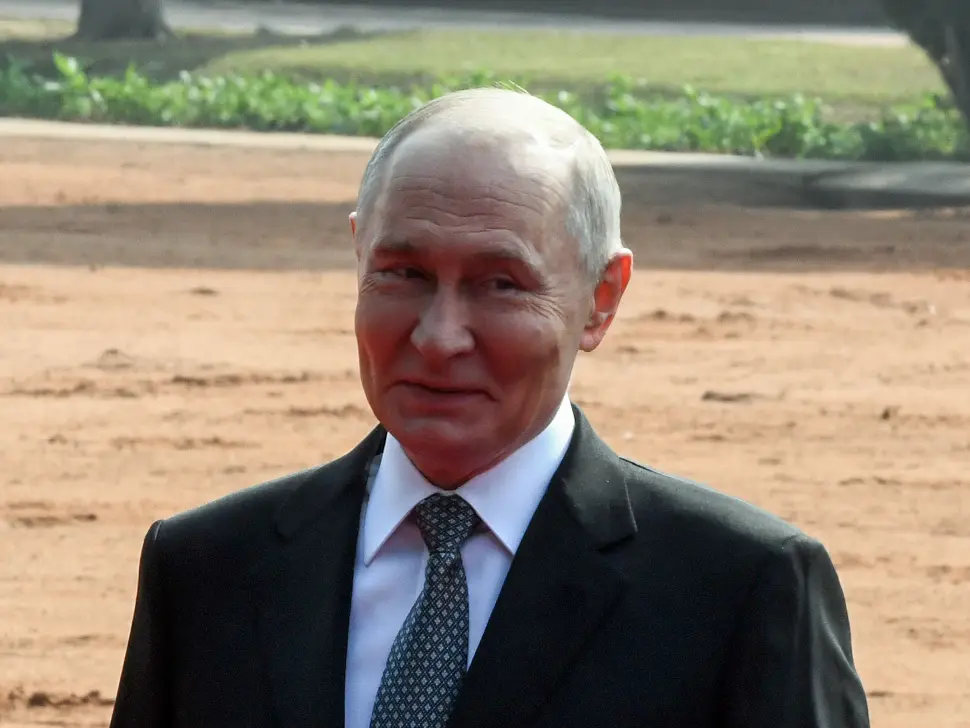
Russia President Vladimir Putin Photograph: (ANI)
Russia President Vladimir Putin is in India for his two-day visit, where he held talks with India Prime Minister Narendra Modi, looking to strengthen trade, defence and economic sector
At the India-Russia Business Forum, Russian President Vladimir Putin emphasised the importance of strengthening the multi-dimensional economic ties between Russia and India. He said, “I pay particular attention to deepen multi-faceted economic ties between Russia and India. Following today's meetings, we adopted a document to develop India-Russia economic cooperation. Russian businesses are ready to increase purchases from India across a wide range of goods and services. I want to assure the businesses that Russia will support all initiatives.”
He also noted the longstanding trade partnership between the two countries, highlighting that, “Indeed, Russia and India are long-time trade partners. Trade volumes are growing at a sustainable pace. And over the past three years, we saw a record increase of up to 80%. As a result, last year, the Russian-Indian trade volume reached $64 billion. There are vast opportunities for further increase of bilateral trade and investment. Russia and India have big consumer markets. Once again, I would like to stress that under the leadership of His Excellency Modi, India is conducting an absolutely independent and sovereign policy and at the same time achieves very good results in the economic field,” he added.
In his speech, Putin also praised India’s economic progress under Prime Minister Narendra Modi, saying, "I would like to stress that under the leadership of PM Modi, India is conducting an independent and sovereign policy and at the same time achieving very good results. Today, the Indian economy is one of the fastest-growing economies in the world. Thanks to the sound economic policy and landmark initiative by PM Modi as the Make in India program, India is becoming technologically sovereign. India's IT and pharmaceutical sectors take a leading position in the world."
Putin further underscored that the Russian delegation’s visit was not just focused on energy agreements, but also on expanding ties across a wide range of sectors, saying, "The Russian delegation did not only come to discuss energy issues and sign contracts for the supplies of oil and gas. What we want is the development of our multifaceted relations with India in various fields. Prime Minister stressed on many occasions in our private talks that India has vast and growing opportunities in many fields, but up until now they haven't been used to the extent both parties want to see it. That is precisely the reason why we convened this forum."
Meanwhile, Prime Minister Narendra Modi discussed several key areas of cooperation between the two countries. He highlighted the liberalisation of sectors like defense and space, which have been opened to the private sector, creating new avenues for collaboration. "Defence and space have been opened to the private sector. This has created new opportunities in these sectors. Now we are going to open the door to new possibilities in the civil-nuclear sector as well. This is not just administrative reform, but mindset reform. The only resolve behind these reforms is a developed India," Modi said.
Trending Stories
)
)
)
)
)
)
&im=FitAndFill=(700,400))
)
)
)
&im=FitAndFill=(700,400))
)
)
)
)
)
)
&im=FitAndFill=(700,400))
)
)
)
)
)
)
)
)
)
)
)
)
)
)
)
)
)
On enhancing connectivity, Modi stressed the importance of fully utilising the potential of logistical corridors, particularly the Chennai-Vladivostok corridor, underlining the commitment to advancing projects like the International North-South Transport Corridor (INSTC) and the Northern Sea Route. "I would like to present some ideas for furthering our cooperation. First, in the area of logistics and connectivity, in today's meeting, President Putin and I emphasised realizing the full potential of our connectivity. We are committed to moving forward on the INSTC, or the Northern Sea Route, i.e., the Chennai-Vladivostok Corridor. Progress will be made in this direction soon. This will reduce transit times, lower costs, and open up new markets for businesses. With the power of digital technology, we can connect customs, logistics, and regulatory systems through virtual trade corridors. This will speed up customs clearance, reduce paperwork, and make cargo movement more seamless."
Modi also outlined the ambitious target for bilateral trade, setting a goal of surpassing $100 billion by 2030. However, based on the ongoing momentum and the potential he sees, he expressed confidence that the target might be achieved ahead of schedule. “President Putin and I set a goal of exceeding the $100 billion target for bilateral trade by 2030. But from my conversations with President Putin since yesterday, and the potential we see, I don't think we'll have to wait until 2030. We are moving forward with determination to achieve that goal ahead of schedule, and my confidence is growing. Tariff and non-tariff barriers are being reduced. The speed and scale of change we have achieved in India over the past 11 years is unprecedented. Following the principle of reform, perform, and transform, India is rapidly moving towards becoming the world's third-largest economy. Our resolve is stronger than ever, and we are moving forward with great confidence and at a rapid pace towards our goals. Next-generation reforms in GST and reduction in compliance are steps taken to promote ease of doing business.”

