Joshimath sinking: Why is this town in India's Uttarakhand falling apart?

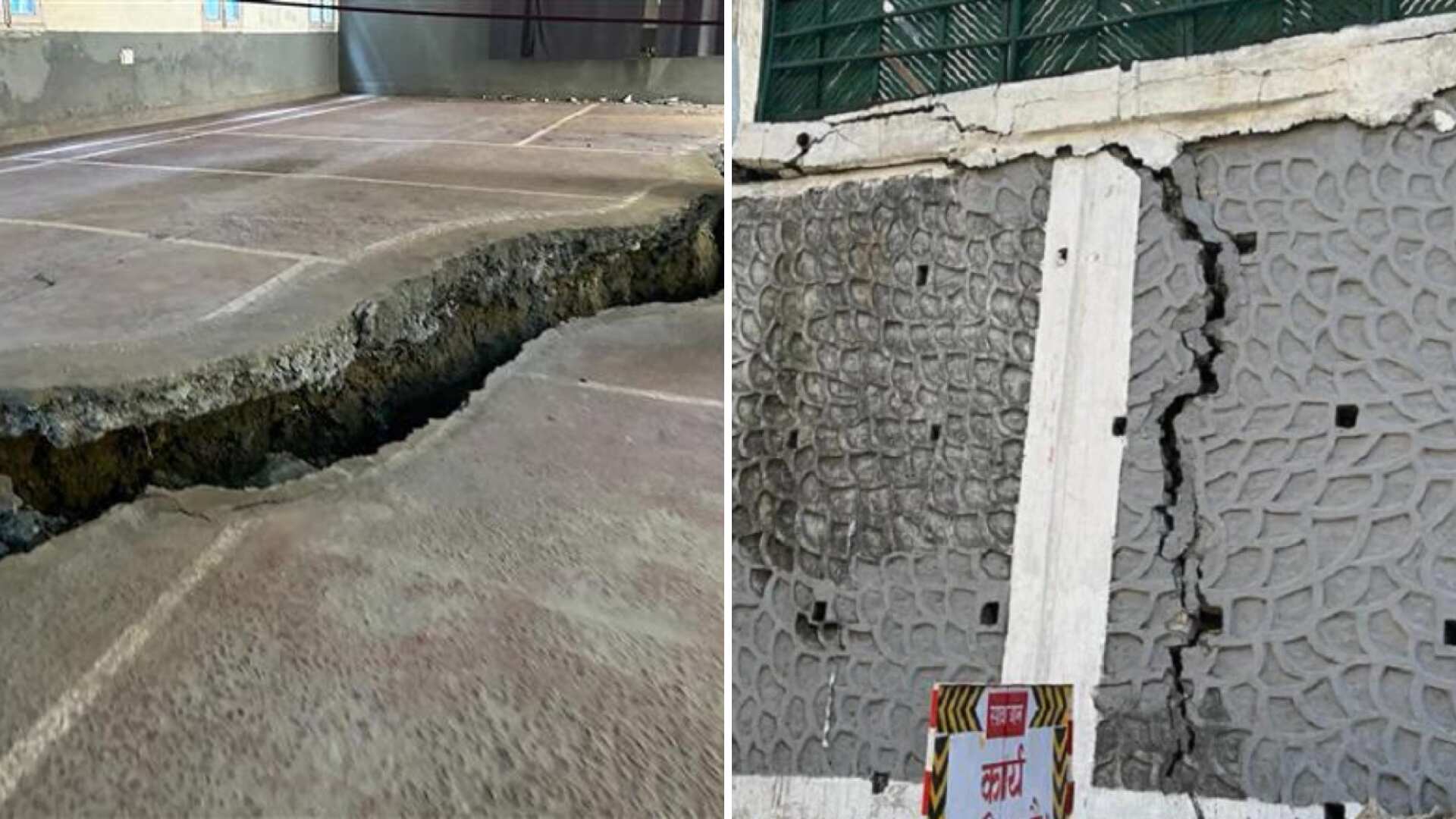
Joshimath sinking
Joshimath, a spiritual townin Uttarakhand where Adi Shankaracharya, a religious reformer, acquired enlightenment in the eighth century, has become a matter of countrywide concern.Nearly 66 families have been forced to vacatetheir homes, the largest ropeway in Asia has been closed to tourists, two hotels have shut their doors for an indefinite period, and locals have taken to the streets. The events in Joshimath come as a second blow to the hill state, the first being theunrest in Haldwani over eviction notices. Many have drawn comparisons between the agitation in Haldwani and the protests in Delhi's Shaheen Bagh over the Citizenship Amendment Act 2020.
On Thursday (5 January),Joshimath villagers blocked the Badrinath national highway amid a new panic as water began to leak from the "Joshimath rock." The residents were already battling menacing cracks and crevices that started to form in their homes, on the roadways, and in their fields.
They heard noises coming from below the ground on Monday (2 January)around midnight. On Wednesday (4 January), many terrified families fled to safer areas, and more are waiting in line. The JP residential estate in Marwari was nearby when an aquifer also burst, adding to the commotion.

On Thursday (5 January), the terrified villagers, who have been pleading with the authorities to halt all construction activities in their "sinking" town, gathered on the streets holding torches. The town is "placed on an old landslide," making it vulnerable, and there is concern that the hillside on which it is built would collapse.
The Uttarakhand government assembled a team of scientists on Thursday (5 January) to determine the cause of the sinking of the land and the cracks in the buildings in an attempt to reassure the locals. The crew will visit the location and look into the cause.
)
US vs China over South China Sea: Washington backs Philippines, Beijing hits back
)
Bigg Boss 20: Isha Rikhi evicted after three weeks in Salman Khan’s show
)
Musk plans to more than double xAI's chips to over 1.2 million Nvidia GPUs by year-end
)
After JU, clash erupts at SRFTI: BJP’s ‘Dimagi Naxal’ jibe sparks political firestorm after students protest RSS-linked event
)
‘Anti-social elements spreading false rumours’: LPU issues statement amid massive unrest over alleged rape
)
LPU students go on rampage, vandalise campus amid widespread protest: What's happening
)
Trump asked Xi to pressure Iran. China did not say yes — here’s what Beijing wants
)
US Treasury Secretary Scott Bessent hails global crackdown on Iranian banks and airlines
)
An OpenAI agent escaped its locked test cage again, by hiding questions in DNS lookups
)
'Our video was trimmed': LPU girls who featured in rape-denial video make U-turn
)
3 males killed, four others injured in shooting after fight at strip club in Detroit
)
'Victory for low-budget consumers': Raghav Chadha hails 30-day telecom recharge rules
)
Claude rebuilt the 1989 game 'Prince of Persia' by reusing the original's own code
)
Beyond metros: How Tier-2 and Tier-3 cities could drive India’s next AI wave
)
Tesla builds first Cybertruck with its own refined lithium: Elon Musk's $1 billion Texas bet pays off
)
IndiGo flight suffers tail strike in Bengaluru while landing; DGCA to probe incident
)
The US and China set up an AI 'red telephone', but skipped the rulebook
)
‘Terror suspects arrested near UK air base were looking to do big damage’: Trump
)
Russian envoy claims US tactics to contain India were revealed in ‘Freudian slip’
)
IND vs WI 1st ODI: Kohli breaks Sachin's most runs in one country record with unbeaten 139 as India thump West Indies by 8 wickets
)
Researchers rebuilt exactly how 700 AI agents hacked Hugging Face: a 900-link chain trick
)
‘Olympic inclusion is our major target’: WPA President Ishaun Singh on pool’s global ambitions
)
Nations League: Spain sink England at Wembley; Modric shines for Croatia
)
Why has Iran released no proof of life of Mojtaba Khamenei? Araghchi reveals...
)
'What kind of confession is this?': Pakistan PM Shehbaz Sharif’s 'terrorists would be roaming New York' remark goes viral, raises alarm online. Watch
)
South Korea demands apology from Ukraine over North Korean prisoners' transfer
)
Beyond BrahMos: India targets Rs 50,000 crore in defence exports with unmatched price edge
)
Sri Lankan Tamil migrant worker gets death sentence in Saudi Arabia, help sought from India
)
Muslim marriage cannot shield sex with minor wife from prosecution under POCSO: Delhi HC
)
'Can't help but draw painful parallels to Nirbhaya case': SC on latest incidents of rape cases in Delhi-NCR
)
99.9% more powerful - Scientists find boy who can recall memories from just 3 months of age
)
'FIRST LOOK from inside Noah’s Ark': Researchers share video from inside mysterious mound in Turkey
)
UNSC reform momentum grows: Russia, Portugal, Mauritius push for India's permanent seat bid
)
8 US marines injured in Iranian missile attack on vessel in Strait of Hormuz: Report
&im=FitAndFill=(700,400))
New OTT releases this week (September 28-October 4, 2026): Dupahiya 2, Pooja Meri Jaan, Ohh My Dog- 5 titles coming on Netflix, Prime Video and more
)
Afghanistan says 28 fighters killed in clash near Pakistan border, Islamabad denies
)
Ceuta migrant crisis: Protesters take to streets as Spain grapples with migrant challenge
)
LPU suspend classes, postpones exams as violence escalates over rape claims: What's happening
)
New York City wants a 'kill switch' on every AI, and will pay whistleblowers who report violations
By the evening of thesame day, the Tapovan-Vishnugad hydro project and the current building of the Helang bypass, which are thought to be two of the primary causes of the sinking, were to be immediately suspended by the orders of the Chamoli district magistrate.
News agencyANIstated that cracks have reportedly been observed in as many as 561 houses. “Now the process of increasing cracks in Singhdhar and Marwadi has started. Badrinath NH near Singhdhar Jain locality and JP Company Gate in Marwadi, near the forest department check post, is continuously cracking. This crack is increasing every hour which is worrying," said Joshimath Municipal Chairman Shailendra Pawar who spoke to ANI.
Sinking Joshimath: First signs of the impending doom
The devastating landslide in Chamoli, which caused many landslides, made the first mention of the cracks in homes in the national media in 2021. To add some support to the homes they are living in, the locals began using wooden poles. Seismic earthquakes continued to be frequent the next year as well.
Also watch |India's EAM S. Jaishankar takes on Europe's charges, calls out China
The Uttarakhand government nevertheless established an expert group in 2022. The researchers discovered that a few areas in Joshimath are "sinking" as a result of both man-made and natural factors. The panel discovered that structural faults and damage have been caused by ground subsidence, which is a gradual sinking or sudden settling of the earth's surface caused by the removal or relocation of subsurface components.
More than 40 families are said to be living in "such risky conditions" in Joshimath's Gandhinagar, Ravigram, and Sunil regions, according to Lalita Devi, a former ward member of Gandhinagar who spoke to ANI. Additionally, 10 families are said to be living in homes that have wooden poles for additional support.Despite a geological examination of the town, the inhabitants claimed that no assistance has yet been given to the affected families.
Notably, Joshimath in the Chamoli district is significant not just because it's close to the Indo-Tibet border but also because it's the last significant town on the roads to Badrinath, Valley of Flowers, and Hemkund.
Why is Joshimath prone to landslides?
The town's location is the main factor contributing to Joshimath's sinking. Experts have long cautioned that the landslide debris on which the city was built has a low bearing capacity and cannot support a rapid rate of construction. The slopes have become extremely unstable in the previous few decades due to increased building, hydropower projects, and the extension of the National Highway.
Researchers from the Wadia Institute of Himalayan Geology did a survey in 2022 and found that these gneissic rocks are extremely worn-out , have a poor cohesive value, and have a propensity for high pore pressure when saturated with water, especially during monsoons.
Joshimath residents blameNational Thermal Power Corporation Limited (NTPC)
The government has been charged with "turning a blind eye" to the complaints of the community on the NTPC projects.
Joshimath Bachao Sangharsh Samiti leader Atul Sati stated to The Times of India (TOI) that the NTPC confessed "the tunnel was witnessing water seepage from a punctured aquifer, leading to the drying of water sources in Joshimath" in 2020.
Environmentalist Ravi Chopra told TOI that the punctured aquifer inside the Joshimath mountain area would act like a leaking balloon. “Just as water will leak out of the balloon, causing it to gradually collapse, a similar phenomenon may have occurred inside the mountains in the area. ”
NPTC officials refuted these assertions, claiming that Joshimath was not "sinking" as a result of the project and that the tunnel was dry, as quoted by the TOI.
How can Joshimath be revived?Experts suggest ways
An expert team led by Dr. Ranjit Sinha, Secretary of Disaster Management, has been dispatched by the government to Joshimath to address the situation, and it will deliver its report following a thorough investigation.
Experts advise that all construction and hydroelectric projects in the area be stopped immediately. The population must first move to a safer area, and only then should the town's planning be revised to account for the new variables and shifting geographical conditions.
One of the most important aspects that need investigation and development is drainage planning. As more and more garbage seeps into the soil, loosening it from the inside, the city is suffering from poor drainage and sewer management. The state administration has urged the irrigation department to check into the situation.
In order to preserve the soil capacity in the area, experts have also recommended replanting, particularly at sensitive sites. To save Joshimath, there needs to be a coordinated effort between the government and civil organisations with the help of military organisations like the Border Roads Organisation (BRO).
(With inputs from agencies)
WATCH WION LIVE HERE: