"India takes G20 Presidency at critical time, will provide solutions," says Chief Coordinator Harsh Shringla

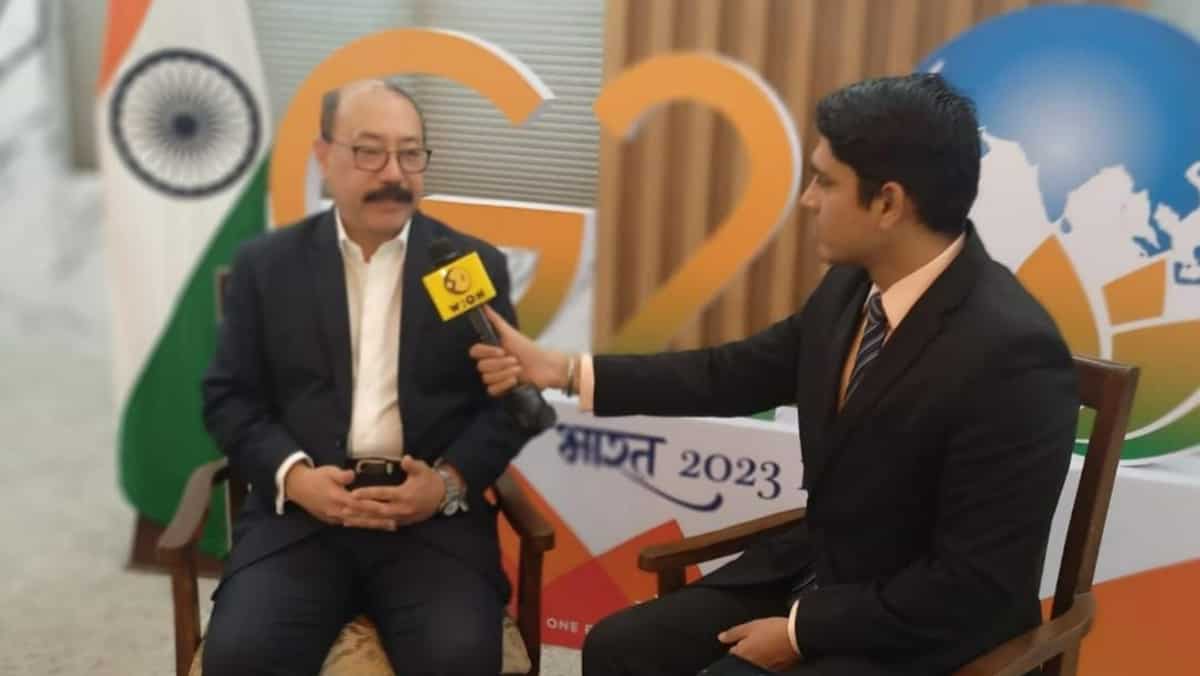
Shringla
Chief Coordinator for India's G20 Presidency Harsh Shringla said on Thursday (January5) that New Delhi has taken over the presidency of G20 at a 'critical time' and that this is a time of "great deal of uncertainty, political, economic, security-related uncertainty." Shringla said that the focus will be on solution.
He was speaking exclusively with WION's Principal Diplomatic Correspondent Sidhant Sibal.
Shringla explained that "rest of the world looks to the G20 to provide solutions to many of the challenges that confront them, from issues like indebtedness, inflation, paying high prices for basic necessities like fuel, food".

India took over the Presidency of the grouping on December 1, 2022 and will host the mega summit in September this year. Along with the summit, India will also host over 200 meetings in 57 different locations. The mega grouping represents more than 80 percent of world GDP, 75 percent of international trade and 60 percent of the world population.
The chief coordinator pointed that,"For every working level meeting you will have a cabinet minister who will go and address the group at the opening session, You also have the cultural event, formal dinner that is part of the process and in every state the governor, the CM". He also talked about India's role on Russia-Ukraine conflict, reforms at UN, and logistics involved in hosting of the yearlong Presidency.
WION: What will be the key focus for India? And what does it plan to achieve during its presidency?
)
Justice eludes Air India 1985 bombing victims as Canada probe goes 'inactive' | Gravitas
)
Mumbai: Gallops restaurant at Mahalaxmi Racecourse licence suspended over food safety violations
)
Erdogan again raises Kashmir issue at UNGA, calls for dialogue under UN Charter
)
'Our team opened the gate of gold medals': Harmanpreet Kaur on India’s Asian Games final win
)
'Needs time away from the international scene': England white-ball captain Brook on pacer Brydon Carse's future
)
Four decades after leaving Kolkata, the Birlas may be coming back for more
)
The Verdict | Moral policing isn’t culture or discipline, it’s crime
)
Cyclone Arnab: Landfall expected before midnight tomorrow as IMD issues orange alerts across six states
)
Glitch in the matrix caught on camera: Woman vanishes after talking to reporter
)
Rani Mukerji's mother Krishna Mukerji passes away; Karan Johar, Jaideep Ahlawat visit actress
)
Asian Games 2026: India women's cricket team beats Sri Lanka by 147 runs for first gold
)
ICC plans T20I expansion and fewer ODIs in 2027–2031 FTP cycle: Report
)
Key accused in Bihar's Jamui molestation case, arrested after police shoot him in leg
)
'Mumma’s boy from Gwalior who dared to dream': Kartik Aaryan pens long note after first National Award win
)
Gravitas | Boosting NHS productivity could save 20,600 lives in UK annually: Report
)
US and China vie for AI dominance as calls grow for regulation | Gravitas
)
Yemen clashes kill 154 people in two days as cornered Saudi battles Houthi offensive | Gravitas
72nd National Film Awards: Kartik Aaryan receives Best Actor honour for Chandu Champion in Gujarat
)
IND vs JPN, one-off T20I: Japan captain Kendel on pushing India to the brink - ‘It was special’
)
Raaka creates history! Allu Arjun’s film secures Guinness World Record ahead of release
)
Saudi Arabia exits China-led mBridge digital currency platform amid Saudi-Houthi conflict
)
WION Iconic Tourism Summit and Awards 2026: Key voices to discuss India’s tourism future
)
National Film Awards 2026: Yami Gautam wins Best Actress for Article 370
)
World leaders repeatedly call Gaza crisis ‘genocide’ as Israel’s war dominates opening sessions of UNGA
)
WION Iconic Tourism Summit and Iconic Awards 2026: India's travel economy leaders gather in Delhi
)
American manufacturing is reshoring faster than its factory floors can absorb
&im=FitAndFill=(700,400))
New OTT releases this week (September 21-27, 2026): Shaque: Trust No One, Hunkkaar, Don’t Be Shy- 5 new titles coming to Netflix, Prime Video and more
)
Trump calls on nations to quit ‘rogue’ and ‘out-of-control’ International Criminal Court, rips UN
)
Who is Clavicular? The 20-year-old controversial 'Looksmaxxing' influencer charged with rape allegations
)
'This is normally what toddlers do': Why a psychiatrist is raising fresh questions about Trump’s recent behaviour
&im=FitAndFill=(700,400))
National Film Awards 2026: Kartik Aaryan, Mammootty, Yami Gautam, Randeep Hooda and other key winners
)
‘Strike a deal or drive Iran into hell’: Trump issues fresh warning to Tehran at UNGA
)
Trump calls Cuba a ‘failed state’ at UN, Cuban delegation walks out
)
Over 4,200 books withdrawn from circulation in J&K colleges, 94% from Kashmir
)
Trump’s China visa crackdown puts US universities, Chinese students in focus ahead of Trump- Xi summit
)
Explainer: Why rare-earth export licences and Board of Trade are US priorities ahead of Trump-Xi summit
)
Oil slips to $98 as Saudi Arabia restarts East-West oil pipeline
)
‘Shame on you’: Netanyahu vows to ‘tell the truth’ about Mamdani at UN ahead of New York visit
Harsh Vardhan Shringla: When you talk about the broad priority for India's presidency, the PM referred to them during his Bali G20 summit speech in November last year. He essentially outlined that our priorities would include accelerated, inclusive and resilient growth. After all, growth and the need to stimulate growth is a priority not only in the G20 but also countries in the developing world.
The world is feeling the pressure of inflation, supply chain disruption, increasing cost of fuel, fertilizer, food. We need to ensure growth on a global basis. So one of our priorities as outlined by PM Modi is to accelerate growth but it should be inclusive, sustainable and lasting.
Other priority was Sustainable Development Goals (SDGs). As you know we are in the middle of that process. It was endorsed by the UN and the international community and these were areas that cover socio-economic development, important areas for any country.
In today's context, in a post-Covid era, the current problems which are the result of the Ukraine conflict, clearly impact on the economies across the world. So how the world works together under the auspices of the G20 to ensure sustainable development goals are achieved will be in focus.
We have also focused on the issue of green development, climate financing and lifestyle for the environment. These have been important priorities for India. India has prioritised the transition to cleaner, greener energy and we have made very significant commitment at COP26 in Glasgow and more recently at COP27 under our nationally determined contribution but at the same what we are saying is that we need to address issues that will enable developing countries to achieve these commitments and goals through climate financing, climate justice and the same time we have work as global societies towards more sustainable lifestyle.
The PM spoke about the fact that in India for centuries, we have been focusing on the lifestyle that has been more harmonious with nature, like reuse of items, like how to ensure that there is sustainability in what we do. Sustainable consumption, and sustainable production which is also part of the SDGs and lifestyle for environment, endorsed by the United Nations Secretary-General.
It is a concept we would like to promote within the G20 and through the G20 to the rest of the world. Besides that, we are looking into digital transformations. India has taken a lead in using digital platforms for the benefit for our people especially more vulnerable parts of the society. Getting direct benefits straight to the actual beneficiary has been the most effective part of our developmental achievements but at the same time, we use digital platforms to administer vaccines via the Cowin platform. We have used Arogya Setu. It is very significant that today India is leading the world in digital inclusive payments, so financial inclusion is an important part of our priorities.
We are also looking to reform multilateral institutions, specifically the Bretton Woods institutions, which have served their purpose very well, but today need an enhanced mandate in order to fulfil the expectations. So how can we work with these institutions to enhance the mandate and at the same time the role of women in economic development, society, this will be an important theme in our presidency.
We are also worried about supply chain disruption. We are looking at more sustainable and resilient supply chains. The issue of food, fuel, energy, fertiliser is important for any developing world. Every presidency determines its priorities based on what the rest of the world is looking for, so it is important we pick on those areas which are of resonance across the globe, within the G20 and across the world. Many of the areas which I have mentioned and which the PM has highlighted, have a pressing need and pressing demand.
We will, as we move along, work with our G20 partners in broad-basing and getting traction for some of the areas that I have mentioned.
WION: Focus has been to showcase India's culture, arts and heritage, so how does India plan to do that?
Harsh Vardhan Shringla: This is the first time we have been the president of the G20. It is one of the most influential groupings of the world. It is a unique opportunity for us to place our narratives on the global agenda and also to be able to showcase our development achievements and experiences, our cultural heritage and diversity and our tourism potential.
I think we would be certainly working on various areas as part of our larger objectives in hosting such a huge and significant event such as the G20. In doing so we need to work closely with our states. The G20 involves 200+ meetings across our country in 56 different locations. No G2O Presidency has ever explored the possibility of such a largenumber of meetings, other presidents have had 10-15 meetings. But meetings at 56 locations is a record within the G20.
What it does is that it takes G20 to international delegates and brings international exposure to cities, towns in India that have had very little of such experiences.
That is a great way to not only involve our citizens, but when PM talks about a pan-India presidency, what he is doing is not only engaging the states but also every citizen of India, in a 'Jan Andolan' mode, to popularise what G20 is and what is India's role in the G20. It takes it down to grassroots level. So when you work in organising meetings in 56 locations, we have to do it with all our stakeholders, partners, right down to districts, local level.
WION: Will meetings take place in Union territories of Jammu and Kashmir, Ladakh?
Harsh Vardhan Shringla: When we talk about a pan-India basis, the idea is that you will have meetings across the country, in every part of our country. The calendar is still being worked out, we have released the first 3 months and we will continue to release the details as and when they are available. But in principle, when the PM speaks about pan-India basis, it covers every part of our country.
WION: Logistics is another area, messy but essential work for smooth functioning of summits and related meetings, if you can talk about it...
Harsh Vardhan Shringla: We need to understand the magnitude of the organisation of such a meeting, when we hosted NAM and Chogam summits, in 1983, the last big summits we hosted--of course we hosted the India-Africa summit more recently in 2015. These were one-off summits, one event.
G20 will see 200+ meetings across our country culminating in the summit in which you will have heads of states and govts in New Delhi. These meetings will be across the country, 56 locations and many of them have very little exposure to international events and capacity is limited.
Our endeavor is to create capacities, work on infrastructure, roads, upgradation of airports, beautification of cities, training of people for soft skills from tourism such as tour guides or policemen working with G20, training of our protocol division of MEA of liaison officers dealing with delegates.
We are dealing with capacities in the states and cities where events will be held but personnel, human resource development are also part of that.
Through the university connect program, we are connected to 75 universities across the country including 56 locations across the country with young enthusiastic students who will be G20 volunteers. We will involve them in the organisational process. It will be broad-based and the organisation of these meetings will be of the complexity and scale which has been experienced before.
Our PM has said that it will be a uniquely Indian experience of the Presidency and every effort is being made to ensure that these meetings are being held with the highest level of efficiency. We already had 3 meetings in various venues like Udaipur where the experience of the delegates was enthralling. Delegates came out of the airport, and they were greeted by folk dancers from Rajasthan and received with great amount of warmth and affection.
They were witness to cultural programs which were very unique representation of Rajasthani culture. Endeavour is to provide them with the taste of the culture of that region they go to like in Maharashtra, Maharashtrian culture. In Bengaluru, it was Kanada culture. We will be meeting shortly in Kolkata and I am sure they will be introduced to Bengali culture.
This, in many senses, presents delegates not only with diversity but also heritage we have in terms of our cultural and tourism potential--right from tying of safas to being exposed to millets.
This year is the International Year of Millets, when we present them with the cuisine of different parts of India, we will certainly have millets. We all know, millets have been traditionally part of our diet in India, across the country and it's considered a superfood and we have promoted and worked to declare 2023 International Year of Millets.
Millet is a crop that is highly nutritious at the same time it grows with very little water. It is climate resilient, so in today's context where Climate Change is an ever-present factor Millet is something that is unique and that the world needs. Millets are indispensable in today's society so we will present Millets along with cuisines from different parts of the country. In Rajasthan they (delegates) had Makki ki Roti, so they were exposed to different types of our cuisines and I think as we go to different parts of the country, delegates will have the opportunity to witness the enormous cultural richness and diversity of our country.
WION: How much has the MEA been involved in it?
Harsh Vardhan Shringla: G20 secretariat has officers from different ministries and departments of govt of India. It also has representatives from different ministries. It is 'Whole of govt' approach. Large number of officers have been contributed by the Ministry of External Affairs but we have officers from police, audits and accounts, people from paramilitary, number of officers from the defense forces. It's a composite effort which includes the state governments and in many senses whole of country, whole of society in organising event of this magnitude.
WION: Do you think, G20 is not the prime forum for international issues as the UN is defunct?
Harsh Vardhan Shringla: The UN and the Bretton Woods institutions like the IMF and the World Bank were set up in the post-2nd world war era and they were set up to deal with the global issues and challenges of that time, and they have done well.
But in this century, the range of issues that have come and the challenges which are with us, possibly very starkly brought to us the need for the reform of the multilateral system we know today to keep up with the time and also with the representation.
What the G20 does is that, it is the group that brings together not only the most influential and largest economies of the world but also brings together the UN, IMF, World Bank institutions that are part of the global decision-making process. It is a very inclusive group, a very representational group, and this is a group whose actions cut across the globe and its actions that have impact.
So when you talk about challenges of today, G20 has in its composition, its ability to take the decisions that will address and provide solutions. It is a different thing that there could be some level of polarisation but when there is consensus then the group comes up with solutions that are lasting.
What is important is that the rest of the world looks to the G20 to provide solutions to many of the challenges that confront them, from issues like indebtedness, inflation, paying high prices for basic necessities like fuel, food, issues that confront the developing countries of the world.
Many countries have been saying that if grouping like yours can come up with the solutions, clearly the UN, and Bretton woods may not have the capacity or representation or composition to come up with solutions but the G20 can. We inherit the presidency at a critical time when there is great deal of uncertainty, political, economic, security-related uncertainty and the G20 has the ability to take decisions not just for the member countries but the entire global community.
WION: Do you think G20 can be expanded? We have already invited a whole host of countries...
Harsh Vardhan Shringla: The G20 is an inclusive group, it can add countries, international organisations, regional organisations if they want to participate. So G20 has 19 countries and one organisation which is the EU. It also has within its composition the UN, IMF, World Bank, Financial Stability Board. These are always part of the G20 process. In addition, the African Union, New Partnership for Africa's Development – NEPAD , and ASEAN are permanent invitees to the G20 process, so they are already there.
They are in every meeting of the G20. G20 Presidency can invite any other country or organisation. From our side we have invited countries from our neighborhood - Bangladesh, Mauritius, and countries from the gulf: UAE, Oman. In addition, we have invited Nigeria and Egypt.
Thus, we have the largest-ever representation of Africa in the G20. We already have South Africa, AU, NEPAD and in addition to that we have Nigeria from West Africa, Egypt from North Africa and you have Mauritius from the oceanic part of Africa. They will be there in all the meetings. So, it is a very inclusive group and in many senses a group that brings together those countries that can actually contribute to the overall process.
WION: What role will India play under its presidency to defuse the Russia-Ukraine conflict? We in some ways are the inheritors of an issue that Indonesia had to deal with...
Harsh Vardhan Shringla: PM has been on record saying that today is not the time of war, and you know the only solution to the conflict is peace and diplomacy. Dialogue and diplomacy are the way out and I think this phrase has also been used in the Bali declaration. What he has said that today is not the time of war has figured in the leaders' declaration at G20 summit in Indonesia, Bali and represents the thinking across the world that continuation of the conflict doesn't help any of the parties, that there is a need to come together and figure out a peaceful way out of this situation. The external affairs minister has been on record saying that we have serious concerns about the way the conflict is going and of course its impact on the rest of the world, especially the developing world, which is really not party to the conflict but yet faces the collateral brunt of the conflict. It is through issues about food, fuel or fertilisers.
Cost of inflation, dwindling foreign exchange reserves, indebtedness, all of these really in some sense are a fallout of the Ukraine conflict.
WION: Do we expect all leaders to be present, including President Putin?
Harsh Vardhan Shringla: PM as you saw recently spoke to both President Putin, President Zelensky and reiterated the need for diplomacy and dialogue in finding a peaceful way out of the conflict. Certainly, our expectation is that G20 participation should be complete and all G20 countries will be part of our presidency, and this is an important process, and we expect every country will participate in the process.
Just one point I wanted to add, you mentioned the organisation of the meetings. It is important to note that you know that in this organisation and in terms of the importance we attach to the meetings and high-level oversight to these meetings, for every working-level meeting you will have a cabinet minister who will go and address the group at the opening session. You also have the cultural event, formal dinner that is part of the process and in every state, the governor, the CM and important representatives will be involved. And both in the center and the state, there will be representation in all working grouping. So even in them, we will have high-level participation in the form of cabinet ministers and state dignitaries at the public events that will take place.