‘Indo’ is out, but focus still on India: US Pacific commander returns for second visit this year

&imwidth=600&imheight=450&format=webp&quality=medium "‘Indo’ is out, but focus still on India: US Pacific commander returns for second visit this year")
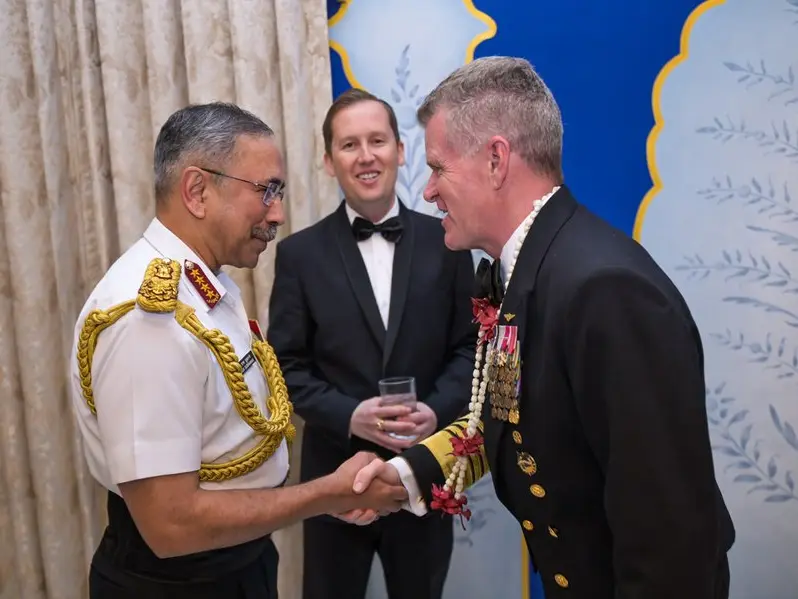
US ambassador to India Sergio Gor hosts Admiral Samuel Paparo, head of US Pacific Command, at the Roosevelt House in Delhi today. Photograph: (X/USAmbIndia)
The US may have dropped “Indo” from the name of its Pacific Command, but India’s military importance to Washington appears to be growing. From F-35s flying in India to joint drills and Admiral Samuel Paparo’s latest visit, here’s what is changing.
Admiral Samuel Paparo’s second visit to India in less than eight months carries a message extending well beyond another round of defence diplomacy. The commander of U.S. Pacific Command is in India from October 3 to 8, meeting India’s senior military leadership: Chief of Defence Staff General N. S. Raja Subramani, Chief of the Army Staff General Dhiraj Seth, and Vice Chief of the Air Staff Air Marshal Ashutosh Dixit.
Paparo was previously in India from February 14 to 19, 2026, when he met the then CDS General Chauhan and Navy Chief Admiral Tripathi, visited India's Western Command, and even toured India’s aerospace ecosystem in Bengaluru.
Paparo’s predecessor Admiral John Aquilino had visited India in 2021, 2023, and 2024, and Paparo has now made two visits in 2026 already.
India-US military ties move ahead
The visit follows another intensive period of India-US military engagement. In September, 600 Indian and 600 American troops trained together during Yudh Abhyas at Auli and Mahajan, including drones, autonomous systems, and multi-domain warfare.
Now American F-35 Lightning IIs are flying from Indian soil during Tarang Shakti 2026 at Jodhpur, alongside Indian and other foreign aircraft.
India is the only country that operates the Russian S-400 air defence system to have hosted F-35s participating in a flying multinational exercise on its territory. The distinction is glaring because the incompatibility between Russia’s S-400 and America’s F-35 was central to Washington’s decision to remove Türkiye from the F-35 programme. F-35s have never flown in Turkish airspace to date, even when Turkiye is a NATO member.
Trending Stories
)
)
)
)
)
)
)
)
)
)
)
)
)
)
)
)
)
)
)
)
)
)
)
)
)
)
)
)
)
)
)
)
)
)
&im=FitAndFill=(700,400))
)
)
)
)
'Indo' removed but India becomes increasingly crucial
In June, Washington restored the command’s historic name from U.S. Indo-Pacific Command to U.S. Pacific Command. Its area of responsibility did not change. It still extends to India’s western border, and its official mission remains maintaining a free and open regional theatre.
After the September Trump-Xi summit, the White House fact sheet explicitly stated that America’s forward military presence had preserved a “Free and Open Indo-Pacific.” China’s official list of eight summit deliverables contained no corresponding reference to a Free and Open Indo-Pacific.
The omission from China's side points to another strategic reality that, despite the red-carpet treatment offered to Xi, the U.S. and China remain divided over the 'Indo-Pacific'.
This enhances India's presence and regional role. Even as unresolved economic issues continue to loom over the India-US relationship, defence engagement is moving forward and driving the relationship.
The word “Indo” may have disappeared from the command’s name, but India becomes more central to America’s Pacific strategy.

