
&imwidth=800&imheight=600&format=webp&quality=medium "Indian officials held talks in Russia for semi-cryo rocket engine purchase")
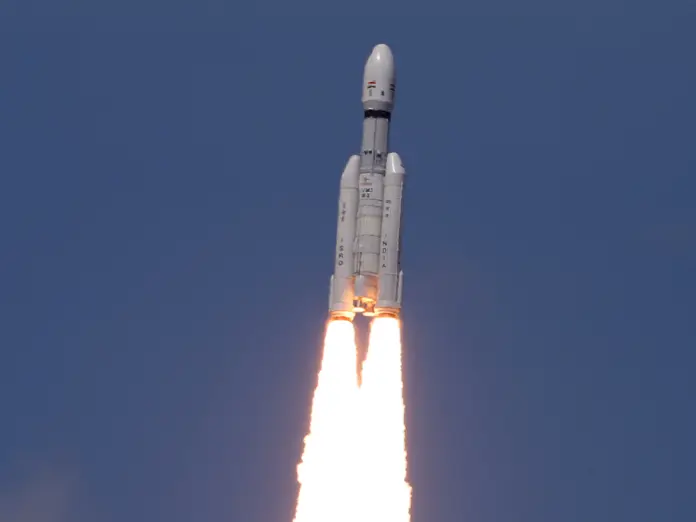
Officials from the Indian Space agency ISRO visited Moscow for technical discussions with Russian Space agency Roscosmos on the delivery of semi-cryogenic rocket engines; the draft contract is currently under the approval process, ISRO revealed in its Annual report for 2025-26. This is the first publicly available ISRO document that refers to the long-drawn process for procuring high-thrust rocket engines from Russia to enhance India's rocketry muscle power for lifting heavier payloads into space.
Recently, a report by India's Parliamentary Standing Committee on Science and Technology stated thatISROhas been allocated funds in 2026-27 for the "Induction of procuredSemi-cryogenic engine towards expediting the enhancement of LVM3 launch vehicle payload capability."
Neither the ISRO annual report nor the Parliamentary committee report specify semi-cryogenic engine variant ISRO would be procuring from Russia. Since the year 2023, this author has been reporting about the possibility of India procuring the 'RD-191'Semi-cryogenic engines from Russia, a longstanding strategic partner in sectors ranging from defence, nuclear energy, space technology, among others.

About the 'RD-191' rocket engine
The 'RD-191' is a high-performance rocket engine fuelled by Kerosene and Liquid oxygen. It falls under the category semi-cryogenic, as its fuel rocket-grade Kerosene can be stored at room temperature; and the oxidizer liquid oxygen has to be stored at super-cooled cryogenic temperatures(below -150degrees Centigrade).
Trending Stories
)
Why asking questions could be more important than memorising answers
)
Did India risk its US trade deal despite softer stance at BRICS?
&im=FitAndFill=(700,400))
How 2nm technology improves iPhone performance
&im=FitAndFill=(700,400))
Shahid Kapoor to Rajkummar Rao: Actors who rule both theatres and OTT
)
BRICS Summit 2026: Trump wants to weaken BRICS, but maybe doing the opposite
&im=FitAndFill=(700,400))
Meet top 5 batters fastest to 3000 runs in T20Is
)
Did BRICS Summit 2026 prove that an 11-member bloc with India and China in it can still agree on key issues?
)
Top 5 places to visit in Goa beyond its famous beaches
)
Delhi’s balancing act: BRICS serves as a stage for West Asia diplomacy
&im=FitAndFill=(700,400))
Why European Meteor missiles use ramjet engines compared to standard US solid rockets
)
'He is popular...': Malaysian PM Anwar Ibrahim's praise for PM Modi during bilateral meeting | WATCH
)
Iran, India agree to deepen humanitarian and political ties, President Pezeshkian says
)
‘Want to reset ties with India, have engagement based on mutual interests,’ says Bangladesh minister
)
BRICS Summit 2026: PM Modi, Xi reach key consensus on ties, China to assume BRICS chairmanship in 2027
)
UK breakup on the cards? Scotland, Wales and Northern Ireland push for independence
)
Russia-Ukraine-US talks in October? Kremlin says not ruling out possibility of trilateral
)
Trump says Canada eager to reach a deal, it could come ‘fairly soon’ if Ottawa treats US farmers better
)
The Verdict | Africa is too big to remain a guest at the BRICS table
)
‘Partners, not rivals’: Xi outlines four point plan for stronger India-China ties
&im=FitAndFill=(700,400))
Why Chinese PL-15 air-to-air missiles use dual-pulse motors compared to European interceptors
)
NATO under Russian threat? Drone strikes just 2 km from Poland, narrow escape for former UK PM, CIA chief
)
Who is the smiling man beside Modi, Putin and Xi at BRICS Summit 2026?
)
BRICS Summit: New Delhi declaration adopted with full consensus, big diplomatic win for India
)
800 million years old - Scientists discover 'fingerprints' of supercontinent Gondwana in ancient rocks
)
Russian drone hits Warsaw-bound train near Polish border, Zelensky accuses Moscow of ‘deliberate’ targeting
)
War is making Russia stronger? How Ukraine is shaping Moscow’s next generation of weapons
)
9-year-old Chennai prodigy clears Cambridge IGCSE grade 10 exams
)
Indian importers urge Bangladesh to lift export ban on 'Hilsa' fish ahead of Durga Puja
)
Humans may lose control of AI: Anthropic CEO calls for slowdown, Altman, Musk back him
)
US diplomat accused of possessing child abuse images secretly flown out of UK by US Marines
)
BRICS Summit 2026: Modi-Xi moment highlights India-China thaw at BRICS
)
Why does your skin need protection from UV rays?
&im=FitAndFill=(700,400))
From Rinku Singh to Mayank Yadav, 5 players dropped from India’s squad for Afghanistan T20Is
)
PM Modi and China's Xi offered to help resolve Russia-Ukraine war: Kremlin
)
Akram, Afridi, Mushtaq tear into PCB after Pakistan’s Test series collapse in UK
India's existing rockets are powered by engines that burn: solid-fuel, liquid-fuel, and cryogenic fuel (where liquid hydrogen and liquid oxygen are stored at super-cooled temperatures). Though efforts have been underway to develop a semi-cryogenic engine dubbed 'SE-2000', India does not possess a proven, flight-ready engine as of now. India may need years more to have its homegrownsemi-cryogenic engine 'SE-2000'.
Developed by NPO Energomash, the 'RD-191' is a workhorse engine used in Russia's Angara series of rockets. 'RD-191' is also a throttleable engine, which means that it can significantly reduce or increase its thrust mid-flight, a crucial capability that enables precise flight control, recovery and re-use of rocket stages. While Russia itself does not possesses reusable/vertical landing rockets, 'RD-191' offers some of the basic capabilities required in that regard.
The RD-191 is approximately two-and-a-half times more powerful than ISRO's workhorse Indo-French Vikas engine. While the Vikas engine delivers about 60-80tons of thrust, the 'RD-191' is known to deliver between 200-220 tons of thrust. First flown by India in 1993, the Vikas engine is the mainstay engine used in India's PSLV, GSLV, and LVM3 rockets. The Vikas engine is based on the French Viking-3 engine of the 1980s.
Why does India need the 'RD-191'?
Indian space agency ISRO's largest and most powerful homegrown rocket LVM3 can lift only 4,000-4,200kg to the Geosynchronous transfer orbit, which is a higher orbit into which communication satellites are launched. Likewise, the LVM3 is said to be capable of lifting around 8,000-10,000kg to Low earth orbit, which is about 500kms above the earth's surface. India's most powerful rocket LVM3 has a very modest lift capability, when compared to its global peers operated by Government-run space agencies or private firms.
India's rocketry muscle power deficiency has been evident on multiple occasions. In recent years, despite having its own rockets, India has had to pay foreign entities like Europe's Arianegroup and America's SpaceX to launch heavy satellites built in India. This was done because these satellites weighed much more than the maximum lifting capability of India's LVM3 rocket.
As India's growing space ambitions include the Gaganyaan human spaceflight programme(astronaut mission), proposed Bharatiya Antariksh Station(Indian crewed space station), envisioned crewed moon landing, the country is in dire need of more rocketry muscle power. Designing and developing all-new rockets and rocket engines could take decades or longer, which is why India is looking to purchase the powerful 'RD-191' engine from Russia.
How would India utilize the 'RD-191' engines?
While the Indian Space Research Organization(ISRO) wishes to design and develop powerful rockets for the future, India's immediate priority is to enhance the lifting capability of the LVM3. To accomplish this, ISROcan use the Russian 'RD-191' engine and associated systems to replace the existing L110 or second stage of the three-stage LVM3 rocket. This is one step towards significantly enhancing the lifting power of the LVM3 rocket.
The LVM3's lifting power can be further bolstered by using a more capable C32 Cryogenic upper stage developed in-house by ISRO. This would help ISROto launch satellites weighing around 4,500-5,000kg from home soil on its own rocket, while reducing dependence on foreign rockets.
In the foreseeable future, the LVM3 rocket powered by the Russian SemiCryogenic engine and the Indian C32 Cryogenic stage could be used for various missions that were earlier not possible for ISROdue to the rocketry muscle power deficiency.
ISRO's future rockets could potentially be designed and developed based on the capabilities offered by the 'RD-191' engine. In heavy-lift rocketry, multiple engines are used in a cluster to deliver high amounts of lifting power. Therefore, a single rocket would require a dozen or more engines. In such cases, production of the engine in India under licence would be a necessity. India and Russia have also been exploring the possibility of making the 'RD-191' in India, in partnership with industry.
