Indian govt defends Triple Talaq ban, says practice makes Muslim women’s condition pathetic

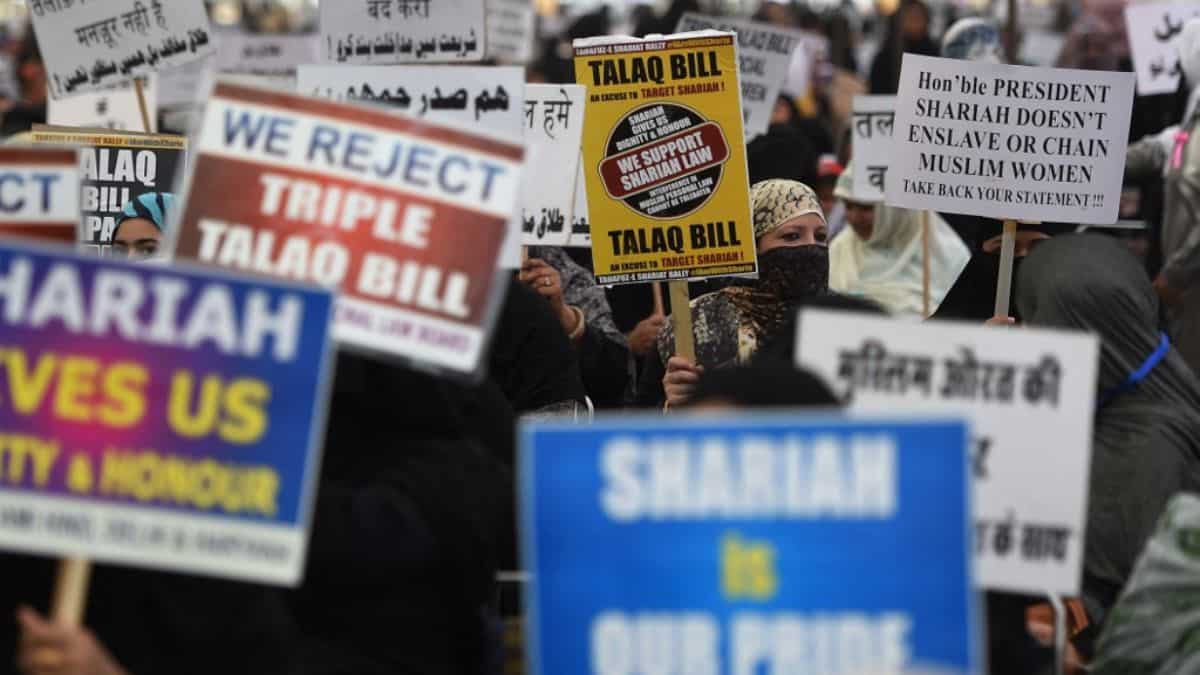
Triple Talaq
The Indian central government on Monday (August 19) claimed that 'triple talaq' was 'fatal' to the social institution of marriage as it defended its 2019 law criminalising the practice.
The need for the law
Responding to an affidavit challenging the law, the Union of India defended the law and said that while the nation's top court had set aside Triple Talaq (talaq-e-biddah) in 2017, it had "not worked as a sufficient deterrent in bringing down the number of divorces by this practice" among the members of the community.

It contended that the "Parliament in its wisdom has enacted the impugned Act to protect the rights of married Muslim women who are being divorced by triple talaq."
Furthermore, the Union government said in its affidavit that the act helps in ensuring "the larger constitutional goals of gender justice and gender equality of married Muslim women and helps subserve their fundamental rights of non-discrimination and empowerment."
)
No Pandya as Auqib Nabi earns maiden ODI call-up; Mayank returns for WI T20Is| check full squads
)
Pakistan boycotts chess match against Israel at Olympiad
)
240-million-year-old bizarre 'pig with a tusk' creature creates new dilemma over origin of dinosaurs
)
US Treasury rallies global financial institutions for Op Economic Outcast to isolate Iran
)
US House votes 417-3 to pass Ratepayer Protection Act targeting AI data center electricity costs
)
Katrina Kaif’s postpartum weight is not the problem; your gaze is
)
Europe wants a common playbook for security threats, seeks security beyond NATO
)
Wildfire tears through forests in Spain's Valencia
)
Trump praises India’s Opium crackdown, hails anti-drug efforts
)
Trump calls Canada-EU associate membership plan ‘laughable’ and threatens 'very serious tariffs'
)
All Indian goods to get duty-free access to New Zealand
)
'Hellish' wildfires burned through Europe for 300,000 years after supercontinent Pangea broke up
)
Want to get married within a year? Why 18 lakh people rush to Jaipur for ‘sacred henna’
)
Former OpenAI researcher warns of growing risks from Artificial Intelligence
)
Formula One reveals the 2027 race calendar; Monaco to host sprint race for the first time
)
India can scale up Finland’s circular solutions, minister Multala says
)
Laura Wolvaardt sets new world record for most WT20I runs in a year
)
Pakistan: Imran Khan's sons Kasim & Sulaiman claim their father is 'tortured' in jail
)
US trade tariff: 100% tariff targets Russian buyers amid trade tensions
)
Daayra movie review: Kareena Kapoor, Prithviraj Sukumaran shine in Meghna Gulzar’s cop-versus-cop crime thriller
)
‘Imagine 50 AI fighters cornering one manned jet’: India’s mobbing doctrine eyes a new era of air warm
)
Ebola outbreak: WHO sees encouraging signs in fight against Ebola outbreak
)
Veteran actor Anant Nag honoured with Indian cinema’s highest award
)
AUS vs SA: Steve Smith still gets 'little flashbacks' from sandpaper gate
)
Hong Kong unveils 11 new measures to boost birth rates, offers higher cash bonuses and housing perks
)
Saudi vs Houthis: Riyadh claims to have shot Houthi drone targeting Mecca
)
Bigg Boss 20: Mahhi Vij reveals she lost Yuva role to Kareena Kapoor; 'didn’t work out in my favour'
Mandakini breaks silence on Dawood Ibrahim photo: 'I was not invited by him'
)
Pakistan naval vessel returns to harbour with 'severe damage' after collision with Indian warship in Arabian Sea
)
Abhishek Sharma rises to No. 2 in T20Is; ENG’s Robinson 3rd after record Pakistan Tests
)
Pak batter Rizwan's petition against being questioned by cyber crime agency rejected by court
)
Fed raises rates for first time in 3 years, Kevin Warsh defies Trump as inflation mounts
)
The Early Spring season 2 is happening, but fans have one request - 'don't change the actors'
)
Saudi Vs Houthis: Yemeni military rebels clash with Houthis
&im=FitAndFill=(700,400))
Suriya and Jyothika say ‘I do’ again after 20 years! See their dreamy wedding pics
)
Protests erupt over migrant housing plan in Piddington
)
Former India player Diana Edulji wants Smriti Mandhana to replace Harman as skipper at the earliest
)
UN General Assembly 2026: What is veto power. Which countries have it and how does it work?
&im=FitAndFill=(700,400))
New OTT releases this week (September 14-20, 2026): Lust Stories 3, Waiting Hai, Irumudi- 5 new titles coming on Netflix, Prime Video and more
)
Lionel Messi for 2026 Ballon d’Or over Mbappe and Yamal, says Diego Simeone
)
Trump gets new power to hit India, China with up to 100% tariffs as US Senate clears Russia sanctions bill
)
Criticism of the law
Two Muslimorganisations, namely Jamiat Ulama-I-Hind and Samastha Kerala Jamiathul Ulema, have urged the Supreme Court of India to declare the Muslim Women (Protection of Rights on Marriage) Act, 2019 as "unconstitutional".
In its petition, Jamiat claimed that the criminalisation of talaq-e-biddah was discriminatory.
"Criminalising a mode of divorce in one particular religion while keeping the subject of marriage and divorce in other religions only within the purview of civil law, leads to discrimination, which is not in conformity with the mandate of Article 15," it said.
It also contended that the punishment for the offence was unfair.
"Section 7 of the Impugned Act makes the pronouncement oftalaq (having the effect ofinstantaneous divorce) a cognisable and a nonbailable offence. It is submitted that even offences like Kidnapping (Section363 of IPC) which are far graver are bailable."
Triple Talaq law
Under the Muslim Women (Protection of Rights on Marriage) Act, 2019, the practice of talaq-e-biddah or Triple Talaq, was made a penal offence punishable by a maximum sentence of up to three years of imprisonment.
Before that, in a landmark judgment, the Supreme Court had in 2017 held the practice "void" and "unconstitutional".
(With inputs from agencies)

