India | Tranquillised, translocated twice in 37 days: Sad plight of wild tusker ‘Arikomban’

‘Arikomban’ translocated
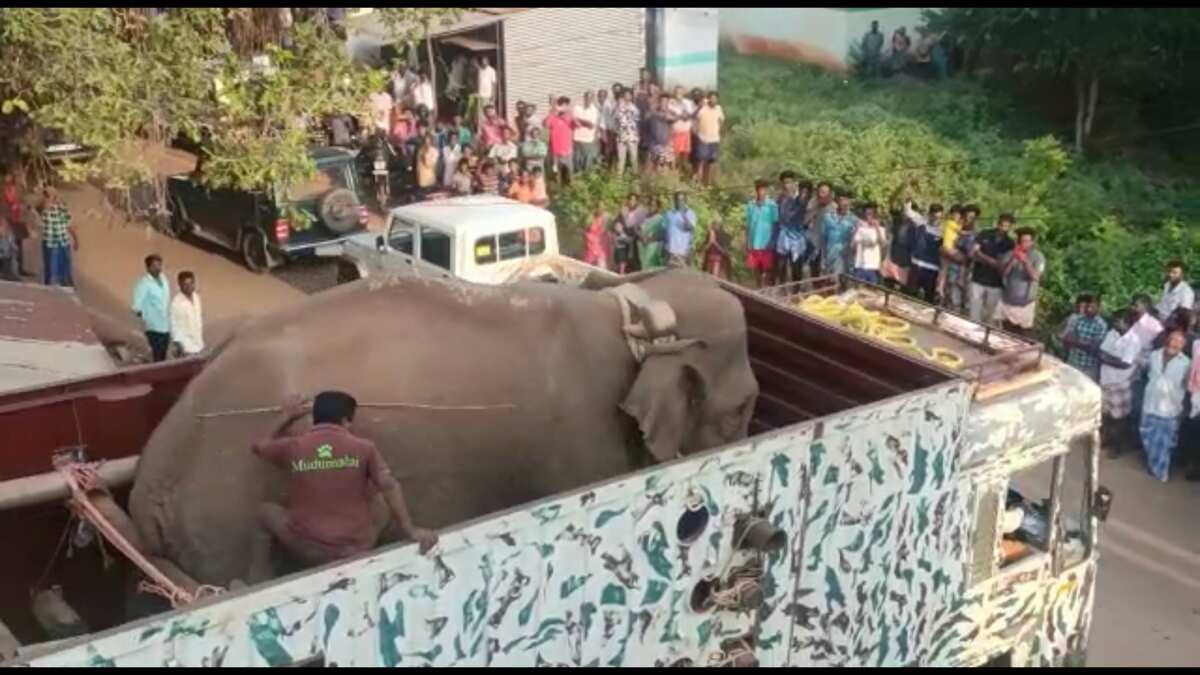
Thirty-seven days after he was first tranquillised, hauled onto a truck and translocated from his natural habitat in Kerala, 35-year-old wild tusker ‘Arikomban’ (rice-eating tusker in Malayalam) is now undergoing the same ordeal againin the adjoining state Tamil Nadu. This shows the irony of the situation, where human settlements in forests and forest fringe areas are on the rise, but in the name of “Conservation and Protection” wild animals are being translocated from their rightful home.
“Arikomban the wild tusker was safely tranquillised early hours today in Cumbum East Range by a team of Forest Veterinary Surgeons and Forest Department Officials. The elephant is being translocated to a suitable habitat where the Tamil Nadu Forest department will continue to monitor him,” Supriya Sahu, IAS, Additional Chief Secretary Environment Climate Change and Forests, Government of Tamil Nadu, had tweeted.

How the wild tusker became 'Arikomban'
The wild tusker's only innocent mistake is that he had developed a fondness for rice and began to raid ration shops and settlements to gorge on some carbs. While there are no recorded instances of violent actions by the tusker, it was claimed by the Kerala Forest Department that the tuskerkilled seven people in recent monthsnear his original habitat in Idukki.
There was also pressure from local residents to relocate the elephant. Based on this, it was proposed that the Kerala Forest Department would capture and turn 'Arikomban'(as he was popularly known among locals in Idukki) into a semi-wild, trained elephant (a cruel process meant to break the elephant's natural ways and make him a captive).
)
BRICS Summit 2026: Trump wants to weaken BRICS, but maybe doing the opposite
)
BRICS Summit 2026: PM Modi, Xi reach key consensus on ties, China to assume BRICS chairmanship in 2027
)
Trump defends Lincoln Memorial pool amid NYT report blaming renovation flaws, not vandalism
)
Indian importers urge Bangladesh to lift export ban on 'Hilsa' fish ahead of Durga Puja
)
War is making Russia stronger? How Ukraine is shaping Moscow’s next generation of weapons
&im=FitAndFill=(700,400))
Shahid Kapoor to Rajkummar Rao: Actors who rule both theatres and OTT
)
'80% of Indians are non-vegetarian': Rahul Gandhi slams BRICS Summit dinner menu, BJP calls it 'politics on food menu'
)
BRICS Summit 2026: Modi-Xi moment highlights India-China thaw at BRICS
)
800 million years old - Scientists discover 'fingerprints' of supercontinent Gondwana in ancient rocks
&im=FitAndFill=(700,400))
Meet top 5 batters fastest to 3000 runs in T20Is
&im=FitAndFill=(700,400))
Why European Meteor missiles use ramjet engines compared to standard US solid rockets
)
‘Partners, not rivals’: Xi outlines four point plan for stronger India-China ties
)
Did BRICS Summit 2026 prove that an 11-member bloc with India and China in it can still agree on key issues?
)
9-year-old Chennai prodigy clears Cambridge IGCSE grade 10 exams
)
Russian drone hits Warsaw-bound train near Polish border, Zelensky accuses Moscow of ‘deliberate’ targeting
)
US diplomat accused of possessing child abuse images secretly flown out of UK by US Marines
)
Russia-Ukraine-US talks in October? Kremlin says not ruling out possibility of trilateral
)
'He is popular...': Malaysian PM Anwar Ibrahim's praise for PM Modi during bilateral meeting | WATCH
)
Top 5 places to visit in Goa beyond its famous beaches
)
NATO under Russian threat? Drone strikes just 2 km from Poland, narrow escape for former UK PM, CIA chief
)
PM Modi and China's Xi offered to help resolve Russia-Ukraine war: Kremlin
)
Bigg Boss 20: Who Is Rohed Khan? Meet the Austrian actor from Bade Miyan Chote Miyan
)
BRICS Summit 2026: Russia-India-China grouping never formalised
)
‘Want to reset ties with India, have engagement based on mutual interests,’ says Bangladesh minister
)
The Verdict | Africa is too big to remain a guest at the BRICS table
)
Akram, Afridi, Mushtaq tear into PCB after Pakistan’s Test series collapse in UK
)
Humans may lose control of AI: Anthropic CEO calls for slowdown, Altman, Musk back him
)
'It’s going to be a war': Ben Shelton on facing Zverev in US Open title clash
)
From severe mobility problems to recovery: Madhuri the elephant’s journey of wildlife care
)
Trump says Canada eager to reach a deal, it could come ‘fairly soon’ if Ottawa treats US farmers better
)
UK breakup on the cards? Scotland, Wales and Northern Ireland push for independence
&im=FitAndFill=(700,400))
Why Chinese PL-15 air-to-air missiles use dual-pulse motors compared to European interceptors
)
Why does your skin need protection from UV rays?
)
BRICS Summit: New Delhi declaration adopted with full consensus, big diplomatic win for India
&im=FitAndFill=(700,400))
How 2nm technology improves iPhone performance
Following staunch opposition from activists and others who stated that the elephant was harmless and had not killed any humans, the Kerala High Court declared that the tusker would be translocated. Amid tight security, in the last week of April, the tusker was tranquilised, radio-collared and then translocated from Idukki to the Periyar Tiger Reserve(a drive of nearly 100 kms). While both locations are in Kerala, the Periyar Tiger Reserve is situated close to the Kerala-Tamil Nadu border.
Crossing over from Kerala to Tamil Nadu
Arikomban was released in the Periyar Tiger Reserve region on April 29th and by the first week of May, he had crossed over into the Megamalai range in Tamil Nadu's Theni district. Known to walk dozens of kilometres every day, wild elephants move across regions in search of food and water. Thanks to a radio collar around his neck, forest department officials from both Tamil Nadu and Kerala have been able to monitor the elephant's location in real time. In Tamil Nadu, Kerala's 'Arikomban'got an equivalent Tamil name "Arisi Komban"and he began to make forays into human settlements in his new habitat as well.
Earlier, forest officials from Theni in Tamil Nadu told WION that the radio collar placed on the elephant's neck is operational and the movement of the animal is being tracked both by radio telemetry and GPS.
Forest department teams have also advised those staying in the region to not venture out unnecessarily and particularly have been advised against venturing out late in the evenings. Forest department personnel are monitoring the elephant's movement round-the-clock and alerting those in the region, the official had said.
As the elephant started frequenting towns in Cumbum, the Tamil Nadu forest department decided to capture him again and relocate him deeper into the forests, into an undisclosed location on Monday.
Thereby, the entire process of tracking, tranquillisation, using trained 'kumki'elephants to haul the semi-conscious tusker onto the modified truck and then ferrying him away for release deep in the forest - all had to be carried out once again. While many see such translocations as a heroic effort, it must be remembered that translocations can have an adverse impact on the elephant's health and well-being.
WATCH WION LIVE HERE
You can now write for wionews.com and be a part of the community. Share your stories and opinions with us here.
