
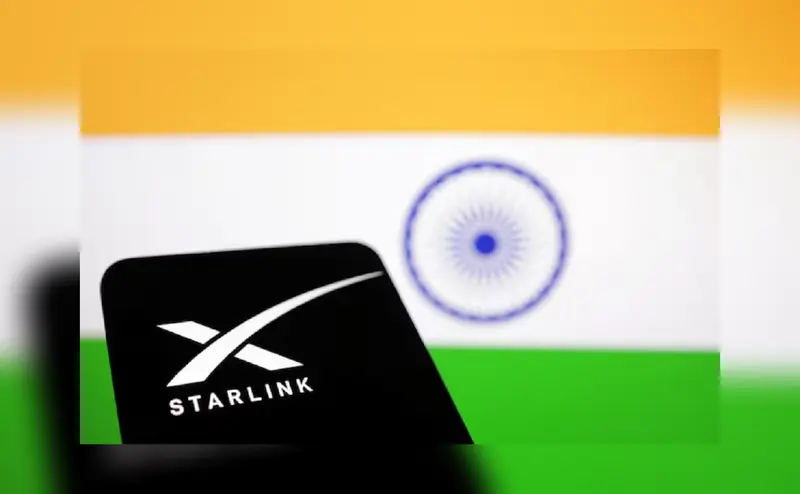
Elon Musk’s satellite internet company Starlink has received an approval from the Indian Government’s IN-SPACE, which is the promoter and facilitator for private space firms in the country. However, this approval is just one step in the list of multiple approvals that the firm still needs from various departments and ministries of the Indian government. Therefore, it could take several months before Starlink clears all hurdles and begins to offer its services in India. Starlink is learned to have been lobbying hard in India, using the political and economic clout of the controversial American billionaire.
Indian National Space Promotion and Authorisation Centre (IN-SPACE) has granted authorisation to M/s Starlink Satellite Communications Private Limited (SSCPL), New Delhi, for enabling provisioning of Low Earth Orbit (LEO) satellites constellation, namely Starlink Gen1. The authorisation will enable SSCPL to provide satellite communication services in India, IN-SPACE announced.
Going by the official announcement from the Indian Government, it appears that the IN-SPACE approval comes with conditions and safeguards. Firstly, the authorisation has been provided only for the Generation 1 constellation, which refers to the older generation of Starlink satellites and related heavier, not-so-portable communication antennae. Secondly, the IN-SPACE authorisation is granted for a period of five years from the date of authorisation (July 8th 2025) or the end of operational life of Gen1 constellation—whichever is earlier. Given the relatively short life of Starlink Gen1 satellites and the considerable time they have already spent in space, it is highly likely that the entire fleet of Generation1 would be defunct before the end of the approved five-year period, July 7th 2030.

The Starlink Gen1 Constellation is a global constellation with 4,408 satellites orbiting earth in altitudes between 540-570 km, and they are touted to be capable of providing ~600 Gbps throughput over India. Throughput refers to the total amount of data a satellite communication system can transmit and receive in a period of time.
Starlink has a more advanced constellation known as the Gen2 and also has the ability to offer direct satellite internet connectivity (marketed as Direct to Cell) to mobile phones. However, there is no mention of those being approved in India.
Starlink Satellite internet will not replace your home broadband
Trending Stories
)
Gaza under attack: Health chief's son killed in IDF strikes
)
Cochin shipyard starts building Indian Navy's next-gen missile vessels
)
Russia holds first parliamentary elections since the beginning of the Ukraine war
)
China may have gained access to US's classified F-35 jets; parts meant for repairs diverted to Hong Kong, sparking Pentagon inquiry
)
Mark Carney mimics Trump in hilarious moment over C$70 billion clean-energy investment; room erupts in laughter
)
9 women found dead near Johannesburg: South Africans rally, demand 'enough' to femicide
)
Pentagon revives mandatory testosterone testing for male troops aged 30 and above
)
Russia extends ban on Western food imports for two more years in extended sanctions countermeasure
)
Iran sets 7 conditions to end war with US: What are Tehran’s demands?
)
Flying cars in UAE: Ras Al Khaimah signs deal with Chinese company to test new transport
)
Africa is splitting, and a lot sooner than estimated, giving way to a new ocean
&im=FitAndFill=(700,400))
‘Not the US or China’: These are the countries leading the world in arable land
)
The Verdict | When precision fails: US commits war crime in Minab school strike, UN finds
)
FACT CHECK: Why did PM Modi ask Xi ‘is it okay’ at BRICS Summit? New video reveals...
)
‘Will go to any extent’: Pakistan vows to defend Saudi Arabia amid Houthi attacks
)
Trump defends AI amid growing alarm, announces new 'AI force' and promises an 'AI czar'
)
Reacher star Alan Ritchson opens up about alleged blackmail, suicide attempt during difficult period
)
Trump 2.0: Dark days ahead for America’s ‘imperial presidency’
)
Nigeria: Protesters take to the streets, police fire shots
)
Tirupati Laddu ghee adulterated with chemicals, says ED, supplier arrested
)
Arvind Kejriwal, family members, Delhi CM Rekha Gupta get SIR notices
)
Ed Sheeran addresses Macklemore's removal, Gaza conflict during Philadelphia concert: 'I cannot hide how I feel'
)
Brigitte Bardot’s private collection set for Paris auction; key items and prices revealed
)
Harry Brook targets long reign at top of T20I rankings after Sri Lanka sweep
&im=FitAndFill=(700,400))
How many F-35s does Britain, Japan and Israel have?
)
US-Iran war: Tehran draws red lines — seven demands before any peace talks
)
Trump wants to rename ‘Artificial Intelligence’, gives 3 options: Which one would you pick?
)
Trump announces ‘AI Force’ as debate grows over AI risks and regulation
66 years of the Indus Waters Treaty: How India and Pakistan settled a bitter river dispute
)
Raphinha hat-trick powers Barcelona to 3-1 win over Sevilla in La Liga
)
Trump bans CNN, MS NOW and Politico from White House over ‘FAKE NEWS’
&im=FitAndFill=(700,400))
Ananya Panday to Sharvari: 5 actresses serving major princess vibes
&im=FitAndFill=(700,400))
Meet top 5 Indian batters with fastest T20I centuries
)
How did an Australian river with 500 crocodiles pass the Olympic test? Here's how
)
Pak: A series of counter terrorism operations in Khyber Pakhtunkhwa
)
Starlink is not alone in wanting to gain access to the Indian satellite communications market. European firms Eutelsat OneWeb, SES are also in the race to foray into the Indian market. In recent months, IN-SPACE has also provided authorisations to the Indian subsidiaries of the aforementioned firms—OneWeb India Communications Private Limited, SES Satellites India Private Limited.
However, it must be emphasised that these satellite internet services are not meant to replace high-speed home broadband connections that are widely available in Indian cities at highly affordable monthly rates around Rs. 500 (approx $5.83) and upwards.
All these satellite internet providers are not targeting big cities, apartments or other institutions in urban centres. Instead, these satellites internet firms see business potential only in remote areas like mountains, deserts, islands, tough terrain etc., where traditional communication systems are weak and there is no reliable high-speed broadband connectivity and related infrastructure. Traditional high-speed broadband is available only in population dense regions where cables are laid and related infrastructure exists. Telecom firms do not install their infrastructure in remote and inaccessible regions with low population, because it becomes too expensive and unviable from a business perspective.
In the case of Starlink, the firm provides an antenna/receiver that can send and receive signals to and from satellites. The antenna can be installed on the rooftop or a window from where it has a direct and unobstructred view of the sky (satellites passing overhead). Gadgets can be connected to the internet router linked to the Starlink antenna and one can access the internet from almost anywhere on earth.
Satellite internet services are significantly more expensive than traditional wired broadband used in most homes. In case of Starlink, as seen in foreign countries, one must pay a one-time cost of around Rs.42780 ($499) for the antenna and then a monthly subscription cost of Rs. 2570 ($30) for the most affordable data plan. While Starlink has not announced its pricing for India, it is expected to be in the aforementioned range, considering how it is priced in similar nations.
By all means, home broadband that is available in Indian cities is significantly cheaper and faster than the speeds offered by the likes of Starlink. However, during times of disasters and emergencies when all traditional means of communication get affected, Starlink and related services can prove useful in cities as well.
