

&imwidth=800&imheight=600&format=webp&quality=medium "Data centres are not optional. So who's responsible for the damage? Part 2")
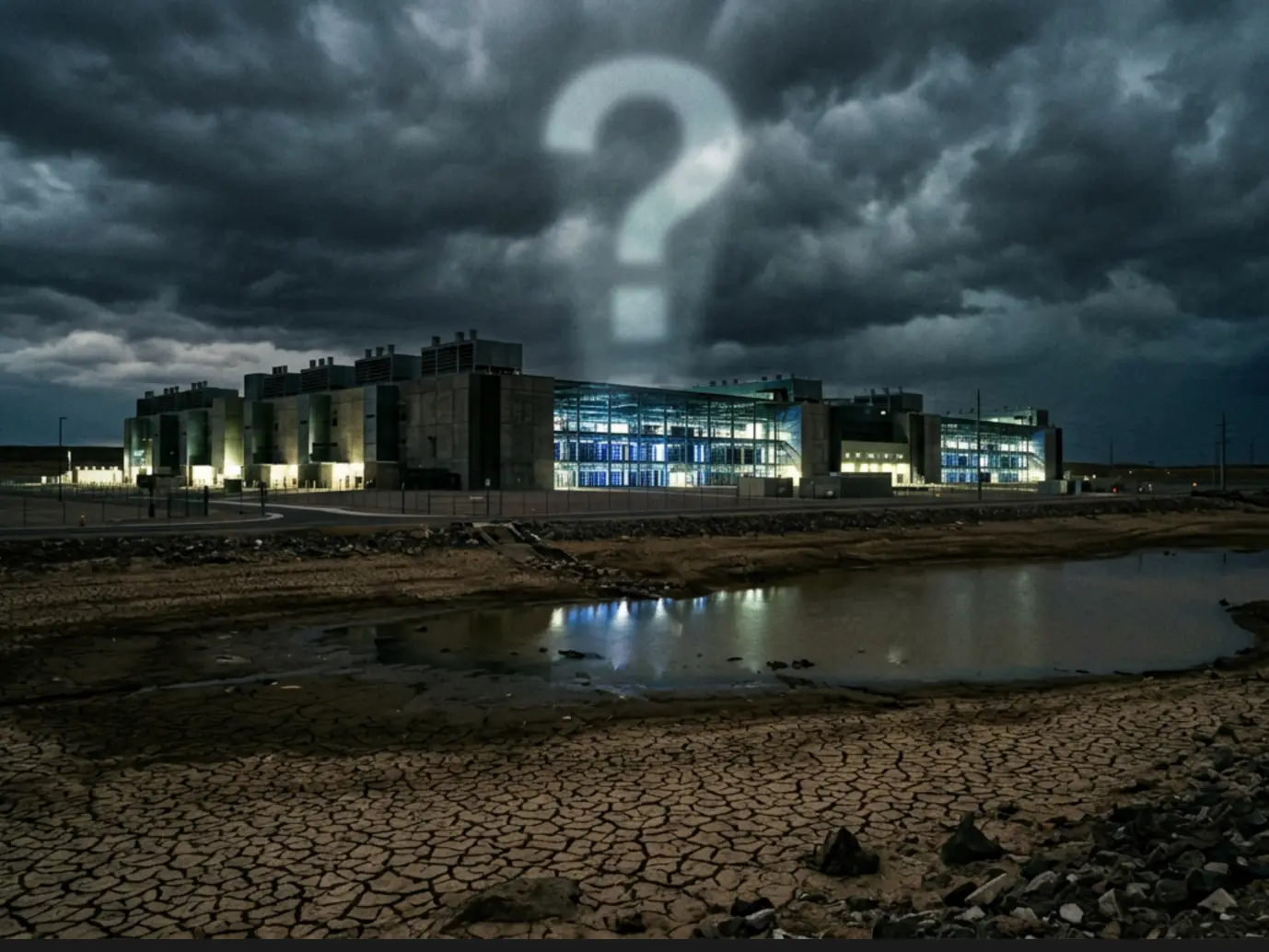
On April 28, 2026, at a sun-baked industrial plot in Tarluvada, Andhra Pradesh, Google broke ground on what it described as its largest investment in India's digital future. Union Minister Ashwini Vaishnaw was there. Chief Minister Chandrababu Naidu was there. So were representatives from Adani Group and Nxtra by Airtel, Google's infrastructure partners for the project. What nobody mentioned, at least not in any official statement, was water. The environmental clearance granted for the gigawatt-scale data centre park at Visakhapatnam did not disclose operational water use figures, according to Mongabay-India's reporting from May 2026. That omission is not an exception, but in India's data centre sector, it is the norm.
The price of the boom
India's data centres consumed approximately 150 billion litres of water in 2025, according to Mordor Intelligence, a figure corroborated by the Council on Energy, Environment and Water. By 2030, that figure is projected to reach 358.66 billion litres, a compound annual growth rate of over 19 per cent. A single 100-megawatt facility can draw roughly two million litres a day for cooling, according to Dialogue Earth. University of California researchers found that generating a 100-word email through an AI model consumes between 200 and 1,500 millilitres of water, a figure that scales to the volume India's AI user base generates daily. According to WRI India's mapping, more than half of India's approximately 271 data centres are already located in water-stressed regions. An S&P Global study projects 60 to 80 per cent of India's data centre facilities could face high water stress before the end of this decade.
The cities carrying the weight
Bengaluru's data centres consume over 26 million litres of water annually, according to Dialogue Earth, in a city that recently faced what researchers described as its worst water crisis in nearly five centuries. Hyderabad faces a projected water deficit of 870 million litres per day by 2027, yet hyperscalers continue to expand operations there. Chennai reached a point in 2019 where its main reservoirs ran completely dry. Delhi, Bengaluru, Chennai, and Hyderabad are all projected to face severe groundwater depletion by 2030, per NITI Aayog's Composite Water Management Index, a report that also found approximately 600 million Indians already face high-to-extreme water stress. India holds four per cent of the world's freshwater while supporting 18 per cent of its population, according to World Bank and NITI Aayog data. The WRI Aqueduct Water Risk Atlas ranks India 13th among the world's most water-stressed nations.
The governance gap
Trending Stories
&imwidth=180&imheight=135&format=webp&quality=medium)
Blasts heard in Sanaa as Saudi-led coalition warns civilians to evacuate; Houthis vow retaliation
&imwidth=180&imheight=135&format=webp&quality=medium)
China's counter-surveillance industry booms amid heightened espionage fears | Gravitas
&imwidth=180&imheight=135&format=webp&quality=medium)
Saudi Arabia strikes Yemen oil sites as Houthi missiles target Riyadh; 'limited fire' breaks out at Aramco
&im=FitAndFill=(700,400)&imwidth=180&imheight=135&format=webp&quality=medium)
Navratri 2026: 9 days, 9 forms of Goddess Durga and 9 colours- Check the complete list
&imwidth=180&imheight=135&format=webp&quality=medium)
Trump accuses Houthis of driving up oil prices before US midterms, warns of consequences
&imwidth=180&imheight=135&format=webp&quality=medium)
New Delhi rejects Beijing’s claims and remarks on Ladakh location naming exercise
&imwidth=180&imheight=135&format=webp&quality=medium)
US Midterms 2026: In Alaska, cost-of-living anxiety meets strangest ballot in high-stakes Senate race
&imwidth=180&imheight=135&format=webp&quality=medium)
CMs Vijay-Naidu meet in Vijayawada, discuss water sharing, river-linking
&imwidth=180&imheight=135&format=webp&quality=medium)
'Don't ever mess with nature!': Trump’s tiger attack post triggers social media backlash as victim's family issues heartbreaking tribute
&imwidth=180&imheight=135&format=webp&quality=medium)
OpenAI employee arrested by FBI after allegedly hiding recording device in office
&imwidth=180&imheight=135&format=webp&quality=medium)
1,500 drones illuminate Mumbai sky as Cordelia Cruises unveils second ship, Cordelia Sky
&imwidth=180&imheight=135&format=webp&quality=medium)
Ranabaali: Vijay Deverakonda, Rashmika Mandanna film gets U/A certificate with zero cuts
&imwidth=180&imheight=135&format=webp&quality=medium)
Delhi Police arrest Cockroach Janta Party's Saurav Das, Ashutosh Ranka, Ajinkya Shinde in Jantar Mantar case, to be produced before court
&imwidth=180&imheight=135&format=webp&quality=medium)
Pope Leo XIV diagnosed with lung cancer after surgery, Vatican says 'successful surgery and recovering'
&imwidth=180&imheight=135&format=webp&quality=medium)
Pakistan to chair UN-backed global Borrowers’ Platform as its own debt burden mounts, triggers sarcastic reactions on social media
&imwidth=180&imheight=135&format=webp&quality=medium)
Suicidal man survives jump from 11th floor in Japan, could now be tried for murder
&imwidth=180&imheight=135&format=webp&quality=medium)
Robot gropes girl, makes thrusting movements in bizarre crime in Germany
&imwidth=180&imheight=135&format=webp&quality=medium)
France accuses Musk of ‘online harassment’ of European leaders, warns of poll interference
&imwidth=180&imheight=135&format=webp&quality=medium)
MI5 chief warns Russia is UK’s ‘aggressor number one’ as Iran and AI threats grow
&imwidth=180&imheight=135&format=webp&quality=medium)
'Turn approver, resign, we'll forgive you': Rahul Gandhi claims receiving messages from CEC Gyanesh Kumar
&imwidth=180&imheight=135&format=webp&quality=medium)
Trump reconsidering calling off Nidal Hasan's execution livestream. Here's why
&imwidth=180&imheight=135&format=webp&quality=medium)
‘My president, I mean my husband’: Trump's new press secretary Katie Zacharia's first briefing goes off the rails in 14 minutes
&im=FitAndFill=(700,400)&imwidth=180&imheight=135&format=webp&quality=medium)
IMF World Economic Outlook: 10 economies to watch for growth in FY27 and FY28 - Where does India stand?
&imwidth=180&imheight=135&format=webp&quality=medium)
Marco Rubio to visit India next week, focus on energy cooperation and strategic ties
&imwidth=180&imheight=135&format=webp&quality=medium)
Is the AI chip boom already over? Global semiconductor stocks slide as investors question unbridled spending
&imwidth=180&imheight=135&format=webp&quality=medium)
L Murugan resigns as Union Minister, expresses wish to return to grassroots
&imwidth=180&imheight=135&format=webp&quality=medium)
'Ouch!!! That must hurt': Kangana Ranaut hails Kamal Haasan's sharp reply to Elon Musk over Starlink row
&imwidth=180&imheight=135&format=webp&quality=medium)
Girl 'dead' for 8 hours wakes up at her own funeral, dad insists she wasn't breathing
&imwidth=180&imheight=135&format=webp&quality=medium)
Sidhu Moose Wala’s younger brother wins hearts by recreating late singer’s signature move at Toronto Hologram Show
&imwidth=180&imheight=135&format=webp&quality=medium)
UK school ditches technology, shifts from screen to pen and paper for learning
&im=FitAndFill=(700,400)&imwidth=180&imheight=135&format=webp&quality=medium)
New OTT releases this week (October 12-18, 2026): Sacrifice, Koffee with Karan S9, Roadies Rebirth- 6 titles coming on Netflix, JioHotstar and more
&imwidth=180&imheight=135&format=webp&quality=medium)
Anupam Kher joins Ranbir Kapoor's Ramayana as Jatayu, new poster unveiled
&imwidth=180&imheight=135&format=webp&quality=medium)
Measles kills again: 6 dead in Pennsylvania as America faces its worst outbreak in decades | Gravitas
&imwidth=180&imheight=135&format=webp&quality=medium)
Ken Paxton's Dubai night out with two US fugitives sparks political storm as Texas Senate race tightens
&imwidth=180&imheight=135&format=webp&quality=medium)
Mundhe: Fight against unsafe food goes on
&imwidth=180&imheight=135&format=webp&quality=medium)
Cornell University suspends fraternity parties over 2024 gang rape allegations
MeitY's Draft National Data Centre Policy was first circulated in 2020. As of June 2026, it has not been formally notified. The draft proposed infrastructure status, single-window clearance, and Data Centre Economic Zones, all of which the industry has since received through budget announcements and state-level policies. What it did not include, and what remains absent from India's data centre governance framework today, is a single binding environmental performance requirement.
A joint study by CEEW and SYSTEMIQ published in February 2026 found that water risk in India's data centre sector is being systematically underestimated, with many stakeholders continuing to treat it as manageable despite documented structural stress. Most large Indian data centre operators are privately held, placing them outside SEBI's Business Responsibility and Sustainability Reporting framework that mandates ESG disclosures for listed companies. "The Draft Data Centre Policy 2020, while articulating noteworthy objectives and incentives, lacked enforceable legal mandates," noted BW Legal World. Six years later, that assessment remains accurate.
What the industry is doing, and not doing
Schneider Electric, one of the world's largest suppliers of cooling and energy management systems for data centres, ranked first in Sustainability Magazine's Top 250 Most Sustainable Companies report for 2025. The company has committed to saving or avoiding 1,500 terawatt-hours of customer energy use between 2026 and 2030. On the critical question of AI data centre water consumption, Tuan Hoang, Head of Cooling Technology and Product Development at Schneider Electric, stated at a press event reported by Sustainability Magazine in May 2026 that closed-loop liquid cooling can reduce AI data centre water consumption by approximately half, and that water consumption for data centres is ultimately "a choice, a geographical choice dependent on power, land and what is required." Through its acquisition of Motivair, Schneider now offers what it describes as the industry's first end-to-end liquid cooling portfolio built specifically for AI data centre workloads.
The technology, in other words, exists. Schneider Electric is supplying cooling infrastructure to some of the fastest-growing data centre markets in India, where no binding Water Use Effectiveness standard currently exists. The company did not provide a spokesperson for this story. What Schneider has publicly advocated for in global markets, mandatory WUE benchmarks, closed-loop systems, and water-neutral design, it has not advocated for publicly in India. That gap, in a country building gigawatts of data centre capacity with no WUE requirement, is worth noting.
Also read: US 'violates MoU', launches fresh strikes on Iranian targets after attacks on vessels in Hormuz
Yotta Data Services, one of India's largest data centre operators, reported revenues of ₹901 crore in FY2025 with a 94 per cent revenue CAGR. The company has made some of the more forward-looking public statements in the sector, claiming to deliver 100 percent green power to customers, committing to run fully on renewables through solar, wind, onsite hydrogen co-generation and fuel cells, and stating that "the industry's real direction is water-neutral data centres, air-cooled plus liquid-cooled plus closed-loop systems, not water-cooled towers," as reported by Down to Earth. Yotta's CEO Sunil Gupta has also publicly noted that global social media and internet platforms have historically avoided hosting in India despite 30 to 40 per cent of their global users being Indian, a data sovereignty gap the Union Budget 2026-27 tax holiday for foreign cloud operators is now beginning to address.
What Yotta has not done is publish independently verified water or energy consumption data. As a private company, it falls outside SEBI's mandatory BRSR disclosure framework. Unlike Nxtra by Airtel, it has not released a public sustainability report with specific consumption figures. The CEEW-SYSTEMIQ study found this to be a sector-wide problem; most large private operators in India have no binding obligation to disclose resource use, making it impossible to distinguish genuine sustainability commitments from unverified claims. Down to Earth's investigation into India's data centre water transparency, published in November 2025, found that companies in this sector routinely claim recycled water usage without disclosing how much clean water they continue to withdraw alongside it. Yotta's public commitments are among the more ambitious in the Indian market. Without verified figures, they cannot be independently assessed.
How the market is moving, and what needs to change
Not every signal points in the wrong direction. "The way data centre locations are being evaluated has changed significantly over the last two to three years," said Gautam Saraf, Executive Managing Director, Mumbai and New Business at Cushman & Wakefield, which advises hyperscalers, operators, and investors on data centre strategy across India. "Earlier, the focus was primarily on demand concentration, latency requirements, fibre connectivity and land availability. Today, location selection is increasingly a resource availability decision." Saraf told WION that water availability is gaining weight in site selection decisions, with growing emphasis on treated water and recycling, and that operators are increasingly evaluating Tier II cities and planned industrial parks where grid connectivity can be secured six to twelve months faster than in congested metros.
Nxtra by Airtel has put numbers behind its commitments. According to its FY2024-25 Sustainability Report, the company contracted 482,800 MWh of renewable energy, three times its 2021 baseline, improved average Power Use Effectiveness by 10 per cent since FY2021, and recycled 15,329 kilolitres of water through advanced sewage treatment systems. It also became the first Indian data centre operator to deploy hydrogen-ready fuel cell technology through a partnership with Bloom Energy. On cooling strategy, Nxtra has stated: "There is also an impact on sustainability if all data centres start consuming too much water to facilitate only liquid-based cooling infrastructure. Hence a more mature approach would be to adopt a mix of cooling strategies based on the type of IT architecture required," as reported by Capacity Global. Speaking during Airtel's Q4 FY2026 earnings webinar on May 14, 2026, Gopal Vittal, Executive Vice Chairman of Bharti Airtel, said: "Our data centers are being built with the latest technologies in terms of cooling capabilities, power efficiency and also a standard toolkit on the build out, which is really world class."
What needs to happen
Three interventions would materially change the trajectory of this sector without impeding India's legitimate infrastructure ambitions. First, a formally notified national data centre policy with binding WUE and PUE benchmarks, not a draft that has been in circulation for six years. Second, mandatory water and energy disclosure for all operators above a defined capacity threshold, regardless of listing status, closing the exemption that currently covers most of the sector. Third, Data Centre Economic Zones with environmental standards built into site approvals at the planning stage, not layered on after construction begins.
CEEW articulated the governing logic in January 2026: "Integrating data centres into energy, water, and land-use planning can help turn sectoral growth into a sustainable digital asset rather than a systemic risk."
India holds real leverage in this negotiation. Microsoft, Google, and the Adani Group have committed hundreds of billions of dollars to build infrastructure on Indian soil. They need India's market, its data localisation requirements, and its sovereign cloud opportunity. As Gopal Vittal noted during Airtel's Q4 FY2026 earnings webinar, "A lot of workloads do need a sovereign requirement. We are fully sovereign, the control plane, the data plane, the jurisdiction, all of it is in India."
That sovereignty is India's strongest card at the negotiating table. It should use it, not just to attract investment, but to set the terms on which that investment is built, operated, and held to account.
The infrastructure is non-negotiable, and so is the damage; thus, India cannot afford to ignore either.
READ PART 1: The Big Data Centre Debate: Are They Optional? - Part 1, it establishes why India cannot stop building this infrastructure and who is already depending on it. (Please insert this link here: https://www.wionews.com/technology/the-big-data-centre-debate-are-they-optional-1783153694054)
WION sought comments from Schneider Electric India and Yotta Data Services. Neither provided spokesperson responses before publication; if the copy is received, it will be updated.
