'Another significant milestone': Rajnath Singh hails successful test of indigenous Pralay missile


DRDO successfully test-fires Pralay missile off Odisha coast
India successfully flight-tested its indigenously developed Pralay missile off the Odisha coast. DRDO said the November 5 trial met all stipulated objectives. Rajnath Singh hailed the achievement as another significant milestone in strengthening India's indigenous defence capabilities.
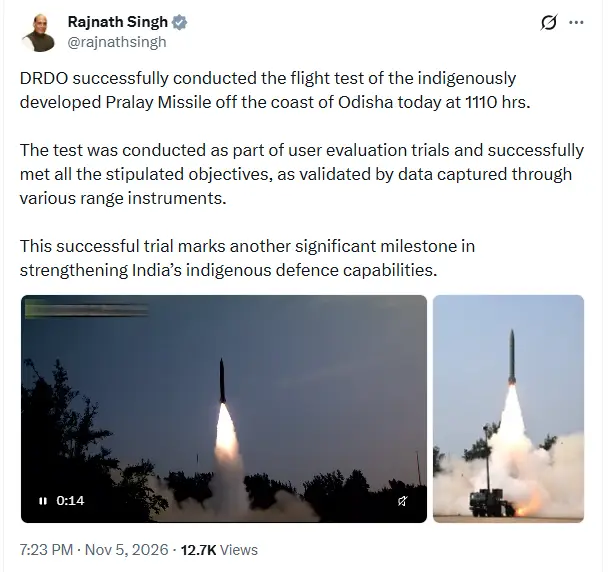
Defence Minister Rajnath Singh on Thursday (Nov 05) announced that DRDO had successfully flight-tested the indigenously developed Pralay missile off the Odisha coast at 1110 hrs. In a post on X, Singh said the test was conducted as part of user evaluation trials and met all stipulated objectives, as validated by data captured through various range instruments.
"This successful trial marks another significant milestone in strengthening India's indigenous defence capabilities," he wrote.
Also read | India's Agnipath revamp: Agniveers get two-year extension and a chance to join the Indian Army
Indigenous Pralay flight-test
The Defence Research and Development Organisation conducted the flight test of the quasi-ballistic missile from Dr APJ Abdul Kalam Island off the Odisha coast at around 1110 hrs on November 5, 2026. All test objectives were fully met, confirmed by data captured by range instruments deployed by the Integrated Test Range, Chandipur.
Trending Stories


Research Centre Imarat, Hyderabad, along with other DRDO laboratories, developed the missile indigenously. Bharat Dynamics Limited, one of the development-cum-production partners, produced the system. The test was conducted in the presence of senior DRDO officials, industry representatives and Defence Forces personnel. With this success, the induction of the system has become imminent.
India's Pralay missile specifications
- Type: Short-range, canisterised, solid-propellant quasi-ballistic missile
- Manoeuvrability: Unlike traditional ballistic missiles, Pralay follows a low-altitude trajectory and can change direction mid-flight, making it difficult for enemy air defence systems to intercept
- Range and payload: Operates at 150 to 500 km depending on warhead weight. It can carry a 1,000 kg payload up to 350 km or a lighter 500 kg payload to its maximum 500 km range.
- Mobility and precision: Launched from a mobile canisterised launcher for rapid deployment, with advanced inertial navigation and guidance systems for high-precision strikes against radar installations, command centres and airfields.

