

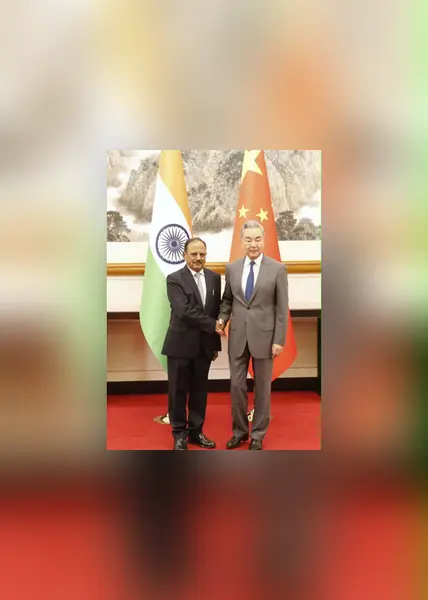
India and China India held the 25th meeting of the special representatives on the China-India boundary question in Beijing on Tuesday (August 25), with both sides holding comprehensive and candid discussions on the long-standing border issue, bilateral relations and regional and international developments. China's Special Representative Wang Yi, Member of the Political Bureau of the CPC Central Committee and Director of the Office of the Central Foreign Affairs Commission, met India's Special Representative and National Security Adviser Ajit Doval for the talks.
The meeting comes as New Delhi and Beijing continue efforts to stabilize bilateral relations and maintain peace along the disputed border. The Chinese Foreign Ministry had earlier said the talks would focus on advancing communication on the boundary question, maintaining peace and tranquility in border areas, and discussing bilateral and international issues.
Wang Yi Calls for strategic and long-term approach.
Wang Yi said China and India are important neighbours and major developing countries, arguing that stable bilateral relations serve the interests of both populations and have significance beyond the two countries. "China and India are important neighbours and representatives of major developing countries and emerging economies. The healthy and stable development of China-India relations is in the fundamental interests of both peoples, meets the common aspirations of countries in the Global South, and aligns with the trend of the times. China-India relations have transcended the bilateral scope and possess global and strategic significance."
Wang referred to meetings between Chinese President Xi Jinping and Indian Prime Minister Narendra Modi in Kazan and Tianjin, saying the two leaders had reached important understandings that provided direction for improving bilateral ties. He said China is prepared to work with India from a strategic and long-term perspective, strengthen communication, improve mutual understanding and manage differences. "China is willing to work with India to grasp bilateral relations from a strategic and long-term perspective, strengthen communication, enhance understanding, eliminate differences, overcome obstacles, and be good-neighborly and friendly friends and mutually beneficial partners, achieving a harmonious coexistence between the dragon and the elephant."
Trending Stories
&imwidth=180&imheight=135&format=webp&quality=medium)
100,000 strikes in 3 years: How October 7 redefined Israel's war
&imwidth=180&imheight=135&format=webp&quality=medium)
Lula campaign accuses Meta of election interference after social media content blocked
&imwidth=180&imheight=135&format=webp&quality=medium)
‘Your people don’t even let us near it’: IAF chief’s blunt response on US F-35; India yet to decide on Russia’s Su-57
&imwidth=180&imheight=135&format=webp&quality=medium)
Real or fake? PIB fact-checks protest videos; Delhi Police clarifies on Gurdwara Bangla Sahib clip
&imwidth=180&imheight=135&format=webp&quality=medium)
UK navy hit by espionage scandal: Sailor accused of spying for Russia | Gravitas
&imwidth=180&imheight=135&format=webp&quality=medium)
Saudi Arabia's King Khalid International Airport attack kills 12, injures 309; India calls it 'unacceptable'
&imwidth=180&imheight=135&format=webp&quality=medium)
‘Never-ending flow of cheap labour’: JD Vance hits back at Indian-origin Congresswoman over US green card curbs for major tech companies
&imwidth=180&imheight=135&format=webp&quality=medium)
Panama president declares ‘major disaster’ after powerful 7.7-magnitude earthquake; over 80 aftershocks recorded
&imwidth=180&imheight=135&format=webp&quality=medium)
HYBE’s Weverse Con India sets ticket sale date for March 2027 festival
&imwidth=180&imheight=135&format=webp&quality=medium)
'Jantar Mantar not the story of India': BJP's Sambit Patra claims 'anarchists' tried to hold Delhi captive
&imwidth=180&imheight=135&format=webp&quality=medium)
Riyadh airport hit in missile attack, dozens injured; 5 in intensive care
&imwidth=180&imheight=135&format=webp&quality=medium)
Nicolas Cage refuses AI waiver for Spider-Noir, hints at Amazon exit and True Detective role
&imwidth=180&imheight=135&format=webp&quality=medium)
'Spent Rs 2,000 cr to elect Trump': Elon Musk bought US President's loyalty by writing the biggest political cheque in human history
&imwidth=180&imheight=135&format=webp&quality=medium)
Powerful 7.7 magnitude earthquake strikes Panama, tsunami warning issued
&imwidth=180&imheight=135&format=webp&quality=medium)
US mid-term elections: What are PACs - Unique American System that lets corporates shape voting
&imwidth=180&imheight=135&format=webp&quality=medium)
Elon musk & India clash over Starlink's market entry terms
&imwidth=180&imheight=135&format=webp&quality=medium)
Who is Ajinkya Shinde, announced to lead CJP protest after Dipke, Das and Ranka's detention?
&imwidth=180&imheight=135&format=webp&quality=medium)
'Ouch!!! That must hurt': Kangana Ranaut hails Kamal Haasan's sharp reply to Elon Musk over Starlink row
&imwidth=180&imheight=135&format=webp&quality=medium)
Hamas used double agents, deceived Israel to carry out October 7 massacre
&imwidth=180&imheight=135&format=webp&quality=medium)
Bigg Boss 20: Who is Manish Goel? Meet the new wild card contestant on Salman Khan’s show
&imwidth=180&imheight=135&format=webp&quality=medium)
Portugal Federation confirms Cristiano Ronaldo’s return to national team despite suspension
&imwidth=180&imheight=135&format=webp&quality=medium)
All 22 Indian seafarers safe in attack on Panama-flagged tanker off UAE coast
&imwidth=180&imheight=135&format=webp&quality=medium)
‘Time for Ukraine to get a new president’: Trump lashes out at Zelensky over Russia strikes
&im=FitAndFill=(700,400)&imwidth=180&imheight=135&format=webp&quality=medium)
Food shortages, suicide attempts and more: USS Abraham Lincoln returns to US after 321 day deployment — What happened aboard the US carrier?
&imwidth=180&imheight=135&format=webp&quality=medium)
Thai queen becomes first reigning monarch to fly jet solothailand #queen #wion
&imwidth=180&imheight=135&format=webp&quality=medium)
Four years, 3 licenses, zero launch: Why is Elon Musk’s Starlink still struggling to crack Indian market? EXPLAINED
&imwidth=180&imheight=135&format=webp&quality=medium)
Rahul Gandhi calls Modi, Shah ‘cowards’ amid CJP protest crackdown in Delhi
&imwidth=180&imheight=135&format=webp&quality=medium)
‘Every game against Liverpool is special’: Erling Haaland ahead of Anfield clash
&imwidth=180&imheight=135&format=webp&quality=medium)
Why was CJP founder Abhijeet Dipke detained? What Delhi Police said
&imwidth=180&imheight=135&format=webp&quality=medium)
Where are Abhijeet Dipke, Ashutosh Ranka, Saurav Das? CJP gives big update after flight detention
&imwidth=180&imheight=135&format=webp&quality=medium)
Putin conveys Iran’s proposal to Trump, offers to take Tehran’s enriched uranium
&imwidth=180&imheight=135&format=webp&quality=medium)
'It’s been 12 hours': CJP writes to Delhi Police, demands release of Dipke, Saurav Das and Ranka
India and China discuss border management
Wang said the two sides are implementing understandings reached during previous Special Representatives' meetings and that institutionalized exchanges and cooperation are gradually resuming. He also said both countries remain committed to maintaining peace and tranquility in border areas. "Both sides should learn from historical experience, place the border issue in its proper place within bilateral relations, and move forward without stagnation, regression, or deviation, gradually building a positive narrative on China-India border affairs, making dialogue, peace, consultation, and cooperation the mainstream, and injecting positive factors into the healthy and stable development of bilateral relations."
The talks covered border demarcation negotiations, border control, institutional mechanisms and cross-border cooperation. Earlier this month, the two countries' Working Mechanism for Consultation and Coordination on India-China Border Affairs also discussed demarcation, border management, mechanisms and cross-border cooperation while preparing for the 25th Special Representatives' meeting.
Doval says India and China are partners, not competitors
Ajit Doval emphasized the importance of stable and predictable relations between the two Asian powers. "India and China are both ancient civilizations, populous nations, and important economies, and are partners, not competitors. Developing a stable, predictable, and forward-looking India-China relationship is in the common interest of both peoples and is of great significance to Asia and the world."
Doval said relations between the two countries had returned to a positive trajectory under the guidance of their leaders and noted that border areas had remained broadly peaceful. “Under the guidance of the leaders of both countries, India-China relations have returned to the right track, border areas have maintained overall peace, and exchanges and cooperation in various fields have steadily progressed.” He added that India is ready to strengthen strategic communication, expand mutually beneficial cooperation, deepen multilateral coordination and improve management of border areas.
"India is willing to further strengthen strategic communication with China, expand mutually beneficial cooperation, deepen multilateral collaboration, effectively manage border areas, explore solutions to border issues, and promote the accelerated improvement and development of India-China relations."
Both sides reaffirm 2005 political guiding principles
During the meeting, China and India discussed ways to advance negotiations on boundary demarcation and strengthen mechanisms for maintaining stability along the frontier. Both sides reaffirmed their commitment to the political guiding principles agreed in 2005 and agreed to use the Special Representatives mechanism to pursue a fair, reasonable and mutually acceptable comprehensive settlement of the boundary question. They also agreed to continue addressing differences through dialogue and consultation while jointly maintaining peace and tranquility along the border.
26th Special Representatives meeting to be held in India next year
A key outcome of the meeting was an agreement to hold the 26th meeting of the Special Representatives on the China-India Boundary Question in India in 2027. The decision signals that both sides intend to maintain the Special Representatives mechanism as a key channel for negotiations and strategic communication on the boundary issue. The Chinese Foreign Ministry has described the Special Representatives talks as the principal channel for China-India boundary negotiations and an important platform for discussing issues of mutual interest. The two sides also exchanged views on international and regional issues of common concern.
‘The Chinese border is our most important border’: MJ Akbar
On SR-level talks between NSA Ajit Doval and Chinese FM Wang Yi in China, former Union Minister MJ Akbar said, "The Chinese border is our most important border, whereas the Pakistani border is our most volatile border. But the management of the Chinese border is a critical element in whether there is equanimity in the relationship between India and China, and this has been true even before 1962. The reason why the NSA inspires confidence is that the Chinese respect his integrity and honour his candour. These virtues play well in the Chinese playbook. There has been a recent issue in terms, again, over Arunachal Pradesh, the Chinese maintain their positions, we assert our positions, but the secret of the relationship between India and China, as established in the historic visit by Rajiv Gandhi in 1988, is, and this is quite remarkable as a philosophy for resolution, both countries have accepted a formula in which non-resolution is the resolution. A conflict between India and China can really have ruinous implications for, I think, for the region as well as for, I think, the world. It will explode and perhaps join the bonfire that lies both to the west of this region as well as to the east."

