
&imwidth=800&imheight=600&format=webp&quality=medium "'Ireland must be at the front': AG Fanning pushes for deeper post-FTA economic ties with India")
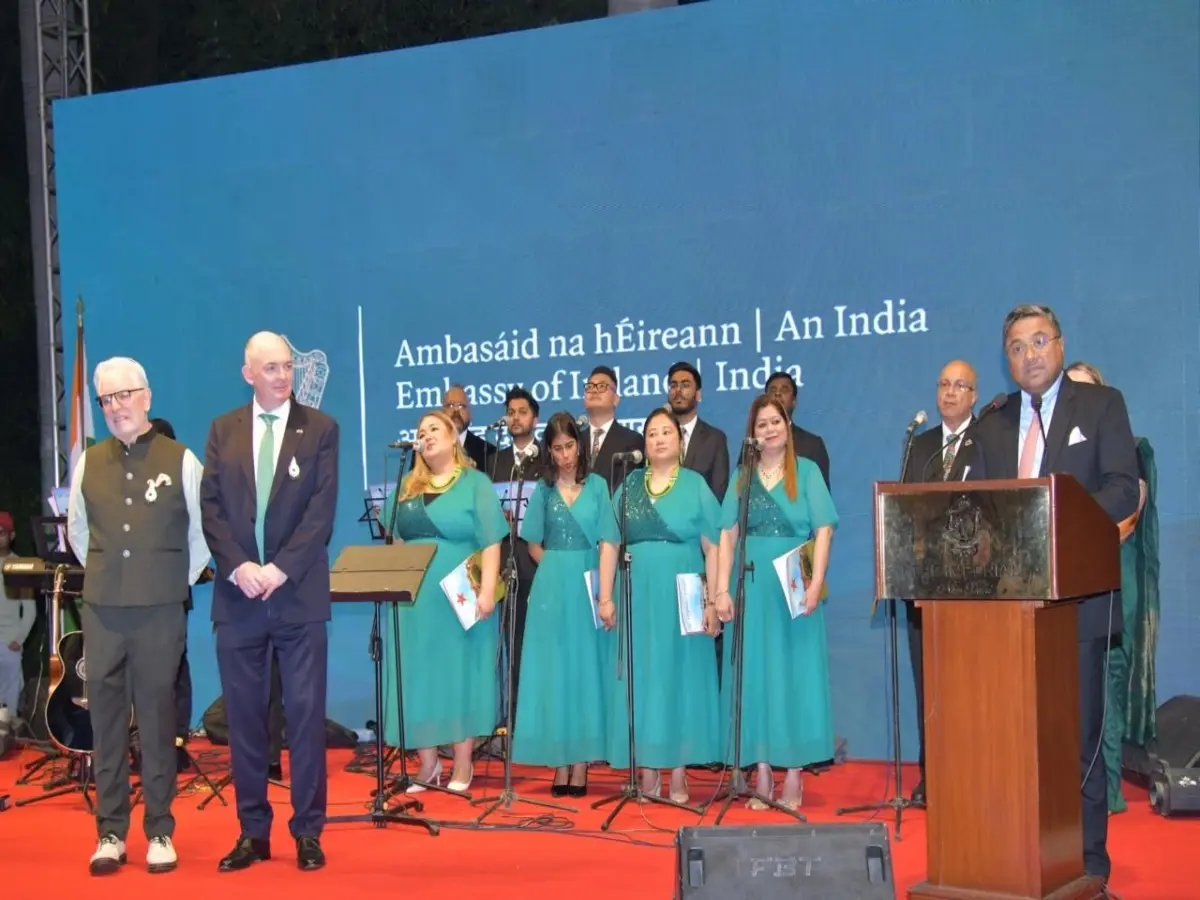
Ireland's Attorney General Rossa Fanning has highlighted the deepening ties between Ireland and India, pointing to a booming Indian community in Ireland and significant trade links, as he joined St Patrick's Day celebrations in Delhi on Tuesday. Speaking during his visit to mark the global Irish festival, Mr Fanning, who attended events hosted by Ireland's Ambassador to India, Kevin Kelly, with India's Secretary (West) at Ministry of External Affairs Amb Sibi George representing the host government, described India as "such an important country to us".
The Attorney General emphasised the scale of the Indian diaspora in Ireland. "There are now about 100,000 Indian citizens living and working in Ireland. Some of them are in college, up to 15,000 Indian students in university in Ireland, and that's the second highest number of Indian students in any EU country, apart from Germany," he said.
With Ireland's population standing at just 5.7 million, he noted the impact: "100,000 people mightn't seem a lot in an Indian context, but... that's almost 2% of our entire population."

The Indian community contributes across key sectors. "The 100,000 Indian people also include many people working in different sectors of the economy, technology, finance, in pharmaceuticals and in the health care system," Mr Fanning added.
Trade figures underscore Ireland's outsized role in EU-India relations. "Ireland does about 16 billion euros of trade each year with India. That's about 10% of all of the EU's trade with India. But Ireland is much smaller than 10% of the EU so we're punching above our weight already in terms of our trading relationship with India."
Mr Fanning linked these ties to shared history and the recent landmark EU-India Free Trade Agreement (FTA), announced earlier this year by European Commission President Ursula von der Leyen and Prime Minister Narendra Modi.
Trending Stories
&im=FitAndFill=(700,400))
National Handloom Day 2026: From Alia Bhatt to Samantha Ruth Prabhu; Actresses who celebrated India's textile heritage as brides
)
The Royals enter the Doctor Who universe: King Charles and Queen Camilla beam into Commonwealth Games in TARDIS
)
Unitree Robotics targets $9 billion valuation in landmark IPO backed by DeepSeek and Tencent
)
India names 27 sites in Arunachal Pradesh
)
Bharat Bhhagya Viddhaata OTT: When will Kangana Ranaut's film stream online?
&im=FitAndFill=(700,400))
How many soldiers operate one S-400 battery?
)
Shakib Al Hasan ready to return to Bangladesh—under one condition
)
‘Fake news’: MEA rejects report claiming India sought defence pact with Israel after Pakistan, Saudi Arabia, Turkey deal
)
Rockstar to unveil GTA 6 extended look ahead of November launch
)
Russia forms Ukrainian Volunteer Spetsnaz Brigade to fight Ukraine
)
Drug-resistant fungus that hides in hair and enters bloodstream reported in 23 US states
)
Technology transfer deal boosts India's defence manufacturing ambitions
)
Border row erupts in Europe after Ceuta crossings, Spain imposes border controls on Italy
)
Morale plummets on USS Abraham Lincoln: Are US sailors reaching a breaking point? | GRAVITAS
)
'Security can't be bought with Pakistan, Turkey deal': Iran tells Saudi Arabia
)
Baba Vanga's 2026 prophecy: 2 predictions 'already came true', 3 terrifying ones remain. Details inside
)
Colombia’s new president Abelardo de la Espriella vows to ‘defeat narco-terrorists’, signals hardline shift
&im=FitAndFill=(700,400))
New Friday OTT releases (August 7, 2026): Operation Safed Sagar, Vadhandhi, Main Vaapis Aaunga- 6 movies and TV shows on Netflix, Prime Video and more
)
Squadron Leader Bhawana Kanth scripts history as Indian Air Force gets its first woman ‘Top Gun’ pilot
)
RSS says Gen Z protests reflect genuine distress
)
Trump says Iranian school bombing photos could be AI-generated - 'I don’t think...'
)
IAF officer held for sharing sensitive information in 'honey trap' case, booked under Official Secrets Act
)
Stray Kids under scrutiny? Fans react to Grammy submission silence after BTS boycott
&im=FitAndFill=(700,400))
Why the Su-30MKI doesn't need external fuel tanks to fly vast distances
)
Jugal Hansraj reunites with Shekhar Kapur after 40 years for Masoom: The Next Generation
)
New speed limits, automatic challans: Big traffic change coming to Delhi-Meerut Expressway. All you need to know
)
India officially names 27 places in Arunachal to counter China's renaming claims
)
Trump calls White House ballroom ruling a 'national disgrace' as court says Congress approval needed
)
US sanctions Iran’s crypto network after Strait of Hormuz attacks, offers $15m bounty for intel on IRGC finance
&im=FitAndFill=(700,400))
Why the Su-30MKI is one of the heaviest fighters ever built
)
Uttarakhand young innovator builds India's own flying vehicle, conducts first test flight: WATCH
)
Chilling video shows students take cover as teen opens fire at Thai school
)
Reese Witherspoon's father hospitalised after poolside incident in Nashville: Report
"One of the themes of my visit is the connections between Ireland and India, which date back a long time. We, of course, are both English speaking countries. We're both former British colonies. We both obtained independence in the 20th century, and we both have written constitutions. The Indian Constitution came 10 years after the Irish document, and in fact, it borrowed, in some respects, from the Irish document," he explained.
With the new FTA opening doors, he positioned Ireland strongly: "There is, I think, now, an increased opportunity for future trade between all European Union countries and India. But Ireland must be at the front of the queue, because we're an English speaking country that has more in common with India than most of the EU."
St Patrick's Day provides the perfect platform for such diplomacy. Mr Fanning described how the Irish government deploys representatives worldwide during the festival season.
"So the Irish government travels all around the world for St Patrick's Day. It's our main diplomatic tour season, and we have 40 different representatives of the Irish government traveling this week to 54 countries. In every major country, China, Australia, Brazil, Argentina, France, Germany, Spain. You name us, we have an Irish government representative," he said.
"So we use the message of St Patrick's Day to talk about our Irish values and our Irish heritage around the world, and to build and foster our connections and economic relations with our trading partners, and we're really pleased to come to India, because India is such an important country to us."
The Delhi event, featuring green-clad crowds and cultural exchanges, kicked off celebrations in India. Mr Fanning's visit, part of a broader two-city programme including Mumbai, also included meetings with senior Indian officials and judiciary members to discuss legal and governance cooperation.
