Swara Bhasker issues video clarification over Padmaavat remarks amid ‘wild’ backlash: ‘Never said Rani Padmavati was a coward’

&imwidth=600&imheight=450&format=webp&quality=medium "Swara Bhasker issues video clarification over Padmaavat remarks amid ‘wild’ backlash: ‘Never said Rani Padmavati was a coward’")
Swara Bhasker issues video clarification Photograph: (X)
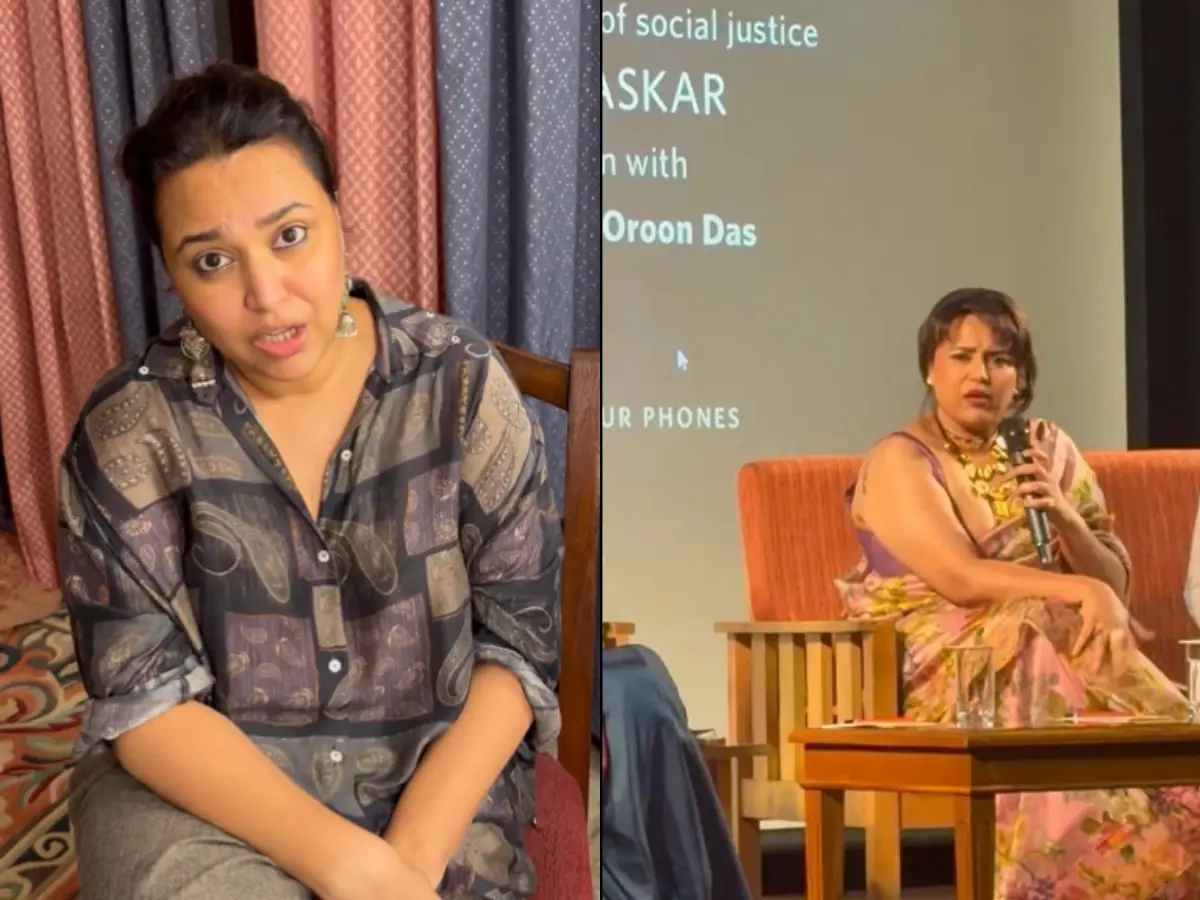
Amid the ongoing "wild" backlash, Swara Bhasker has shared a video statement clarifying her remark about the jauhar sequence in Sanjay Leela Bhansali’s Padmaavat. Read on to know more.
Swara Bhasker has once again responded to the criticism surrounding her recent viral remarks about the jauhar sequence in Sanjay Leela Bhansali’s Padmaavat. After a clip from her appearance at an event sparked a wave of reactions online, the actor has now shared a video statement clarifying that she may have been misunderstood.
Swara's video statement
Taking to X, she said that the viral clip did not accurately represent her comments. She also accused media and social media users of misinterpreting her words.
"So, when I was explaining what my problem was, I said something which is being translated in a completely wrong way and which is being spread as a lie that I said that Padmavati, Rani Padmavati and the other women who did johar were cowards," she clarified in the video. "I want to say clearly that I never said that Rani Padmavati was a coward or the other women, the queens of the palace and the women who did johar were cowards. What did I say? I said it in English. I will translate it myself and tell you. Because when you don't understand the language, you should ask or check it. You shouldn't spread it as a lie and you shouldn't inspire people."
Addressing the trolls, she added, "Those who want to abuse me, do it but on the right thing. What did I say? I said while watching the climax. When I was watching the climax, I felt that God forbid if I had been a rape victim. God forbid if I had been a rape victim, I would have felt like a coward. I would have felt like a coward that I did not kill myself. That I did not kill myself. That is, I would have felt that I was a coward if I survived the rape."
Trending Stories
&im=FitAndFill=(700,400))
)
)
)
)
)
)
)
)
)
)
)
)
)
)
&im=FitAndFill=(700,400))
)
)
)
)
)
)
)
)
)
)
)
)
)
&im=FitAndFill=(700,400))
She posted the video with a caption, "My video clip has gone viral—it's being wrongly and falsely translated! I absolutely did not say that Queen Padmavati or any sati was a coward. If you want to hurl abuses, then do so—but do it on the basis of my actual statement!!! Listen and share. Women have the right to life even after rape."
Earlier, she had also addressed the intensity of the reaction, saying, "It is WILD that so many people are triggered (women included) by the basic idea that rape survivors have a right to life after rape!!!"
What did Swara say about Padmaavat?
During the event at the India International Centre in Delhi on August 31, Bhasker said, "I'm watching this and it shows all these 800 women committing jauhar which is the story. Watching it I was thinking that 'God forbid, I was a rape survivor, what is this film telling me? I would feel like a coward. That I didn't kill myself to save my 'honour'."
She further added, "Is that what you want to tell women in a society like ours where I feel like there's any way a rape epidemic. Is that what we want to tell our survivors that you don't deserve to live? That if you had actually been brave and honourable women, you would have killed yourself? Are we saying that rape is the end of a woman's life?"
The actor also recalled a particular visual from the sequence involving a pregnant woman. "And then there was that one shot, it made me so mad, I was like, chiii, in the audience loudly. There is a close-up of a pregnant woman’s belly. And she is going, so you’re saying that a foetus that might be female doesn’t deserve to be born, because she might be raped by a Muslim ruler?"
Following the circulation of a video from the event on social media, several users criticised her for "disrespecting Rajput women".
About the film
Starring Padukone, Shahid Kapoor and Ranveer Singh in the lead, the film draws from Malik Muhammad Jayasi’s 16th-century epic poem Padmavat. Aditi Rao Hydari, Jim Sarbh, Raza Murad and Anupriya Goenka also play key roles in the period drama.

