

&imwidth=800&imheight=600&format=webp&quality=medium "Russia’s war economy: Can Putin withstand Trump’s pressure in Alaska?")
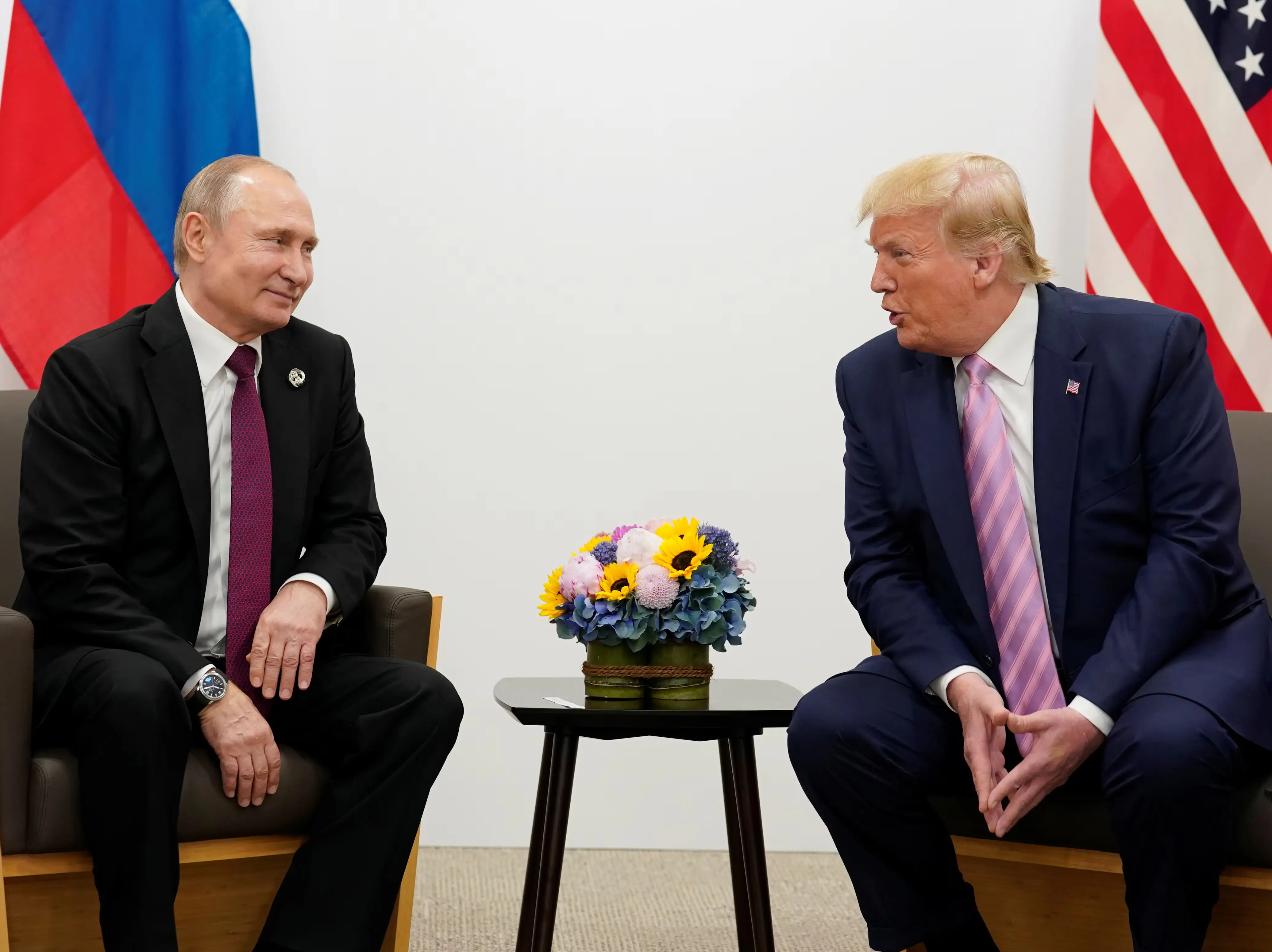
As Russian President Vladimir Putin heads to Alaska for a high-stakes summit with US President Donald Trump, his battlefield strategy in Ukraine may be colliding with a new front, economic survival. Behind the Kremlin’s confident rhetoric, signs of strain are emerging that could give Washington unexpected leverage.
According to Bloomberg, Russia’s economic growth has slowed sharply, oil revenues have fallen, and the budget deficit has ballooned to its highest level in more than three decades. Inflation is high, interest rates are at their most punishing in over 20 years, and insiders in the banking sector are warning of a looming debt crisis.
War machine vs. economic reality
When Putin ordered the invasion of Ukraine in February 2022, Moscow bet it could finance a long war without destabilising the home front. Military and national security spending has now soared to nearly $172 billion in 2025, about 8 per cent of GDP, as per Alexandra Prokopenko of the Carnegie Endowment for International Peace, quoted by Bloomberg.
To keep the war economy running, Russian banks, many state-controlled and run by Putin loyalists, were compelled to give “preferential” loans to defence contractors at below-market rates. Harvard’s Craig Kennedy estimates that from mid-2022 to late 2024, corporate debt surged by up to 71 per cent, or about 36.6 trillion rubles ($460 billion), with most of it concentrated in military-linked industries.
The oil price blow
Trending Stories
&imwidth=180&imheight=135&format=webp&quality=medium)
'My name has always been Ilhan Omar': Congresswoman hits back at Trump, calls him a 'creep'
&imwidth=180&imheight=135&format=webp&quality=medium)
Gravitas | US attack could trigger WW III: Russian planes in Tehran, Israeli jets, US warships in action
&imwidth=180&imheight=135&format=webp&quality=medium)
Viral video shows cross falling on Colombia priest, no official confirmation | WATCH
&imwidth=180&imheight=135&format=webp&quality=medium)
US Navy, Marine Corps boards defy Trump's transgender military ban, vote to retain troops
&imwidth=180&imheight=135&format=webp&quality=medium)
Will the US attack Iran this weekend? Trump's envoy says, 'absolutely'
&imwidth=180&imheight=135&format=webp&quality=medium)
Fauzi teaser out: Prabhas takes on the British Empire in patriotic avatar | Watch
&imwidth=180&imheight=135&format=webp&quality=medium)
India-China face-off continues near Arunachal’s Taksing, reveals ITBP chief in first official confirmation of tensions
&imwidth=180&imheight=135&format=webp&quality=medium)
Nairobi building collapse: Several feared trapped after 16-storey structure crumbles; rescue operation underway
&imwidth=180&imheight=135&format=webp&quality=medium)
Pakistan airline PIA unveils new crew uniforms, faces online criticism
&imwidth=180&imheight=135&format=webp&quality=medium)
Did Neha Bora call for Bangladesh-like GenZ protest, 'anarchy' in India? WION Fact-checks viral claim
&imwidth=180&imheight=135&format=webp&quality=medium)
'Already tired of his 9-to-5': Baby born with a moustache becomes internet sensation, video goes viral | Watch
&imwidth=180&imheight=135&format=webp&quality=medium)
Horrific video shows the moment 18-year-old fell to her death from Mexico amusement park ride
&imwidth=180&imheight=135&format=webp&quality=medium)
'Black triangle' UFO flying at 1,800mph spotted over sensitive US site: Latest Trump admin UFO file dump
&imwidth=180&imheight=135&format=webp&quality=medium)
IND-W vs ZIM-W, 1st ODI: Rawal, Charani star in India’s nine-wicket win over Zimbabwe
&imwidth=180&imheight=135&format=webp&quality=medium)
Massive 7.2 magnitude quake off Vanuatu triggers tsunami warning for coasts within 300 km
&imwidth=180&imheight=135&format=webp&quality=medium)
French Open: PV Sindhu storms into final with win over Hina Akechi
&imwidth=180&imheight=135&format=webp&quality=medium)
Google Fitbit Air’s new health guardian feature tracks trends: How it works
&imwidth=180&imheight=135&format=webp&quality=medium)
US midterms 2026: Trump revises Canada tariffs as Susan Collins faces tight re-election race in Maine
&imwidth=180&imheight=135&format=webp&quality=medium)
US midterms 2026: Viral video claims Lindsey Graham paid underage men for sex; clip released weeks before his sister's Senate race
&imwidth=180&imheight=135&format=webp&quality=medium)
IND vs NZ 2nd T20I: Shreyas Iyer on brink of breaking Rohit Sharma’s record
&imwidth=180&imheight=135&format=webp&quality=medium)
AI deepfakes are spreading online: Why is removing them so difficult?
&imwidth=180&imheight=135&format=webp&quality=medium)
China's dancing robot turns violent bodyguard, lifts cars and fights intruders - Watch
&imwidth=180&imheight=135&format=webp&quality=medium)
Global cybersecurity alert: PHP flaws trigger website shutdowns as hack attempts surge into millions
&imwidth=180&imheight=135&format=webp&quality=medium)
'You’re a horrible little reporter, aren’t you?': Trump snaps at NBC reporter questioning his support for Ramaswamy's campaign ad
&imwidth=180&imheight=135&format=webp&quality=medium)
Chemical warehouse explosion in Mexico: Several injured in multiple blasts, 1,000 evacuated in León
&imwidth=180&imheight=135&format=webp&quality=medium)
US charges two former FBI officials with lying to Congress about Hunter Biden probes. 'Politically motivated' Trump grievance or something else?
&im=FitAndFill=(700,400)&imwidth=180&imheight=135&format=webp&quality=medium)
How smart robots and AI assemble vehicles in 20 hours
&im=FitAndFill=(700,400)&imwidth=180&imheight=135&format=webp&quality=medium)
New Friday OTT releases (October 23, 2026): Gajab Raat, Dorothy, Chaar Yaar- Watch these 6 new movies and TV shows on Netflix, Prime Video and more
&imwidth=180&imheight=135&format=webp&quality=medium)
Anthropic security chief issues grim cyberattack warning: ‘It’s going to get a lot worse’
&imwidth=180&imheight=135&format=webp&quality=medium)
Tu Hai Meri Kiran film review: Sonakshi Sinha and Zaheer Iqbal's thriller gets tangled in its own twists
&imwidth=180&imheight=135&format=webp&quality=medium)
First Lady Melania Trump secures ceasefire between Russia, Ukraine in Oleshky: White House
&imwidth=180&imheight=135&format=webp&quality=medium)
Negotiators from Ukraine, Russia, United States to meet in Abu Dhabi: Zelensky
&imwidth=180&imheight=135&format=webp&quality=medium)
Farooq Abdullah says Pakistan’s raising of Kashmir issue keeps pressure on Delhi
&imwidth=180&imheight=135&format=webp&quality=medium)
Emmanuel Macron calls Paris suburb shooting a 'racist terrorist attack' after one killed, several injured
For much of the war, rising energy prices shielded Russia from sanctions. But now, global crude has slipped to around $60 per barrel, and Russia’s discounted oil sells for even less. As per the Bank of Finland’s analysis cited by Bloomberg, this has delivered a heavy hit to state coffers, pushing July’s monthly deficit to 4.9 trillion rubles, even worse than the peak of the Covid-19 pandemic.
The shortfall is draining the National Wealth Fund, Russia’s key fiscal cushion. Economists at the Gaidar Institute warn it could be fully depleted by the end of 2025, stripping Moscow of a major buffer against sanctions.
Russia’s oil revenue projection
| Year | Oil & Gas Revenue (RUB trillions) | Non-Oil & Gas Revenue (RUB trillions) | Projected Total Budget Revenue (RUB trillions) |
| 2019 | ~7 | ~15 | — |
| 2020 | ~6 | ~14 | — |
| 2021 | ~9 | ~15 | — |
| 2022 | ~9 | ~17 | — |
| 2023 | ~8 | ~20 | — |
| 2024 | ~8 | ~21 | — |
| 2025 | ~8 | ~22 | ~35 (projected) |
| 2026 | ~8 | ~22 | ~35 (projected) |
| 2027 | ~8 | ~22 | ~35 (projected) |
(Source: Russian Ministry of Finance Budget, Janes – via Bloomberg)
Despite Russia’s war-driven fiscal expansion, oil and gas revenues, which accounted for roughly 30 per cent of federal income in 2024 are expected to stagnate at around 8 trillion rubles annually through 2027. Bloomberg notes this is a sharp contrast to earlier wartime windfalls, with global crude prices slipping to $60 per barrel and discounted Russian grades fetching just $55 by mid-2025. The resulting shortfall has widened the monthly budget deficit to a record 4.9 trillion rubles in July, forcing Moscow to draw heavily on its National Wealth Fund.
Banking on trouble
High interest rates, raised to 21 per cent in October 2024, the highest in two decades are crushing both consumers and businesses. Many banks are trapped: they must pay high rates on deposits and borrowing while sitting on mountains of low-yield war loans. Even defence firms, supposedly flush with state work, are struggling to repay debts.
The Central Bank of Russia, under Governor Elvira Nabiullina, has quietly allowed banks to roll over bad loans and loosened monitoring rules for the defence sector. That makes it difficult to know the true scale of risk, but senior figures in Moscow’s own banking system, quoted anonymously by Bloomberg, fear a systemic crisis within a year.
A tale of two economies
Defence-linked industries are running hot; the civilian economy is barely ticking over. GDP growth fell to 1.1 per cent in Q2 2025 from over 4 per cent in 2024. The IMF has cut its 2025 forecast to just 0.9 per cent. Sectors like construction, retail and agriculture are seeing rising bankruptcies and falling demand.
Breakdown of Russia’s military spending
| Year | Personnel | Procurement of Weapons | Operations & Maintenance | R&D | Other | Total Military Spend (USD billions) |
| 2006 | Low | Low | Minimal | Low | Low | <50 |
| 2014 | Higher | Rising | Moderate | Low | Low | ~70 |
| 2020 | Elevated | Moderate | Moderate | Low | Low | ~90 |
| 2022 | Sharp rise | Higher | Higher | Low | Low | ~120 |
| 2024 | Peak | Moderate | Higher | Low | Low | ~150 |
| 2025 | Peak | Moderate | Higher | Low | Low | ~172 |
(Source: Janes – via Bloomberg)
Janes’ data, cited by Bloomberg, shows that the majority of Russia’s record $172 billion military budget in 2025 is being absorbed by personnel costs soldier salaries, allowances and benefits, leaving a smaller share for procurement, maintenance and R&D. This spending pattern underscores Moscow’s focus on sustaining troop numbers in Ukraine rather than investing in advanced weapons systems, a choice that could weaken long-term military capability if economic pressures persist.
Trump’s leverage
As per Bloomberg, Trump has openly said Russia’s weak economy could force Putin’s hand in Ukraine talks, even suggesting that lowering oil prices by $10 a barrel would leave Moscow with “no choice” but to scale back the war.
Putin arrives in Alaska asking for sanctions relief, while demanding that Ukraine cede all of Donbas and Crimea. Kyiv and European capitals, excluded from the talks have rejected the terms outright. If Trump uses Russia’s economic fragility as a bargaining chip, it could test how far Putin’s war economy can bend before it breaks.
Russia’s war economy has so far defied Western pressure, but the combination of falling oil revenues, high borrowing costs, and mounting debt risk is eroding its resilience. Whether Putin can sustain his war footing now depends on two things: global oil prices and Trump’s willingness to press his advantage in Alaska.
If Washington turns the screws, through lower energy prices or tighter sanctions, the Kremlin may be forced into compromises it has long resisted. The coming summit could reveal whether Russia’s economic armour is already cracked.
(With inputs from the agencies)