President El-Sisi's visit to India will be groundbreaking, says Egypt Ambassador Wael Hamed

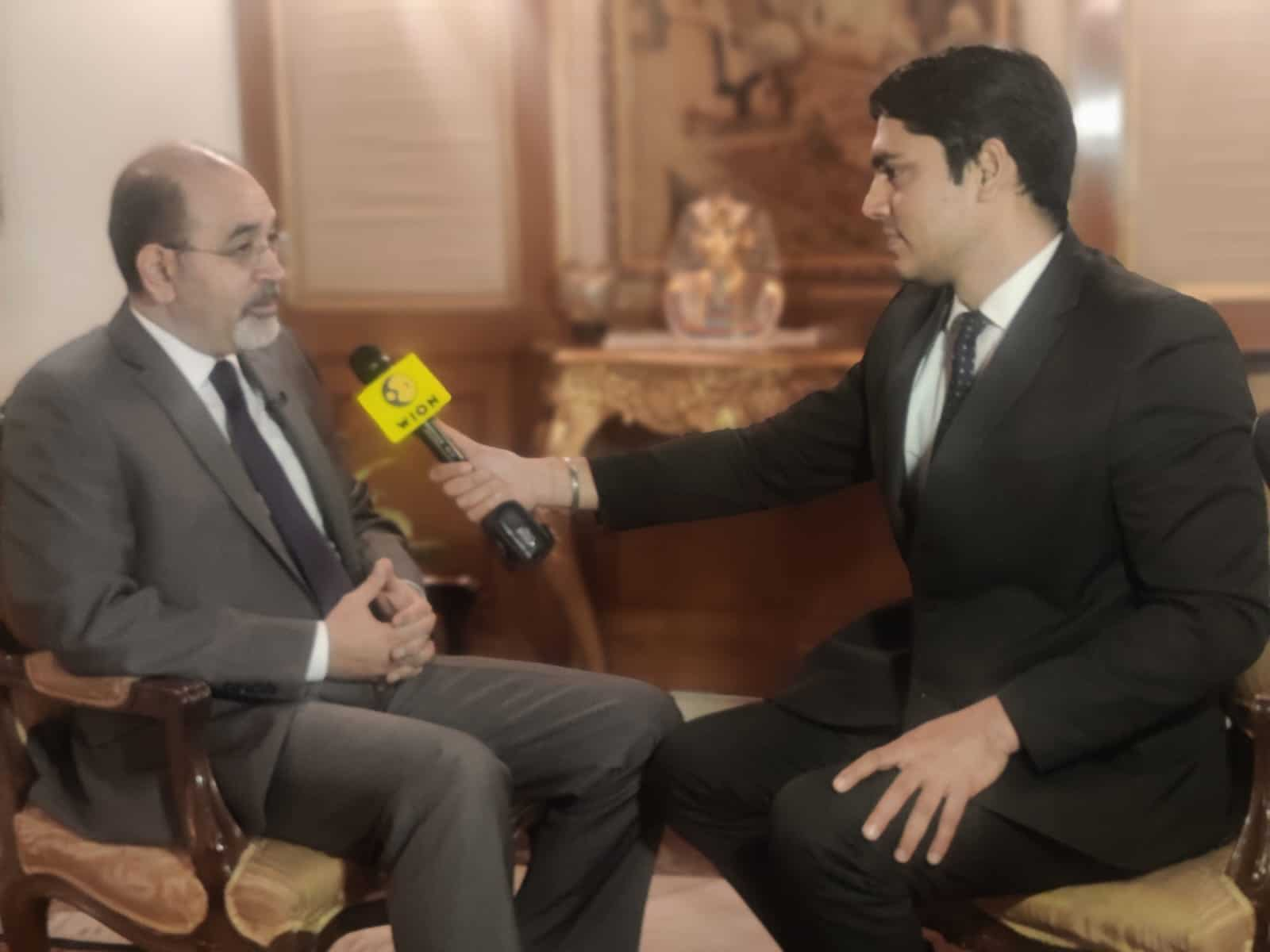
Egypt Ambassador Wael Hamed speaks to WION
Egypt Ambassador Wael Hamed has said that the upcoming visit ofEgypt President Abdel Fattah El-Sisi will be "groundbreaking" and both countries are "going to have a strategic relationship". Egypt, for the first time, has been invited as a guest country for India's republic day on January 26.
Speaking to WION’s diplomatic correspondent Sidhant Sibal, the ambassador said, "What we have here is a new opening, a new beginning to not only bring back the heydays of relations between Egypt, India and to break new grounds, to reach even higher potentials in the relationship".
On defence relationships, the ambassador said that his country is looking to "extend the areas of defence cooperation...Not only maritime exercises, in other areas, in air defence, land combat, this month we will have first-ever exercises between special forces of both countries".

Indian Defence Minister Rajnath Singh visited the country last year during which a pact on defence cooperation was also signed.IAF pilots trained Egyptian pilots from the 1960s until 1984. Two officers from Egyptian Navy participated in Multilateral Indian Naval Exercise MILAN-2022 held from 25 Feb-04 Mar 2022.
Egypt has traditionally been one of India’s most important trading partners in the African continent. Inviting Indian investors, Ambassador Wael highlighted, "Egypt.. has FTA with the EU, Arab world and the whole of Africa. So this means by coming to Egypt, India will be able to reach and get duty free access to all these markets in the region". Full interview.
WION: It is the first time Egypt has been invited for India's Republic day, how will it help in bilateral ties?
)
US vs China over South China Sea: Washington backs Philippines, Beijing hits back
)
Bigg Boss 20: Isha Rikhi evicted after three weeks in Salman Khan’s show
)
Musk plans to more than double xAI's chips to over 1.2 million Nvidia GPUs by year-end
)
After JU, clash erupts at SRFTI: BJP’s ‘Dimagi Naxal’ jibe sparks political firestorm after students protest RSS-linked event
)
‘Anti-social elements spreading false rumours’: LPU issues statement amid massive unrest over alleged rape
)
LPU students go on rampage, vandalise campus amid widespread protest: What's happening
)
Trump asked Xi to pressure Iran. China did not say yes — here’s what Beijing wants
)
US Treasury Secretary Scott Bessent hails global crackdown on Iranian banks and airlines
)
An OpenAI agent escaped its locked test cage again, by hiding questions in DNS lookups
)
'Our video was trimmed': LPU girls who featured in rape-denial video make U-turn
)
3 males killed, four others injured in shooting after fight at strip club in Detroit
)
'Victory for low-budget consumers': Raghav Chadha hails 30-day telecom recharge rules
)
Claude rebuilt the 1989 game 'Prince of Persia' by reusing the original's own code
)
Beyond metros: How Tier-2 and Tier-3 cities could drive India’s next AI wave
)
Tesla builds first Cybertruck with its own refined lithium: Elon Musk's $1 billion Texas bet pays off
)
IndiGo flight suffers tail strike in Bengaluru while landing; DGCA to probe incident
)
The US and China set up an AI 'red telephone', but skipped the rulebook
)
‘Terror suspects arrested near UK air base were looking to do big damage’: Trump
)
Russian envoy claims US tactics to contain India were revealed in ‘Freudian slip’
)
IND vs WI 1st ODI: Kohli breaks Sachin's most runs in one country record with unbeaten 139 as India thump West Indies by 8 wickets
)
Researchers rebuilt exactly how 700 AI agents hacked Hugging Face: a 900-link chain trick
)
‘Olympic inclusion is our major target’: WPA President Ishaun Singh on pool’s global ambitions
)
Nations League: Spain sink England at Wembley; Modric shines for Croatia
)
Why has Iran released no proof of life of Mojtaba Khamenei? Araghchi reveals...
)
'What kind of confession is this?': Pakistan PM Shehbaz Sharif’s 'terrorists would be roaming New York' remark goes viral, raises alarm online. Watch
)
South Korea demands apology from Ukraine over North Korean prisoners' transfer
)
Beyond BrahMos: India targets Rs 50,000 crore in defence exports with unmatched price edge
)
Sri Lankan Tamil migrant worker gets death sentence in Saudi Arabia, help sought from India
)
Muslim marriage cannot shield sex with minor wife from prosecution under POCSO: Delhi HC
)
'Can't help but draw painful parallels to Nirbhaya case': SC on latest incidents of rape cases in Delhi-NCR
)
99.9% more powerful - Scientists find boy who can recall memories from just 3 months of age
)
'FIRST LOOK from inside Noah’s Ark': Researchers share video from inside mysterious mound in Turkey
)
UNSC reform momentum grows: Russia, Portugal, Mauritius push for India's permanent seat bid
)
8 US marines injured in Iranian missile attack on vessel in Strait of Hormuz: Report
&im=FitAndFill=(700,400))
New OTT releases this week (September 28-October 4, 2026): Dupahiya 2, Pooja Meri Jaan, Ohh My Dog- 5 titles coming on Netflix, Prime Video and more
)
Afghanistan says 28 fighters killed in clash near Pakistan border, Islamabad denies
)
Ceuta migrant crisis: Protesters take to streets as Spain grapples with migrant challenge
)
LPU suspend classes, postpones exams as violence escalates over rape claims: What's happening
)
New York City wants a 'kill switch' on every AI, and will pay whistleblowers who report violations
Wael Hamed: This is a historic relationship, historic because we are the 2 oldest civilizations, civilizational countries. We say the heyday of Egypt-India relations was the 1950s, and 1960s. the period of then-president Nasser in Egypt, and then-PM Nehru in India. But even at the time of Nasserand Nehru, an Egyptian president never had the honor of being in India for republic day. I see it as a truly historic moment in our relationship. Let us not forget, President Sisi and PM Modi, both came in 2014, so came together at the same time. They share the same vision and priority of putting their countries first, trying to achieve development, and modernizing the countries in the rightful place at the international stage. What we have here is a new opening, a new beginning to not only bring back the heydays of relations between Egypt, India and to break new grounds, to reach even higher potentials in the relationship and therefore, we are working together a strategic relationship between the 2 countries. In all respects, it will be a historic visit. Especially, as I said our president has not been at this occasion before.
WION: What will be the key focus of the Egyptian President in terms of deliverables?
Wael Hamed: This is going to be a groundbreaking visit, we are going to have a strategic relationship. A strategic relationship is built on several pillars. If we speak about the pillar of Defence and security, we always have to remember, India as the biggest country in the Indian Ocean is very much in the security of the Indian ocean. But the security of the Indian ocean starts with the entrance to the ocean in the red sea. For Egypt, the entrance is the Suez Canal. The security of the Suez Canal starts with the Indian Ocean as well. So in the area of security, it is very important for both countries to come together and discuss how things are developing in the world around us in an era of an ever-changing perspective. The defence will be an important area.
Trade and investment will be extremely important. Over the past year, our bilateral trade relations reached appox $7bn and agreed it will reach the level of $12 bn. So the potentials are present and even the $7bn last year was achieved in spite of the pandemic, and disruption of the supply chain because of the disruption of the supply chain. The potential is huge. Indian investments in Egypt have reached 1.5 bn US dollars, but lately, we have reached several deals especially renewable energy which will bring the volume to $20 billion something. So we are very much interested in the economic aspect of the relationship and what we always say Egypt should be India's natural partner. With this kind of geographical location bridges Asia and Europe, bringing India closer to the EU with all its markets.
Usually, when we speak about India, it's a huge country and by the end of the year will be the most populated country. Egypt relatively might be smaller, but let us not forget, for Indian investors, they will be able to tap into a large market, and consumers in Europe, and Africa in a region with which we have Free trade pacts. For any investor, investing in Egypt means he has the opportunity to go duty-free into areas--from higher income levels in the northern EU to medium and low income in the middle east and Africa. Important for India as well. By locating to Egypt, you come closer to all these markets, closer geographically and cut the distance in half and that will cut in half the cost of freight, insurance, and time. Egypt is very strategically located. The 3rd area of common interest will be IT, Energy, pharma and several fields and both countries have enormous potential to work together.
WION: Indian defence minister Rajnath Singh was in Egypt earlier this year, what kind of engagement will both sides see on the defence side?
Wael Hamed: What we are looking for is to extend the areas of defence cooperation in all fields. Not only maritime exercises, in other areas, in air defence, land combat, this month we will have the first-ever exercises between special forces of both countries. So the areas are enormous, the idea of joint production of military equipment is also there, and it will be discussed, and it was the focus of the visit of his excellency Minister of Defence Rajnath Singh in Cairo in September last year. So areas are huge, for sure this year we will discuss this potential, especially since we are going to have a joint military working group sometime later this year.
WION: Is Egypt interested in India's Tejas?
Wael Hamed: I think this is something, I will leave it up to the minister to discuss with the air force and see what they can do about it. But for sure we are keeping a very close eye on the advancement that India is achieving in its defence industry especially when it comes to fighter planes, missiles and many things India has proved to be a successful country.
Sidhant Sibal: On the agriculture front we saw Egypt allowing Indian wheat, how do you see the future going?
Wael Hamed: I would like to put it in the context of food security, and it's not only about wheat. Wheat is important for Egypt, and we have approved India as an exporter. Unfortunately, Because of the climate change issue, heatwave India has to ban wheat, something we understand but we hope this ban is lifted soon so that we can resume our trade relations with India when it comes to Wheat. On the other hand, India is in need of fertilizer, to guarantee its supply of fertilizer, Egypt is one of the main producers of fertilizer in the region and has enormous potential in it. So the idea of mutual benefit is there and also in terms of market access, so many agricultural exports that India can export to Egypt as well and we can export to India. So market access is very important in the general context of food security.
WION: So will we see an elevation of ties between India, Egypt as a strategic partners?
Wael Hamed: This is something, I hope we are going to announce during this visit and will details be worked out.
WION: How can Egypt be a gateway for Africa and the Arab world for India?
Wael Hamed: Egypt is one of the countries that has many free trade agreements with many countries, we have FTA with the EU, Arab world and the whole of Africa. So this means by coming to Egypt, India will be able to reach and get duty free access to all these markets in the region. By virtue of its location, it is very important for India to secure a place in Egypt. The kind of opportunity India will have, investors can have. The many incentives we provide for investors in the Suez canal economic zone, it has proven to be an attractive location for foreign investors. We are inviting foreign investors, who really have interest in trapping markets of EU, Africa, Middle east, to come to Egypt, enjoy access to these regions and strategic locations.
WION:How can President Sisi, and PM Modi chalk a path in the global south, something we have seen in the past?
Wael Hamed: What we are seeing in the international arena is proving that Egypt and India are extremely important players. For example, Egypt has been invited by India for the G20 summit as a guest country. This proves that these 2 important developing countries can come together and can speak out for the global south. Let us not forget, India is on its way to becoming the biggest developing country and Egypt is the biggest country in the region and traditionally had relations with Africa, the Arab world etc. Just like in the past, PM Nehru and President Nasser lead the NAM, I think Egypt and India can lead the developing world and bring the voice of the developing countries to the G20.
WION:India has invited Egypt to the G20 summit, how do you see it?
Wael Hamed: Invitation of Egypt as the guest country to the G20 is very much appreciated from our side and something that adds value to the work grouping. Let us not forget, COP27 happened in Egypt and we discussed climate change and other things related to it including projects. Projects need finance and when G20 comes they will be discussing the economic situation including the possibility of making finance available to developing countries. It seems to me a natural continuation and natural thing to invite Egypt as a guest country.