

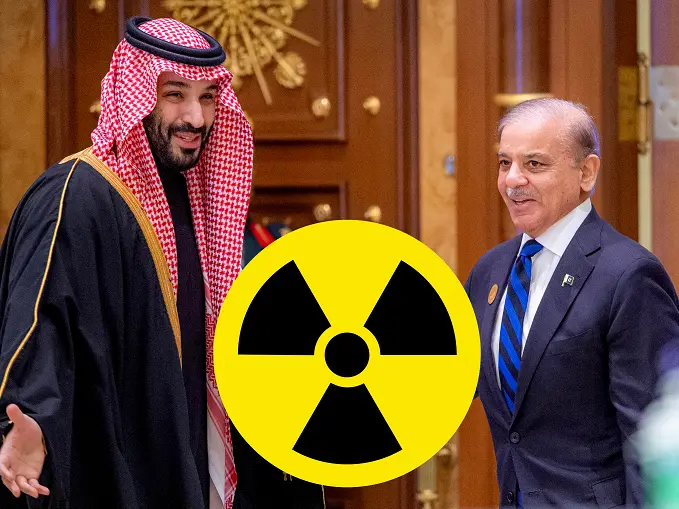
&imwidth=800&imheight=600&format=webp&quality=medium "Pakistan - Saudi Arabia mutual defence pact: Next, nukes for Saudi? Why new agreement raises concerns, given the history of...")
Pakistan and Saudi Arabia have signed an unprecedented agreement that, in essence, vows mutual defence. It is similar to NATO’s Article 5, as it considers an attack on one to be an attack on both. Saudi Arabia’s defence cooperation with Pakistan is no secret. But what worries observers is the historical context of their collaboration, particularly regarding Pakistan’s nuclear programme. Saudi Arabia's perceived threats from Iran add to the concern. Analysts in India, meanwhile, are questioning whether Saudi Arabia might support Pakistan militarily in future conflicts, such as the recent Operation Sindoor. Officially, India has said it would ‘study the implications’ of the pact. Here is why the Pakistan-Saudi Arabia Strategic Mutual Defence Agreement (SMDA) is considered problematic.
Pakistan nuclear weapons for Saudi Arabia? A question debated for decades
There is no evidence that Pakistan has transferred nuclear weapons or technology to Saudi Arabia. However, the possibility has been debated in strategic circles for years. Historical, cultural, and military ties, coupled with shared security concerns—especially regarding Iran—and recent geopolitical shifts in the Middle East, make this a persistent issue.
What is the Strategic Mutual Defence Agreement between Pakistan and Saudi Arabia?
The Pakistan-Saudi Arabia Strategic Mutual Defence Agreement (SMDA) states that an attack on either nation will be treated as an attack on both. It includes provisions for intelligence sharing, joint military exercises, and cybersecurity cooperation. Although nuclear weapons are not mentioned, analysts fear that the agreement could lay the groundwork for future nuclear cooperation if regional threats increase. In Pakistan’s case, this mostly concerns India, whose strategic community is closely analysing the implications of this pact.
Also read: Nuclear armed Pakistan, Saudi Arabia sign defence deal, India says 'will study implications'
Trending Stories
Saudi and Pakistan enjoy a long strategic relationship
Relations between Saudi Arabia and Pakistan date back to the 1970s, when the Kingdom provided economic aid, cheap oil, and military support. In return, Pakistan deployed tens of thousands of troops to Saudi Arabia and helped train its forces. Saudi Arabia has also made major investments in Pakistan’s defence sector.
Did Saudi Arabia help bankroll Pakistan’s nuclear programme?
There have been reports suggesting that Saudi Arabia helped fund Pakistan’s nuclear development. In the 1980s, a former CIA official claimed that Saudi Arabia provided more than $1 billion to Pakistan’s nuclear efforts. In return, it was rumoured that Saudi Arabia expected access to nuclear weapons if needed in the future, especially in the event of an Iranian threat.
In 2003, a Pakistani source claimed that a secret nuclear deal was discussed during a visit by then Saudi Crown Prince Abdullah. The alleged deal offered Saudi Arabia nuclear assistance in exchange for continued oil support. Both countries denied any such agreement.
Does Saudi Crown Prince Mohammed bin Salman want nuclear weapons?
Crown Prince Mohammed bin Salman, who signed the defence pact with Pakistani Prime Minister Shehbaz Sharif, has given ambiguous answers on the nuclear questions in the past. In a 2018 CBS interview, he said that if Iran built a nuclear bomb, Saudi Arabia would follow “as soon as possible.” At the time, this statement raised global concerns. Given the close ties between Pakistan and Saudi Arabia, experts believe Pakistan could be the most likely source of nuclear assistance, whether through direct transfer or technical support to build weapons independently.
Saudi nuclear energy programme
Officially, Saudi Arabia maintains that it seeks nuclear energy for peaceful purposes. In 2010, it announced plans to construct 16 nuclear reactors. Progress has been slow. Notably, Saudi Arabia has not signed the Additional Protocol to the Nuclear Non-Proliferation Treaty (NPT), which would allow stricter international inspections.
In 2020, The Wall Street Journal reported that Saudi Arabia, with Chinese assistance, had built a facility for extracting uranium. This is legal under international law, but it increased suspicions about possible dual-use intentions.
Pakistan’s role: a nuclear detour for Saudi Arabia?
Pakistan is one of the few Muslim-majority countries with nuclear weapons. It has previously faced allegations of nuclear proliferation, including through the AQ Khan network, which was linked to North Korea, Libya, and Iran. Pakistan’s strong relationship with Saudi Arabia makes it a plausible future partner if Saudi Arabia decides to acquire nuclear weapons.
If Iran develops nuclear arms, Saudi Arabia might seek to "borrow" or purchase warheads from Pakistan. Experts are concerned that the new defence pact makes such an outcome more plausible.

