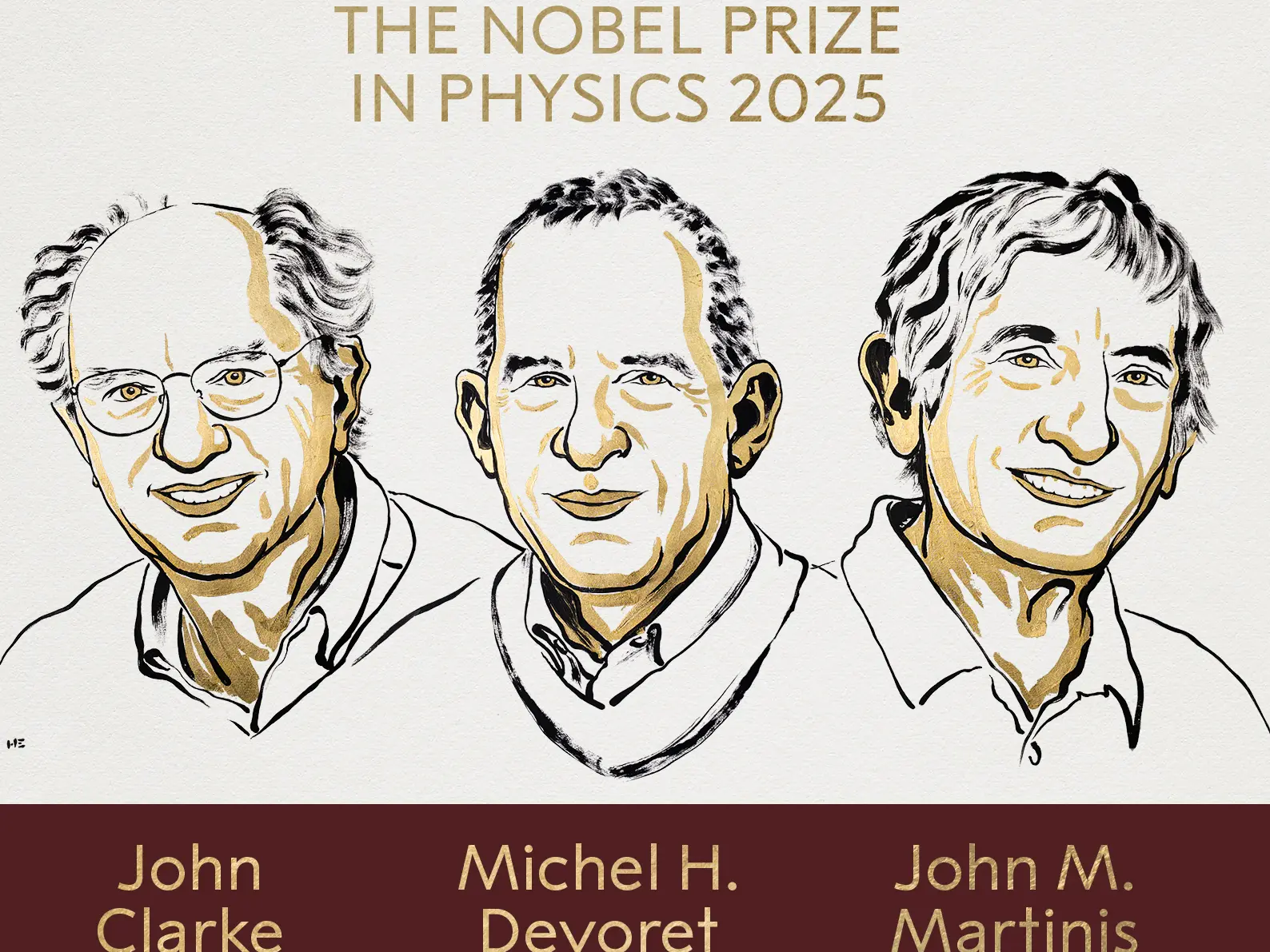
Nobel Prize 2025 in Physics winners: Who are John Clarke, Michel Devoret and John Martinis?

&imwidth=600&imheight=450&format=webp&quality=medium "Nobel Prize 2025 in Physics winners: Who are John Clarke, Michel Devoret and John Martinis?")
Nobel Prize 2025 in Physics winners: Who are John Clarke, Michel Devoret and John Martinis? Photograph: (X/@NobelPrize)
The three laureates will receive their prizes from Sweden’s King Carl XVI Gustaf in a formal ceremony in Stockholm on December 10 this year.
The Royal Swedish Academy of Sciences on Tuesday (Oct 7) announced that the 2025 Nobel Prize in Physics has been awarded to John Clarke, Michel H Devoret and John M Martinis “for the discovery of macroscopic quantum mechanical tunnelling and energy quantisation in an electric circuit.” The trio led a series of experiments in 1984 and 1985, which showed that the bizarre properties of the quantum world can translate into measurable effects in everyday life.
British physicist John Clarke, who is based at the University of California at Berkeley, French physicist Michel Devoret, who is based at Yale University, and American physicist John Martinis of the University of California, Santa Barbara, will share the 11 million Swedish kronor (about $1,171,000) prize.
John Clarke
Born in 1942 in Cambridge, UK, Clarke completed his PhD from the University of Cambridge in 1968. The 83-year-old is currently a professor at the University of California, Berkeley.
“To put it mildly, it was the surprise of my life,” Clarke told reporters following the announcement of the prize. “It never occurred to me in any way that this might be the basis of a Nobel Prize.”
“It certainly had not occurred to us in any way that this discovery would have such a significant impact,” he said.
Michel H Devoret
Devoret, 72, is a professor at the University of California, Santa Barbara and is listed as a professor emeritus at Yale University. He was born in 1953 in Paris, France and completed his PhD in 1982 from Paris-Sud University, France.
Trending Stories
)
)
)
)
)
)
)
&im=FitAndFill=(700,400))
)
)
&im=FitAndFill=(700,400))
)
&im=FitAndFill=(700,400))
)
)
)
)
)
&im=FitAndFill=(700,400))
)
)
)
)
)
)
)
)
)
)
)
)
)
)
)
)
)
)
John M Martinis
Martinis was born in 1958 and is also a professor at the University of California, Santa Barbara. He completed his PhD in 1987 from the University of California, Berkeley, USA.
The three laureates will receive their prizes from Sweden’s King Carl XVI Gustaf in a formal ceremony in Stockholm on December 10 this year.

