Kabul to become first big city without water by 2030, amid conflict, climate change and government failure

&imwidth=600&imheight=450&format=webp&quality=medium "Kabul to become first big city without water by 2030, amid conflict, climate change and government failure")
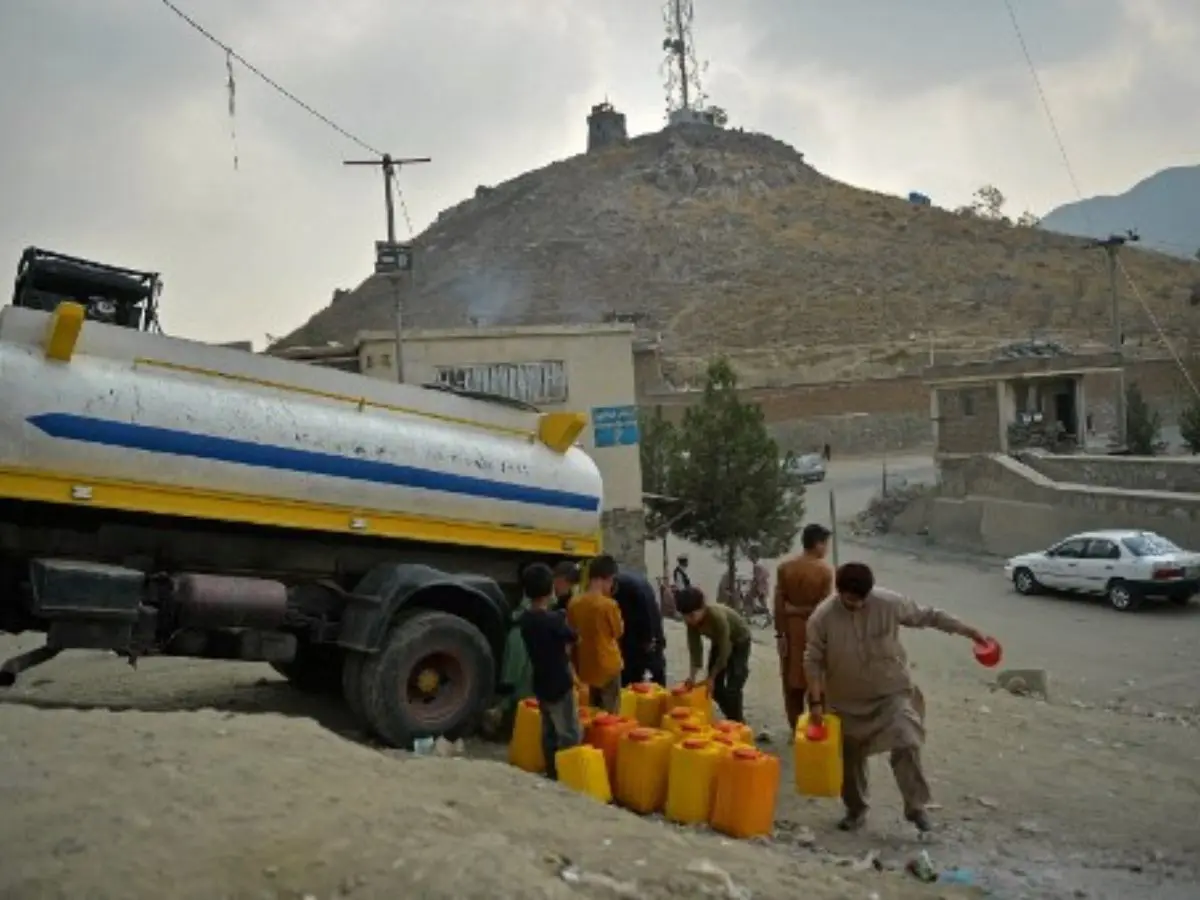
People fetch drinking water from a tanker in Kabul on October Photograph: (AFP)
Kabul is at a dire water crisis, with the growing gap between groundwater recharge and the annual water extraction. A report by Mercy Corps predicts that Kabul will run out of water by 2030.
Kabul could become the first modern city to run out of water in the next five years, with groundwater level dropping significantly due to over-extraction and the effects of climate change. According to a report by Mercy Corps, Kabul’s aquifer levels have plummeted by 82 – 98 feet in the last 10 years. The extraction level of water has exceeded natural reserves by a staggering 44 million cubic metres a year. The report said that according to UNICEF, nearly half of Kabul's underground bore wells are already dry. The reports project that if the current trend is followed, then Kabul will be dry by 2030. It also discloses that groundwater is believed to be unsafe, with high levels of sewage, arsenic and salinity.
Why is Kabul in a water crisis?
Firstly, a decade-long Soviet War in Afghanistan and a two-decade-long US intervention in Kabul have left the country in disarray. It forced people to move to Kabul as governance in the rest of the country suffered. Years of war have left the country in a poorly governed state. Weak governance and sanctions have compounded the problem; much of the aid that was allotted to the nation was used for security reasons. Since the Taliban's return to power, there have been efforts to manage the water crisis, but Western sanctions have made it difficult for the authorities.
“In well-managed cities, such impacts are mitigated through robust water governance and infrastructure. Kabul lacks such capacity, and the current authorities are unable to address the problem without external support,” said Aseem Mayar, a former lecturer at Kabul Polytechnic University, as quoted by Al Jazeera.
“The three rivers — Kabul river, Paghman river and Logar river—that replenish Kabul’s groundwater rely heavily on snow and glacier meltwater from the Hindu Kush mountains,” mentioned the report. ”However, between October 2023 to January 2024, Afghanistan only received only 45 to 60 percent of the average precipitation during the peak winter season compared to previous years."
The prediction is based on the increasing difference between the groundwater recharge and the annual water extraction. “It reflects a worst-case scenario that could materialise by 2030 if no effective interventions are made,” said Mayar. Even though it is impossible to predict the exact date of the running out of water. But the crisis is dire.
Trending Stories
)
)
)
)
&im=FitAndFill=(700,400))
)
)
)
)
)
&im=FitAndFill=(700,400))
)
)
)
)
)
)
)
&im=FitAndFill=(700,400))
)
)
)
)
)
)
)
)
)
)
)
)
&im=FitAndFill=(700,400))
)
)
)
The majority of the Afghan population relies on borewells. According to the National Statistics Directorate, there are approximately 310,000 drilled wells and 120,000 unregulated bore wells in Kabul. According to a UN report of 23, around 49 per cent of the bore wells in Kabul are dry, and the rest of them are working at 60 per cent efficiency. As water becomes less people who can afford it, they dig deeper. Thus making less water available for poorer people. Water crisis exposes the divide between the city’s rich and poor.
How can this crisis be addressed?
"Artificial groundwater recharge and the development of basic water infrastructure around the city are urgently needed. Once these foundations are in place, a citywide water supply network can gradually be developed,” said Mayar.
“Sanctions restrict Afghanistan’s access to essential resources, technology, and funding needed for water infrastructure development and maintenance,” said Mayar.
The Afghan government needs to renew ageing water pipes t bring in water to the city from nearby rivers. They also need to recharge underground aquifers with the construction of check dams and reservoirs.

