Israel confirms response to Iran attack as Netanyahu urges countries to 'stand united'

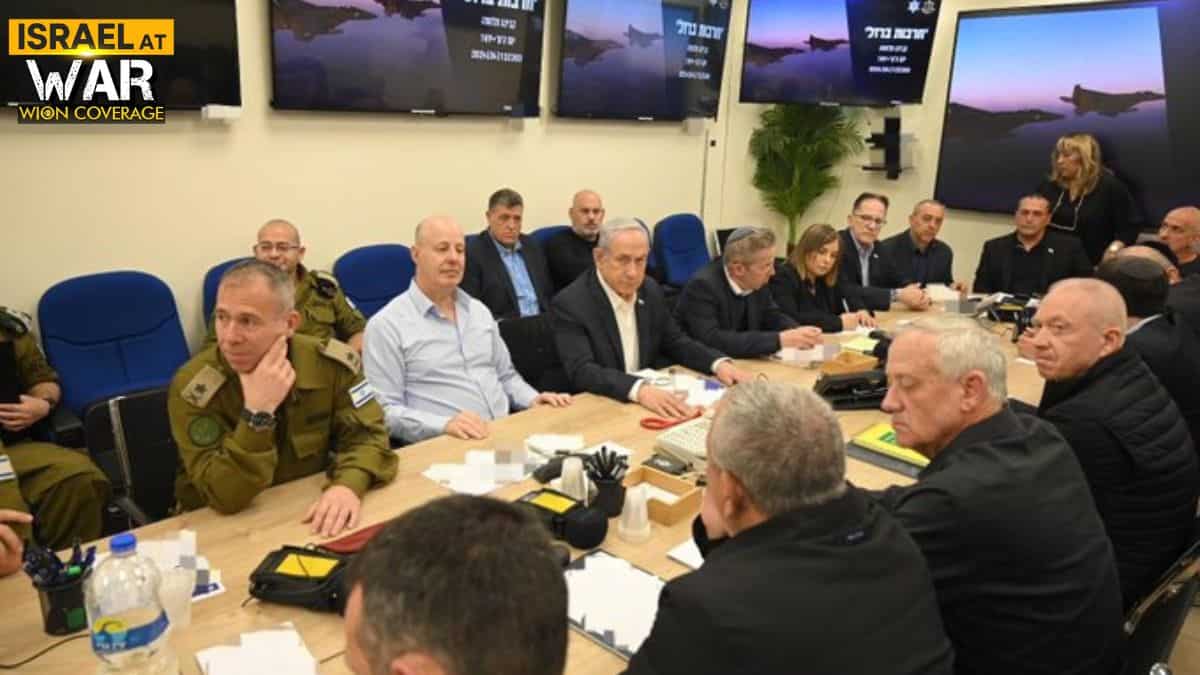
Israel Prime Minister Benjamin Netanyahu convenes the War Cabinet.
The war cabinet of Israel held a meeting to discuss and decide how they would respond to the missile and drone attack of Iran. Israel did not announce if they had reached a decision.
The actions of Iran were strongly condemned by the allies of Israel, however, Prime Minister Benjamin Netanyahu's government was appealed by the countries to show some restraint.
Even though Iran has signalled they consider the matter closed, the Israeli military's chief of staff Lt Gen Herzi Halevi said that the attack will not go unanswered.

“This launch of so many missiles, cruise missiles and drones into Israeli territory will be met with a response,” said Halevi, while speaking from the Nevatim Air Force base in southern Israel, which also suffered a little damage in the attack.
Since the attack, this is the clearest confirmation given by Israel Defense Forces Chief of Staff Lt Gen Herzi Halevi that Israel would strike back.
Also Read:Iran says it informed neighbours about attack on Israel 72 hours in advance
)
'Blockbuster' nor'easter develops an eye similar to hurricanes as warnings are issued
)
US faces fresh cost crunch as mortgage rates hit 7%, oil tops $107 and gas prices surge
)
'Fund people, not bombs': Hundreds take to New York streets as Netanyahu delivers speech at UN; dozens arrested
)
UNGA 2026: Israeli PM attacks Britain, France for past colonialism
)
Alarming video emerges as landslide damages houses in Sikkim’s Rimbi village. Watch
)
What’s in a name? Trump’s 'Lake America' move gets a tit-for-tat response from Canada
&im=FitAndFill=(700,400))
Netanyahu at UN: Mass walkout, attack on Mamdani and Iran threats | In Pics
)
Susan Sarandon and Hannah Einbinder detained by NYPD outside UN Headquarters
)
Air India pilot suspended after failing pre-flight alcohol test on Zurich-Delhi route
)
CNN, Politico and MS NOW back in White House after judge blocks Trump’s media ban
)
Nations League: Germany draw on Klopp debut; Portugal, Norway win
)
Trump's welcome to Xi demonstrates 'attraction' to dictators: Chuck Schumer
)
Yemen called Trump for US military support in fight against Houthis: Official
)
Bollywood mourns Mushtaq Khan: Sunny Deol, Rajpal Yadav and others pay tribute
)
‘We’ve never gotten along better’: Trump praises Xi, jokes about White House ballroom at high-stakes state dinner
Don't Be Shy movie review: A frothy coming-of-age tale that is too shy to experiment
)
Scientists detect first radio signals directly from faraway planet
)
OpenAI is building AI to fight cyber threats: What GPT-6 Cyber means for security
)
Trump gifts Xi a bald eagle sculpture at White House dinner: Here’s what it symbolises
)
Tesla is preparing something big for Optimus: new Gen 3 models surface in app
)
Bias or safety concerns? Bengaluru CEO says firm will not hire men from UP, Bihar, Rajasthan, MP. Here's why
)
Xi Jinping's 'special plane' vs Trump's Air Force One: What's the difference?
)
'What kind of confession is this?': Pakistan PM Shehbaz Sharif’s 'terrorists would be roaming New York' remark goes viral, raises alarm online. Watch
)
WATCH: Pak PM Shehbaz Sharif refuses to answer on Hafeez Sayeed, walks away
)
WION Iconic Tourism Summit 2026: Union Minister Shekhawat on 'experiential travel', peace diplomacy
)
Israeli envoy to US Yechiel Leiter’s son critically injured in West Bank ramming attack
)
Meet Adrian Abraham: 9-year-old Indian-origin guitar prodigy aiming for a Guinness World Record
)
Outrage erupts after 3-year-old is married to 60-year-old man in Pakistan, link to her sister's murder being probed
)
The Vvaan Review: This Ekta Kapoor's Tulsi Virani-coded world can't be saved by Sidharth Malhotra and Tamannaah Bhatia
)
A seven-day roadmap? Iran proposes plan to end war, reopen Strait of Hormuz and resume nuclear talks
)
‘Not just a local tragedy’: Nepal PM Shah warns UN of growing climate threat, says Nepal floods were 'a warning to the world'
)
China to test supersonic jet that moves at Mach 2, double the speed of sound
)
West Indies coach Sammy looking at India series as opportunity to finetune ahead of ODI World Cup 2027 qualifiers
)
'FIRST LOOK from inside Noah’s Ark': Researchers share video from inside mysterious mound in Turkey
)
Farhan, who went viral for AK47 celebration vs India in Asia Cup, hopes to lead Pakistan beyond Asian Games
)
'We do not wish to continue. It's America that must choose': Iran president Pezeshkian calls on US to end war
)
Myanmar training camp case: US national, 6 Ukrainians allowed to meet their families abroad
)
'Making history': Xi Jinping praises Trump as US-China leaders dine at White House
)
Meanwhile, Iran stated that they would respond to any strikes from Israel in 'seconds'.
Iran's Deputy Foreign Minister for Political Affairs, Ali Bagheri Kan emphasised that the response speed from Iran "will be less than a few seconds."
In the last two days, Israel’s war cabinet held a meeting for the fourth time as Prime Minister Benjamin Netanyahu again discussed what should be the next step with his Defence Minister Yoav Gallant, and Benny Gantz, the former defence minister and centrist Netanyahu rival.
Netanyahu appeals countries to 'stand united' against Iran
Israeli Prime Minister Benjamin Netanyahu said that world peace is being threatened by Iran and asked the international community to stand united against the Islamic Republic.
"The international community must continue to stand united in resisting this Iranian aggression, which threatens world peace," Netanyahu said, in a statement released by his office on X.
IAEA chief says Israel may strike Iran nuclear facilities
International Atomic Energy Agency (IAEA) Director General Rafael Grossi said that the nuclear facilities had been closed in Iran over “security considerations” and although it was reopened on Monday (April 16), IAEA inspectors were kept away “until we see that the situation is completely calm.”
“We are going to resume tomorrow. This has not had an impact on our inspection activity," said Grossi, while speaking to reporters in New York.
Speaking about the possibility of Israeli striking Iranian nuclear facilities, Grossi said, “We are always concerned about this possibility.” He urged “extreme restraint.”
US says 'not involved' in Israel's decision-making process
The US officials on Monday (April 15) said that Israel is most likely to counter Iran’s attack, in which more than 300 missiles and drones were involved.
However, the Biden administration is hoping that Israel's retaliation will be limited to counterstrikes and they will not aim at Iranian territory.
Speaking to CNN on Monday (April 15), White House national security spokesperson John Kirby said, “We respect that that’s a decision the war cabinet, the prime minister, have to make. We know that they live in a very tough neighbourhood. We are not involved in their decision-making process about a potential response."
Watch:Iran attacks Israel: Israel's war cabinet decides to retaliate: Reports
However, he said that US President Joe Biden had “also been very clear that we don’t want a war with Iran. We don’t seek to widen and broaden this conflict. We don’t want to see things escalate.”
The Pentagon said that additional fighter squadrons which were stationed in the Middle East before the weekend are still there.
Pentagon press secretary Maj. Gen. Pat Ryder said that Air Force fighter jet squadrons in the region along with the Navy ships in the Mediterranean Sea shot down Iranian missiles and drones early on Sunday (April 14).
(With inputs from agencies)