In a move likely to anger China, Pompeo lifts restrictions on US-Taiwan relationship

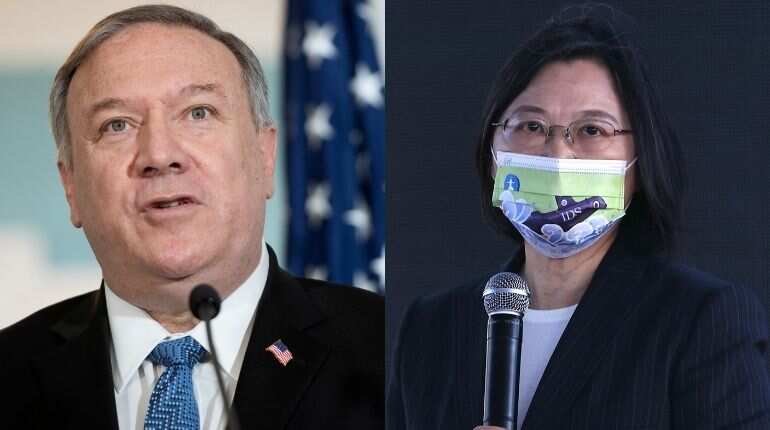
Mike Pompeo and Tsai Ing-wen
Secretary of State Mike Pompeo said on Saturday that theUnited States is ending decades-old restrictions governing official contacts with Taiwan,a move likely to anger China and increase tensions between Beijing and Washington in the waning days of President Donald Trump's presidency.
In a statement, Pompeo said that for several decades the State Department had created complex internal restrictions on interactions with Taiwanese counterparts by American diplomats, service members and other officials.

"The United States government took these actions unilaterally, in an attempt to appease the Communist regime in Beijing," Pompeo said in a statement.
"Today I am announcing that I am lifting all of these self-imposed restrictions," he added.
He said the "complex internal restrictions" on contacts with Taipei by diplomats, service members and others had been imposed "in an attempt to appease the Communist regime in Beijing."
&im=FitAndFill=(700,400))
National Handloom Day 2026: From Alia Bhatt to Samantha Ruth Prabhu; Actresses who celebrated India's textile heritage as brides
)
The Royals enter the Doctor Who universe: King Charles and Queen Camilla beam into Commonwealth Games in TARDIS
)
Unitree Robotics targets $9 billion valuation in landmark IPO backed by DeepSeek and Tencent
)
India names 27 sites in Arunachal Pradesh
)
Bharat Bhhagya Viddhaata OTT: When will Kangana Ranaut's film stream online?
&im=FitAndFill=(700,400))
How many soldiers operate one S-400 battery?
)
Shakib Al Hasan ready to return to Bangladesh—under one condition
)
‘Fake news’: MEA rejects report claiming India sought defence pact with Israel after Pakistan, Saudi Arabia, Turkey deal
)
Rockstar to unveil GTA 6 extended look ahead of November launch
)
Russia forms Ukrainian Volunteer Spetsnaz Brigade to fight Ukraine
)
Drug-resistant fungus that hides in hair and enters bloodstream reported in 23 US states
)
Technology transfer deal boosts India's defence manufacturing ambitions
)
Border row erupts in Europe after Ceuta crossings, Spain imposes border controls on Italy
)
Morale plummets on USS Abraham Lincoln: Are US sailors reaching a breaking point? | GRAVITAS
)
'Security can't be bought with Pakistan, Turkey deal': Iran tells Saudi Arabia
)
Baba Vanga's 2026 prophecy: 2 predictions 'already came true', 3 terrifying ones remain. Details inside
)
Colombia’s new president Abelardo de la Espriella vows to ‘defeat narco-terrorists’, signals hardline shift
&im=FitAndFill=(700,400))
New Friday OTT releases (August 7, 2026): Operation Safed Sagar, Vadhandhi, Main Vaapis Aaunga- 6 movies and TV shows on Netflix, Prime Video and more
)
Squadron Leader Bhawana Kanth scripts history as Indian Air Force gets its first woman ‘Top Gun’ pilot
)
RSS says Gen Z protests reflect genuine distress
)
Trump says Iranian school bombing photos could be AI-generated - 'I don’t think...'
)
IAF officer held for sharing sensitive information in 'honey trap' case, booked under Official Secrets Act
)
Stray Kids under scrutiny? Fans react to Grammy submission silence after BTS boycott
&im=FitAndFill=(700,400))
Why the Su-30MKI doesn't need external fuel tanks to fly vast distances
)
Jugal Hansraj reunites with Shekhar Kapur after 40 years for Masoom: The Next Generation
)
New speed limits, automatic challans: Big traffic change coming to Delhi-Meerut Expressway. All you need to know
)
India officially names 27 places in Arunachal to counter China's renaming claims
)
Trump calls White House ballroom ruling a 'national disgrace' as court says Congress approval needed
)
US sanctions Iran’s crypto network after Strait of Hormuz attacks, offers $15m bounty for intel on IRGC finance
&im=FitAndFill=(700,400))
Why the Su-30MKI is one of the heaviest fighters ever built
)
Uttarakhand young innovator builds India's own flying vehicle, conducts first test flight: WATCH
)
Chilling video shows students take cover as teen opens fire at Thai school
)
Reese Witherspoon's father hospitalised after poolside incident in Nashville: Report
"The United States government maintains relationships with unofficial partners around the world, and Taiwan is no exception. ... Today’s statement recognizes that the US-Taiwan relationship need not, and should not, be shackled by self-imposed restrictions of our permanent bureaucracy," Pompeo said.
China claims democratic and separately ruled Taiwan as its own territory, and regularly describe Taiwan as the most sensitive issue in its ties with the United States.
While the United States, like most countries, has no official relations with Taiwan, the Trump administration has ramped up backing for the island country, with arms sales and laws to help Taiwan deal with pressure from China.
The declaration may be more symbolic than substantive in effect, but it nonetheless appears certain to anger China, which sees Taiwan as its own territory.
It comes in the final weeks of the Donald Trump administration, and at a time of already heightened tensions between Beijing and both Washington and Taipei.
It was not clear what the change means in practice, with Pompeo saying executive branch communications with Taiwan will be handled by the American Institute in Taiwan (AIT), which is owned by the US government and serves as the de facto embassy.
The shift comes after a year of mounting US-Chinese tensions.
Pompeo, who has taken an increasingly hard-line stance toward China and identified it as the principal long-term threat faced by the United States, has repeatedly used the red-button Taiwan issue to push back against Beijing.
In November, he appeared to call into question the long-standing US"one-China policy" by stating in a radio interview that Taiwan "has not been a part of China," causing Beijing to warn that behaviour that undermined "China's core interests and interferes with China's domestic affairs will be met with a resolute counterattack."
The United States is Taiwan's strongest international backer and arms supplier and is obliged to help provide it with the means to defend itself under the 1979 Taiwan Relations Act.
Clash over envoy's visit
Trump has sent multiple senior officials to Taipei over the last year, even as he clashed with China on a host of issues, ranging from its handling of the coronavirus pandemic to disputes over trade, security and human rights.
Pompeo's statement also came just two days after China warned the United States it would pay a "heavy price" if its United Nations ambassador, Kelly Craft, made good on plans to travel to Taiwan on Wednesday.
Beijing opposes any diplomatic recognition of Taiwan.
Craft's scheduled three-day visit will come just a week before Joe Biden's inauguration as US president, adding to a string of diplomatic headaches facing the incoming administration.
"The United States will pay a heavy price for its wrong action," the Chinese mission to the UN said in a statement responding to Craft's planned trip.
"China strongly urges the United States to stop its crazy provocation, stop creating new difficulties for China-US relations... and stop going further on the wrong path."