How Higgsfield sells 'unlimited' Seedance 2.5 that barely generates anything

&imwidth=600&imheight=450&format=webp&quality=medium "How Higgsfield sells 'unlimited' Seedance 2.5 that barely generates anything")
How Higgsfield sells 'unlimited' Seedance 2.5 that barely generates anything
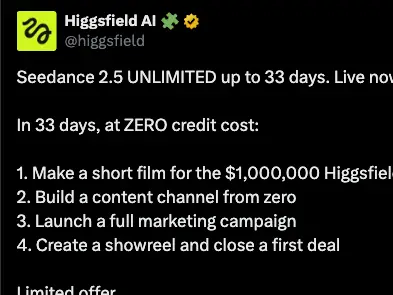
Higgsfield sold discounted ‘unlimited’ AI video plans to thousands of customers. Its own terms of use state that unlimited generations run on a queue separate from the priority queue used for paid credits, that speed is not guaranteed, and that it may throttle usage exceeding an undefined threshold. Its support has directed users to buy credits for acceptable speed, and customers report free trial accounts generating faster than plans they paid for.
Higgsfield sold thousands of people unlimited access to AI video generation, at discounts of up to 85 per cent. What many of them describe receiving is a product too slow to use and a support system that tells them to buy credits instead.
The company's own documentation explains why, and it is not a malfunction. It is designed to deceive.
The Architecture
Higgsfield operates two queues, and it says so in its own terms of use. Section 10.6 states that ‘Unlimited models operate on a dedicated processing queue, separate from the priority queue used for credit-based generations.’ Buying credits buys the priority lane. An unlimited subscription does not.
That is a design decision, not a capacity problem. A customer who pays for an unlimited plan is placed, by construction, in the slower lane. A customer who buys credits is moved to the faster one.
The practical gap is substantial. Users report that a simple 15-second video takes two to four hours on Unlimited, against 10 to 15 seconds in credit mode, the same platform, the same model. Others describe generations sitting in processing for hours. Higgsfield's own help documentation advises that if a generation is stuck for more than 10 hours, contact support.
Trending Stories
&im=FitAndFill=(700,400)&imwidth=280&imheight=210&format=webp&quality=medium)
&imwidth=280&imheight=210&format=webp&quality=medium)
&imwidth=280&imheight=210&format=webp&quality=medium)
&imwidth=280&imheight=210&format=webp&quality=medium)
&imwidth=280&imheight=210&format=webp&quality=medium)
&imwidth=280&imheight=210&format=webp&quality=medium)
&imwidth=280&imheight=210&format=webp&quality=medium)
&imwidth=280&imheight=210&format=webp&quality=medium)
&imwidth=280&imheight=210&format=webp&quality=medium)
&imwidth=280&imheight=210&format=webp&quality=medium)
&imwidth=280&imheight=210&format=webp&quality=medium)
&imwidth=280&imheight=210&format=webp&quality=medium)
&imwidth=280&imheight=210&format=webp&quality=medium)
&imwidth=280&imheight=210&format=webp&quality=medium)
&imwidth=280&imheight=210&format=webp&quality=medium)
&imwidth=280&imheight=210&format=webp&quality=medium)
&imwidth=280&imheight=210&format=webp&quality=medium)
&imwidth=280&imheight=210&format=webp&quality=medium)
&imwidth=280&imheight=210&format=webp&quality=medium)
&imwidth=280&imheight=210&format=webp&quality=medium)
&imwidth=280&imheight=210&format=webp&quality=medium)
&im=FitAndFill=(700,400)&imwidth=280&imheight=210&format=webp&quality=medium)
&imwidth=280&imheight=210&format=webp&quality=medium)
&imwidth=280&imheight=210&format=webp&quality=medium)
&imwidth=280&imheight=210&format=webp&quality=medium)
&imwidth=280&imheight=210&format=webp&quality=medium)
&imwidth=280&imheight=210&format=webp&quality=medium)
&imwidth=280&imheight=210&format=webp&quality=medium)
&im=FitAndFill=(700,400)&imwidth=280&imheight=210&format=webp&quality=medium)
&imwidth=280&imheight=210&format=webp&quality=medium)
&imwidth=280&imheight=210&format=webp&quality=medium)
&imwidth=280&imheight=210&format=webp&quality=medium)
The Company's Own Advice
The clearest evidence of how the two tiers are meant to relate comes from Higgsfield itself.
Its published guidance recommends drafting at 480p or 720p on Unlimited and using credit mode for 1080p ‘for maximum speed’. Customers on review platforms report that support, when told Unlimited was too slow to work with, directed them to use paid credits instead.
Users have described that as deceptive marketing designed to push them into buying extra credits. It is at minimum an acknowledgement, in the company's own words, that the unlimited product is the degraded one.
The Terms Permit It
Higgsfield has not hidden that it throttles. It has put it in section 10.6.
That section opens by stating that usage under tiers ‘marketed as Unlimited’ is subject to the company's ‘fair-use limits and the dynamic speed and concurrency limitations described below’. It then permits the company to ‘restrict, suspend, throttle, or place on a slower processing queue’ any usage that is ‘automated or materially exceeds typical individual use’.
The terms do not define typical individual use, set a threshold, or say who decides. The same section adds that ‘during periods of high demand, generation speeds may vary and additional concurrency limits may apply’, and that processing speed and parallel generation capacity are not guaranteed at all.
That clause is the company's legal cover, and it is a real one. Nobody buying an unlimited plan can claim they were told throttling would never occur. But ‘unlimited’ was the word on the promotion, at $25 a month with 65 per cent off, and the qualification sits in a clause with no number attached to it — leaving the company sole authority over how slow the product it sold as unlimited is permitted to become.
Users also describe a mechanism they call the battery system, in which generation speed falls the more the unlimited tier is used, replacing earlier unlimited speeds without notice.
The Pattern That Follows The Refund Window
The most striking element in customer accounts is the timing.
Subscribers describe fast generation in the first week, mild slowdown in weeks two and three, and delays of 15 to 30 minutes or more by week four — while newly created trial accounts on the same platform generate almost instantly. One customer's summary has circulated widely: paying $20 a month for unlimited while a friend on a free trial gets faster service.
Set that against the refund policy. Section 9.3 of the same terms permits refunds only within seven days of the initial purchase, only where no credits have been used, and minus a service fee of up to six per cent. Renewals are excluded in as many words: refunds apply to ‘initial purchases, not renewals’.
So the degradation customers describe becomes unmistakable in roughly week four, and the window to reclaim the money closes at day seven. Whether that alignment is deliberate or a consequence of infrastructure filling up, the effect on the customer is the same: by the time the problem is undeniable, the contractual remedy has expired.
What Happened To The Heavy Users
On December 19, 2025, Higgsfield banned large numbers of heavy unlimited-plan users. Accounts froze and credits disappeared.
The company's position was that 99 per cent of the bans involved fraudulent activity through what it described as grey or black payment methods. Numerous affected users said they had paid with ordinary personal credit cards, with no intermediary involved.
Customers also report terms changing after purchase: concurrent generation slots cut without notice, and content filters applied retroactively to accounts bought before they existed. On Trustpilot, multiple users reported that suspensions began shortly after Higgsfield stopped selling unlimited plans. The company says suspensions follow content violations and denies any correlation with unlimited holders.
What Is Not In Dispute
Higgsfield refunded $1.35 million to users affected by slowdowns, attributing those partly to some 40,000 fraudulent bot accounts it closed over December and January. A company does not refund $1.35 million over a problem it believes did not occur.
Chief executive Alex Mashrabov, formerly head of generative AI at Snap, has acknowledged the criticism directly: ‘Rapid scaling brings real challenges. We acknowledge that our internal processes and external communications haven’t always kept pace with our core values, and we have made mistakes.'
The company's Trustpilot rating sits at around 3.2 out of 5 across more than 1,200 reviews, and it carries an open complaints record with the Better Business Bureau. A post on the verified-employee platform Blind is titled simply: higgsfield is a total bait and switch.
The Word That Is Doing The Work
None of this is unique to one company, and that is the more useful point for anyone about to pay for an AI subscription.
‘Unlimited’ has quietly been redefined across the industry to mean generation without credit deduction — not without limits. Speed throttling, resolution caps, concurrency limits and queue deprioritisation have become standard instruments for controlling infrastructure costs while keeping the word in the marketing.
There is precedent for where that ends. The US Federal Trade Commission sued AT&T over throttling customers on plans sold as unlimited data. The AI industry is now using the same word, with the same gap between the promise and the delivery, and none of the regulatory attention.
For customers, the practical defences are unglamorous. Read the throttling clause before the marketing. Note the refund window, and test the product hard inside it rather than after. And treat ‘unlimited’ as a claim about billing rather than about performance — because on the evidence of Higgsfield's own architecture, that is precisely what it now means.
