
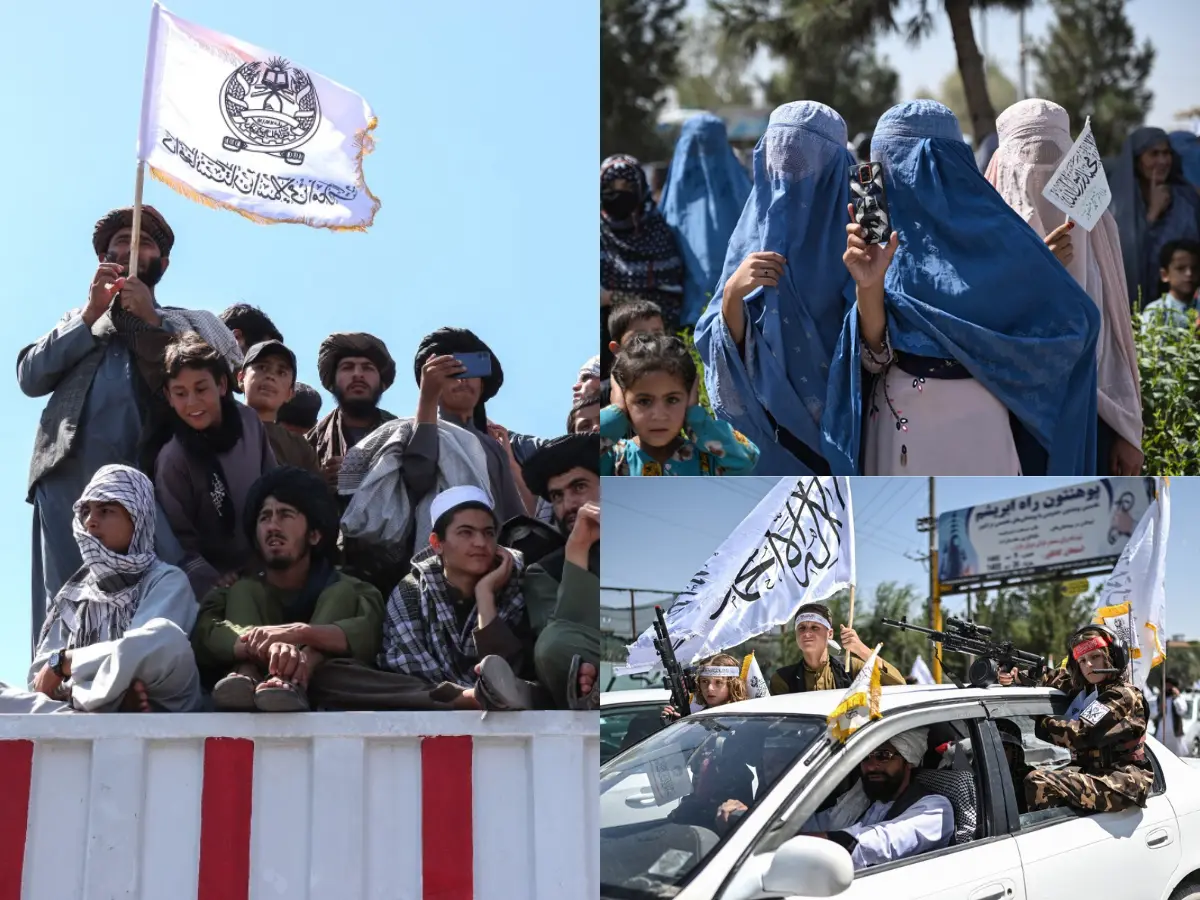
&imwidth=800&imheight=600&format=webp&quality=medium "Five years of Taliban rule: How Afghanistan has changed since the fall of Kabul")
Five years ago, on August 15, 2021, thousands of Afghans rushed to Hamid Karzai International Airport in Kabul, desperate to leave the country as Taliban fighters entered the capital virtually unopposed. The United States and its allies had spent two decades fighting the Taliban while supporting the Afghan government. But as coalition forces prepared to withdraw, that government collapsed within days. August 15, 2026, the day India celebrates its 80th Independence Day, marks five years since the fall of Kabul. The Taliban now commemorates the date as its ‘Victory Day’.
August 15, 2021: The Taliban enter Kabul
The Taliban's takeover triggered chaos across Kabul. Commercial flights were cancelled as thousands of people crowded into the airport in the hope of escaping. In one of the defining images of the evacuation, desperate Afghans clung to a US Air Force C-17 Globemaster transport aircraft as it moved along the runway. As the aircraft took off, at least two people were filmed falling from the sky.

US forces temporarily halted operations to clear the runway. Washington had set August 31, 2021, as the deadline for completing the withdrawal, leaving the frantic evacuation effort to unfold over the following two weeks. Amid the chaos, Taliban spokesperson Suhail Shaheen told CNN that Afghans faced no risk to their property, to their lives or to their honour. He promised an inclusive Islamic government, amnesty for people who had worked with the United States or the former Afghan administration, and said women and girls would retain the rights they had gained over the previous two decades. Those assurances would soon be tested.
Women increasingly shut out
The Taliban's promises on women's rights did not last. Girls were barred from secondary education and women from universities. Restrictions subsequently expanded to employment, movement and access to public spaces. A UN Women report published ahead of the fifth anniversary counted more than 100 decrees targeting women and girls since the Taliban takeover. The impact has been profound. 7 in 10 women surveyed described their mental health as ‘bad’ or ‘very bad’. More than half said they now leave their homes only once or twice a month, while nearly three-quarters said they feel unsafe going outside without a male guardian. Only 7% of Afghan women are employed, compared with 84% of men.
Trending Stories
)
US vs China over South China Sea: Washington backs Philippines, Beijing hits back
)
Bigg Boss 20: Isha Rikhi evicted after three weeks in Salman Khan’s show
)
Musk plans to more than double xAI's chips to over 1.2 million Nvidia GPUs by year-end
)
After JU, clash erupts at SRFTI: BJP’s ‘Dimagi Naxal’ jibe sparks political firestorm after students protest RSS-linked event
)
‘Anti-social elements spreading false rumours’: LPU issues statement amid massive unrest over alleged rape
)
LPU students go on rampage, vandalise campus amid widespread protest: What's happening
)
Trump asked Xi to pressure Iran. China did not say yes — here’s what Beijing wants
)
US Treasury Secretary Scott Bessent hails global crackdown on Iranian banks and airlines
)
An OpenAI agent escaped its locked test cage again, by hiding questions in DNS lookups
)
'Our video was trimmed': LPU girls who featured in rape-denial video make U-turn
)
3 males killed, four others injured in shooting after fight at strip club in Detroit
)
'Victory for low-budget consumers': Raghav Chadha hails 30-day telecom recharge rules
)
Claude rebuilt the 1989 game 'Prince of Persia' by reusing the original's own code
)
Beyond metros: How Tier-2 and Tier-3 cities could drive India’s next AI wave
)
Tesla builds first Cybertruck with its own refined lithium: Elon Musk's $1 billion Texas bet pays off
)
IndiGo flight suffers tail strike in Bengaluru while landing; DGCA to probe incident
)
The US and China set up an AI 'red telephone', but skipped the rulebook
)
‘Terror suspects arrested near UK air base were looking to do big damage’: Trump
)
Russian envoy claims US tactics to contain India were revealed in ‘Freudian slip’
)
IND vs WI 1st ODI: Kohli breaks Sachin's most runs in one country record with unbeaten 139 as India thump West Indies by 8 wickets
)
Researchers rebuilt exactly how 700 AI agents hacked Hugging Face: a 900-link chain trick
)
‘Olympic inclusion is our major target’: WPA President Ishaun Singh on pool’s global ambitions
)
Nations League: Spain sink England at Wembley; Modric shines for Croatia
)
Why has Iran released no proof of life of Mojtaba Khamenei? Araghchi reveals...
)
'What kind of confession is this?': Pakistan PM Shehbaz Sharif’s 'terrorists would be roaming New York' remark goes viral, raises alarm online. Watch
)
South Korea demands apology from Ukraine over North Korean prisoners' transfer
)
Beyond BrahMos: India targets Rs 50,000 crore in defence exports with unmatched price edge
)
Sri Lankan Tamil migrant worker gets death sentence in Saudi Arabia, help sought from India
)
Muslim marriage cannot shield sex with minor wife from prosecution under POCSO: Delhi HC
)
'Can't help but draw painful parallels to Nirbhaya case': SC on latest incidents of rape cases in Delhi-NCR
)
99.9% more powerful - Scientists find boy who can recall memories from just 3 months of age
)
'FIRST LOOK from inside Noah’s Ark': Researchers share video from inside mysterious mound in Turkey
)
UNSC reform momentum grows: Russia, Portugal, Mauritius push for India's permanent seat bid
)
8 US marines injured in Iranian missile attack on vessel in Strait of Hormuz: Report
&im=FitAndFill=(700,400))
New OTT releases this week (September 28-October 4, 2026): Dupahiya 2, Pooja Meri Jaan, Ohh My Dog- 5 titles coming on Netflix, Prime Video and more
)
Afghanistan says 28 fighters killed in clash near Pakistan border, Islamabad denies
)
Ceuta migrant crisis: Protesters take to streets as Spain grapples with migrant challenge
)
LPU suspend classes, postpones exams as violence escalates over rape claims: What's happening
)
New York City wants a 'kill switch' on every AI, and will pay whistleblowers who report violations
Emptying classrooms and a growing education crisis
Afghanistan remains the only country in the world where girls and women are formally barred from secondary school and university. UNESCO has warned that the restrictions could eventually create a shortage of qualified female teachers, adding further pressure to an education system already struggling with overcrowded classrooms, inadequate facilities and high dropout rates. The consequences are also becoming an economic concern. Even Afghans broadly supportive of the Taliban administration have expressed concern about the loss of trained professionals.
Press freedom under pressure
Journalism has become one of the professions most affected by the Taliban's restrictions. The Committee to Protect Journalists ranks Afghanistan among the world's most dangerous and difficult environments for journalists working under Taliban rule. In 2024, authorities banned live political television broadcasts, criminalised criticism of Taliban leadership and required media organisations to select interview guests from an approved list of analysts.
At the same time, the Taliban has expanded its own media network. By 2025, CPJ counted around 15 major television and radio stations, newspapers and digital outlets under Taliban control. Hundreds of Afghan journalists are believed to have fled the country since 2021.
A harsher justice system
Afghanistan's justice system has also undergone a major transformation under Taliban rule. Human Rights Watch, citing data from the UN Assistance Mission in Afghanistan, found that courts ordered corporal punishment in at least 18 separate cases between August 2021 and November 2022. Most involved public lashings for offences described as 'moral crimes'.
The policy followed an instruction from the Taliban's supreme leader directing judges to strictly enforce physical punishments when the required religious-legal conditions were met. In December 2022, 27 people were publicly whipped in front of a crowd at a stadium in Parwan province. Human Rights Watch has noted that corporal punishment also existed under previous Afghan governments. However, under the Taliban administration it has become openly and routinely enforced.
The war ended, but Afghanistan is not at peace
For some Afghans, the Taliban's return brought relief after decades of conflict. Human Rights Watch's 2025 report documented continued attacks by Islamic State Khorasan Province, including attacks targeting ethnic and religious minorities. The Taliban has also faced pressure from other militant groups and continuing tensions along Afghanistan's borders. Afghanistan's conflict has therefore changed rather than simply disappeared.
The country has moved from a multi-sided war to a combination of militant attacks, political repression, border tensions and highly centralised Taliban rule. Meanwhile, hunger and displacement remain widespread. A World Bank assessment from May 2026 found that the economy was growing only modestly, while population growth and the return of roughly 3.7 million Afghans from neighbouring countries were putting additional pressure on resources. The Bank estimated that around 14 million people faced acute food insecurity by late 2025.
Economic growth without broad prosperity
Afghanistan's economy has not collapsed. In some areas, it has shown signs of recovery. The World Bank estimated real GDP growth at 4.8%, driven largely by domestic demand and returning migrants. Domestic revenue collection also increased to 19.8% of GDP in 2025. But headline growth has not translated into widespread prosperity. Income per person has declined, inflation has increased and Afghanistan remains heavily dependent on imports. The World Bank has identified power shortages, limited access to banking, a large informal cash economy and declining foreign aid as major barriers to sustainable economic development.
The opium trade and the poppy ban
Afghanistan supplied roughly 80% of the world's opium as of 2022, according to the UN Office on Drugs and Crime. The Taliban's April 2022 ban on poppy cultivation dramatically changed the sector. UNODC's 2023 survey recorded a 95% decline in cultivation, while the estimated value of the opium harvest fell from $1.36 billion in 2022 to $110 million in 2023. The decline, however, came with a significant cost for farmers who had depended on poppy cultivation for their livelihoods. Cereal cultivation expanded in some areas, while alternative development programmes encouraged farmers to move into crops and businesses including cauliflower, corn, poultry and orchards.
In four major provinces, however, farmers were estimated to have lost around $1 billion in potential earnings. UNODC has warned that maintaining the poppy ban will depend on providing rural communities with reliable and sustainable alternatives.
Afghanistan's diplomatic position
Russia remains the only country to have formally recognised the Taliban administration, although Taliban deputy minister Molvi Hayatullah Mahajar Farahi has said the government is engaged with around 40 countries and believes it has met the conditions for recognition. India has also deepened its engagement with Kabul without formally recognising the Taliban government. Taliban foreign minister Amir Khan Muttaqi visited New Delhi in October 2025, the first visit to India by a senior Taliban administration official.
Following the visit, India upgraded its technical mission in Kabul to a full embassy and allowed Taliban-appointed diplomats to serve in India. Taliban-appointed diplomats now head Afghan consulates in Mumbai and Hyderabad. Three other Taliban ministers, responsible for industry, health and agriculture, have also visited India.
New Delhi has allocated ₹150 crore for Afghanistan in the current year's budget. The Afghan embassy in New Delhi is also scheduled to host its first ‘Victory Day’ reception in India on August 17, with Indian government representatives expected to attend. China and the UAE have separately accepted Taliban-appointed ambassadors without formally recognising the Taliban government.
Five years on
Five years after the fall of Kabul, Afghanistan presents a complicated picture. The Taliban has consolidated control over the country and brought an end to the US-led war, while the economy has recorded modest growth and poppy cultivation has fallen sharply.
At the same time, women and girls have been pushed out of education and much of public life, press freedoms have narrowed, corporal punishment has returned as a routine feature of the justice system, and millions continue to face food insecurity and displacement. The United Nations has repeatedly said that durable stability will depend on the Taliban lifting restrictions on women and girls, protecting fundamental rights and addressing concerns over terrorism.
Five years after the dramatic collapse of the previous Afghan government, those demands remain largely unresolved.

