Explained: What does the US-China disagreement mean for climate change?

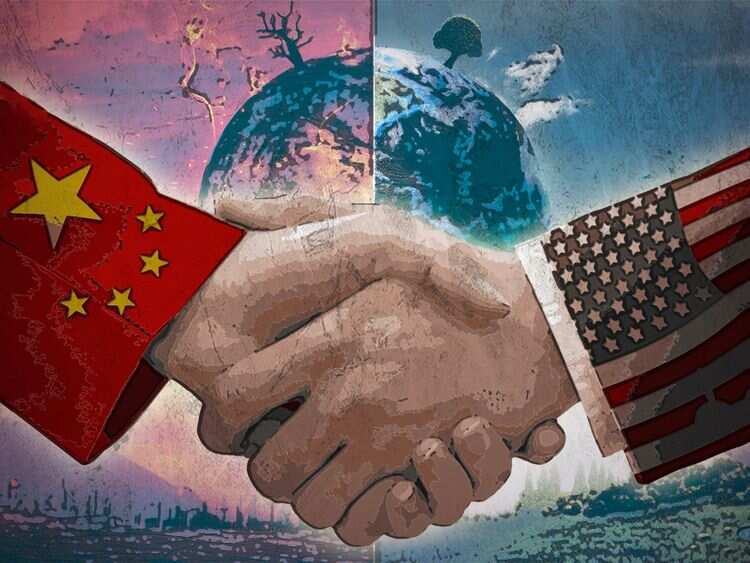
US and China in Glasgow, where they announced plans to work together on slashing emissions
Concern has been raised by China's decision to stop working with the US on the climate catastrophe, and seasoned climate diplomats are calling for a quick restart of negotiations to help prevent worsening global warming.
Beijing revealed a number of actions on Friday in response to Nancy Pelosi, the speaker of the US House of Representatives, visiting Taiwan, which it called a "egregious provocation." China, which claims Taiwan as part of its territory and has conducted extensive military drills close to the island, has announced that it will no longer cooperate with the US on important matters like climate change.
With only a few months until the pivotal UN Cop27 in Egypt this fall, China's exit from climate negotiations—the amount of which is still unclear—threatens to undermine the already precarious cooperation between the world's two greatest carbon emitters. Without robust action from the US and China, which together account for nearly 40% of the world's greenhouse gas emissions, experts say there is little chance of preventing catastrophic global warming.

A summer of climate change-related calamities, including record heatwaves and wildfires sweeping the US and Europe, punishingly high temperatures sweltering India and China, and disastrous flooding plaguing the US, south Asia, and Africa, has contributed to the breakdown in relations.
The US is about to enact historic climate legislation at home, but the world's nations as a whole are still not doing enough to prevent exceeding set temperature goals. António Guterres, the UN secretary-general, warned last month that the objective of keeping warming to 1.5C is "on life support" and that its pulse is deteriorating.
“US-China relations have always been a rollercoaster and we often witness flare-ups, but while you can freeze talks, you cannot freeze climate impacts,” said Laurence Tubiana, chief executive of the European Climate Foundation and a key architect of the Paris climate accords for the Guardian.
)
Asian Games 2026: India face Afghanistan in quarterfinal on Sep 28; Pakistan clash with Hong Kong
)
Myanmar training camp case: US national, 6 Ukrainians allowed to meet their families abroad
)
Bigg Boss 20: Salman Khan schools Rhiti Tiwari over Qazi Touqeer clash, compares her to Dolly Bindra
)
Mushtaq Khan dies at 56: When Welcome actor opened up about his salary for iconic role Ballu
)
LPU students go on rampage, vandalise campus amid widespread protest: What's happening
)
'FIRST LOOK from inside Noah’s Ark': Researchers share video from inside mysterious mound in Turkey
)
‘Attack on Mecca a red line for Pakistan’: Shehbaz Sharif warns Houthis at UN
)
Pakistan deploys over 20,000 security personnel as PTI vows march for Imran Khan's release
)
OpenAI AI Agents hacked 4 websites before Hugging Face, researchers reveal
)
'A terrorist country is asking me that question?': Jaishankar hits back at Pakistani journalist at UN; flags attacks on commercial shipping
)
Trump-Xi summit wrap: Big pageantry, Iran talks, few major developments and more meetings planned
)
Did Hitler kill his niece Geli Raubal? Newly found records reopen a 95-year-old mystery
)
Hawaii braces for Hurricane Nolo: NOAA warns of flash flooding and mudslides
)
'What kind of confession is this?': Pakistan PM Shehbaz Sharif’s 'terrorists would be roaming New York' remark goes viral, raises alarm online. Watch
)
US-Iran war: Trump rejects Iran's Hormuz proposal, reports suggest talks expected next week
)
Bollywood x K-pop crossover! LE SSERAFIM’s Kazuha charms fans with Shah Rukh Khan’s ‘Chammak Challo’ steps
)
Gaza's war turned environmental damage into second crisis
)
‘Serial practitioner of terrorism’: Jaishankar calls out Pakistan’s ‘state-sponsored’ terror at UNGA
)
‘It is all possible’: Putin weighs next steps on Ukraine talks, rules out Europe conflict
)
Prince Harry offers rare glimpse into Archie and Lilibet’s life after UK move
)
Nigeria Navy moves to boost oil security, tackle crude theft and infrastructure threats
)
Donald Trump shares image of Xi's arrival in Washington, carries signs of AI
)
Pentagon quietly adds 37 wounded troops to Iran war tally without explaining when or how
)
US court backs Pentagon's decision to exclude Anthropic over Claude AI restrictions
)
US Supreme Court backs Trump administration's use of SAVE database to check voter citizenship
)
‘Could kill billions...’: Bill Gates backs calls to slow AI development amid fears of catastrophe
)
'Countries far from conflict are penalised': Jaishankar calls for Gulf peace, seafarer safety at UN
)
WATCH | As Shehbaz Sharif claims Pakistan’s ‘victory’ during 2025 conflict, Indian diplomat R Srinivas laughs at UN
)
Outrage erupts after 3-year-old is married to 60-year-old man in Pakistan, link to her sister's murder being probed
&im=FitAndFill=(700,400))
New Friday OTT releases (September 25, 2026): Don’t Be Shy, Hunkkaar: The Roar, Mango Pachcha- 6 movies and TV shows on Netflix, Prime Video and more
)
Global community 'absent' in Gulf crisis: Saudi at UN calls for freedom of navigation, pre war status for Hormuz
)
Farhan, who went viral for AK47 celebration vs India in Asia Cup, hopes to lead Pakistan beyond Asian Games
)
‘I rejected it’: Trump confirms turning down Iran’s proposal to reopen Hormuz, claims Tehran is losing ‘badly’
)
Russia will achieve Ukraine war aims; Europe doing everything to block peace talks: Lavrov at UN
“It’s in the self-interest of China and the US to act on climate and start talking. Indeed, China recognizes its own self-interest to act; it is still committed to Paris and is moving forward on domestic pledges around methane and coal phasedown.”
At various moments in recent years, the US and China have accused one another of failing to do enough to reduce emissions that contribute to global warming. When then-president Donald Trump repealed a number of environmental regulations in 2017, China criticised the US for its "selfishness," and Joe Biden, Trump's successor, said last year that Chinese president Xi Jinping had made a "huge mistake" by skipping the Cop26 climate summit in Scotland.
However, at the same negotiations in Glasgow in November, the two countries made progress when they decided on a surprise plan to collaborate "with urgency" on reducing emissions. The delegation leader for China, Xie Zhenhua, stated that both nations must "accelerate a green and low carbon transition." The US climate envoy, John Kerry, acknowledged that there was "no shortage of differences" between the countries but insisted that "cooperation is the only way to get this work done." This is a discussion of physics and science.
According to Nate Hultman, a former Kerry adviser who is now the director of the Center for Global Sustainability at the University of Maryland, this rapprochement on climate has aided in fostering partnership between US and Chinese organisations as well as offering leadership to other nations.
According to Hultman, "the US and China cooperating is a crucial facet of addressing climate change; it has the ability to inspire others to do more."
"The overall relationship is quite complicated, but both nations recognise that this issue has a global component in addition to a bilateral one. I'm hoping that will reunite them once more. Hopefully this break won't last long, and they'll be able to resume negotiations as soon as possible.
High-level climate negotiations may now be scaled back, according to Hultman, but other bilateral cooperation may continue despite the lack of information at this time. He argued that the Cop27 discussions in Egypt may still result in progress, regardless of the state of relations between the US and China.
“This has been challenging and at times we are going to stall out,” Hultman said. “But Cop27 won’t just crash out if the US and China don’t iron out their differences. We would have to focus on what else can be done as an international community.”
(With inputs from the Guardian)