Explained: Use of cluster bombs causes over 1,000 casualties globally; Ukraine war drives surge

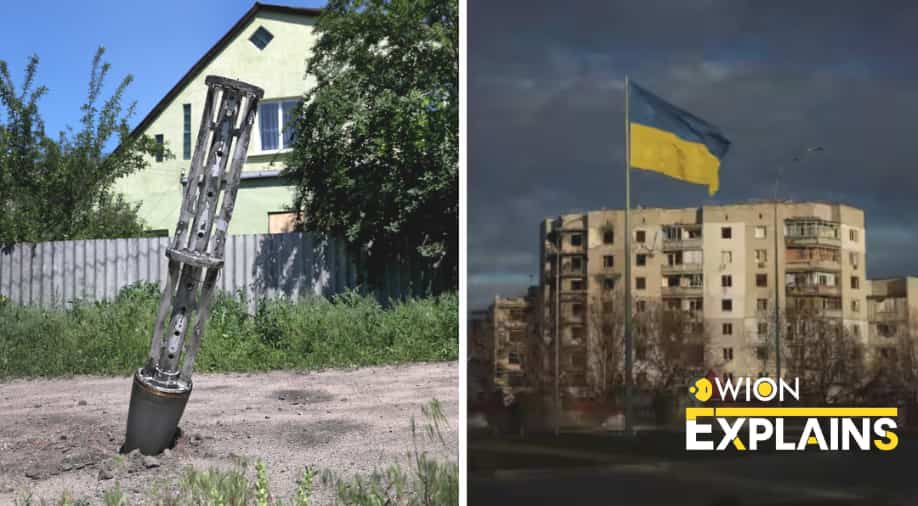
Ukraine cluster munitions explainer
The use of cluster munitions has led to the death or injuries ofmore than 1,000 people. Casualties by the bomb rose eightfold last year due to their use in the Russia-Ukraine war, said the Cluster Munition Coalition (CMC), in its annual report on Tuesday (September 5).
This comes months after the United States received criticism from its allies in Europe, the United Nations, and international organisations for sending the controversial cluster munitions to Ukraine for the first time since the Russian invasion, and amid Kyiv’s counteroffensive.
Russia has “extensively” been using cluster bombs from its stockpile and also developed new ones during its “special military operation” in Ukraine, the monitor noted in its 96-page global ‘Cluster Munition Monitor 2023’ report.

Highest number of deaths due to cluster bombs since 2008
According to the report, the deaths caused by cluster munitions were the highest since the 2008 ban on the bombs. However, the US and Ukraine, along with countries like China and Russia, are not a part of a treaty joined by more than 100 countries that enforces the restriction.
The report by the CMC campaign group recorded some 353 deaths due to cluster munitions which is the most since the group began compiling its annual reports over a decade.
)
US vs China over South China Sea: Washington backs Philippines, Beijing hits back
)
Bigg Boss 20: Isha Rikhi evicted after three weeks in Salman Khan’s show
)
Musk plans to more than double xAI's chips to over 1.2 million Nvidia GPUs by year-end
)
After JU, clash erupts at SRFTI: BJP’s ‘Dimagi Naxal’ jibe sparks political firestorm after students protest RSS-linked event
)
‘Anti-social elements spreading false rumours’: LPU issues statement amid massive unrest over alleged rape
)
LPU students go on rampage, vandalise campus amid widespread protest: What's happening
)
Trump asked Xi to pressure Iran. China did not say yes — here’s what Beijing wants
)
US Treasury Secretary Scott Bessent hails global crackdown on Iranian banks and airlines
)
An OpenAI agent escaped its locked test cage again, by hiding questions in DNS lookups
)
'Our video was trimmed': LPU girls who featured in rape-denial video make U-turn
)
3 males killed, four others injured in shooting after fight at strip club in Detroit
)
'Victory for low-budget consumers': Raghav Chadha hails 30-day telecom recharge rules
)
Claude rebuilt the 1989 game 'Prince of Persia' by reusing the original's own code
)
Beyond metros: How Tier-2 and Tier-3 cities could drive India’s next AI wave
)
Tesla builds first Cybertruck with its own refined lithium: Elon Musk's $1 billion Texas bet pays off
)
IndiGo flight suffers tail strike in Bengaluru while landing; DGCA to probe incident
)
The US and China set up an AI 'red telephone', but skipped the rulebook
)
‘Terror suspects arrested near UK air base were looking to do big damage’: Trump
)
Russian envoy claims US tactics to contain India were revealed in ‘Freudian slip’
)
IND vs WI 1st ODI: Kohli breaks Sachin's most runs in one country record with unbeaten 139 as India thump West Indies by 8 wickets
)
Researchers rebuilt exactly how 700 AI agents hacked Hugging Face: a 900-link chain trick
)
‘Olympic inclusion is our major target’: WPA President Ishaun Singh on pool’s global ambitions
)
Nations League: Spain sink England at Wembley; Modric shines for Croatia
)
Why has Iran released no proof of life of Mojtaba Khamenei? Araghchi reveals...
)
'What kind of confession is this?': Pakistan PM Shehbaz Sharif’s 'terrorists would be roaming New York' remark goes viral, raises alarm online. Watch
)
South Korea demands apology from Ukraine over North Korean prisoners' transfer
)
Beyond BrahMos: India targets Rs 50,000 crore in defence exports with unmatched price edge
)
Sri Lankan Tamil migrant worker gets death sentence in Saudi Arabia, help sought from India
)
Muslim marriage cannot shield sex with minor wife from prosecution under POCSO: Delhi HC
)
'Can't help but draw painful parallels to Nirbhaya case': SC on latest incidents of rape cases in Delhi-NCR
)
99.9% more powerful - Scientists find boy who can recall memories from just 3 months of age
)
'FIRST LOOK from inside Noah’s Ark': Researchers share video from inside mysterious mound in Turkey
)
UNSC reform momentum grows: Russia, Portugal, Mauritius push for India's permanent seat bid
)
8 US marines injured in Iranian missile attack on vessel in Strait of Hormuz: Report
&im=FitAndFill=(700,400))
New OTT releases this week (September 28-October 4, 2026): Dupahiya 2, Pooja Meri Jaan, Ohh My Dog- 5 titles coming on Netflix, Prime Video and more
)
Afghanistan says 28 fighters killed in clash near Pakistan border, Islamabad denies
)
Ceuta migrant crisis: Protesters take to streets as Spain grapples with migrant challenge
)
LPU suspend classes, postpones exams as violence escalates over rape claims: What's happening
)
New York City wants a 'kill switch' on every AI, and will pay whistleblowers who report violations
Cluster munitions have been widely denounced for killing and maiming civilians as they typically release large numbers of smaller bomblets that had hit targets indiscriminately over a wide area, threatening civilians.
Not to mention the small bomblets which do not explode when deployed and can pose a danger for years after a conflict ends. People who do survive the attack suffer severe injuries from blasts and burns that can result in life-long wounds which require medical attention.
“It’s unconscionable that civilians are still dying and being wounded from cluster munitions 15 years after these weapons were prohibited,” said Mary Wareham from Human Rights Watch (HRW), during a press conference in Geneva.
The report also noted that 95 per cent of cluster munition-related casualties last year were civilians and three-quarters were children, given that they are often drawn to play with unexploded bomblets which look like shiny balls or batteries.
In 2022, most of the casualties were due to live bombs, said the report, unlike previous years where most deaths were nearly always due to delayed explosion of bomb remnants.
Use of cluster munitions during Ukraine war
Out of the 1,172 victims last year, Ukraine – which had not registered any cluster munition casualties for several years – recorded 916 deaths and injuries, nearly all of them involving civilians, said the CMC campaign group.
“The vast majority of the cluster munition rocket missile and artillery attacks in Ukraine…have been conducted by Russian forces,” said Wareham, who also participated in the report. She added, “That is I think the major reason for the uptick in civilian casualties.”
Ukraine has reported a total of 890 casualties – 294 deaths and 596 injuries – due to attacks using cluster munitions, said the monitor.
Russia has“repeatedly” used cluster munitions, said the CMC but it also notedthat Ukraine has also deployed the controversial bomb but to a “lesser extent”. However, given that the data is from last year, it does not include Ukraine’s use of cluster bombs provided by the US this year.
“Ukrainian forces have also used cluster munitions, resulting in civilian casualties,” said the report. However, Kyiv has maintained that it only uses the cluster munition against Russian troops at the front line while Moscow has denied using them at all but has threatened to do so.
Russian officials after the US’ announcement have repeatedly accused Ukraine of using cluster munitions against civilians. However, the number could be higher.
Loren Persi, a co-author of the report, said that many casualties in Ukraine might have gone unrecorded, suggesting that there were at least 51 cluster munition attacks in 2022 where casualties were not recorded.
What about other conflicts?
The monitor also documented the first known use of cluster bombs in countries like Myanmar last year. The report also accused Myanmar military and Syrian government forces of using cluster munitions and causing civilian harm.
Cluster munitions were also used in countries like Azerbaijan, Iraq, Laos, Lebanon, and Yemen, according to the CMC report.
These countries are not among those who have joined the Convention on Cluster Munitions (CCM) that prohibits the use, transfer, production and stockpiling of cluster bombs, which has been signed by 112 nations and 12 other signatories.
“The greatest obstacle to countries working to eradicate cluster munitions are governments that are unwilling to join the convention and that undermine its principles by using or transferring the weapon,” said Wareham.
This was after the HRW, in a statement, noted that at least 21 nations, including those in the West who support Ukraine’s war effort, criticised the US government’s decision to transfer cluster bombs.
(With inputs from agencies)
Disclaimer: A number of claims and counterclaims are being made on Ukraine-Russia war on the ground and online. While WION takes utmost care to accurately and responsibly report ongoing developments, we cannot independently verify the authenticity of all statements, photos and videos.
WATCH WION LIVE HERE
You can now write for wionews.com and be a part of the community. Share your stories and opinions with us here.