Explained | Israel: Netanyahu govt's controversial legal plan passes first reading amid protests

Israel protests
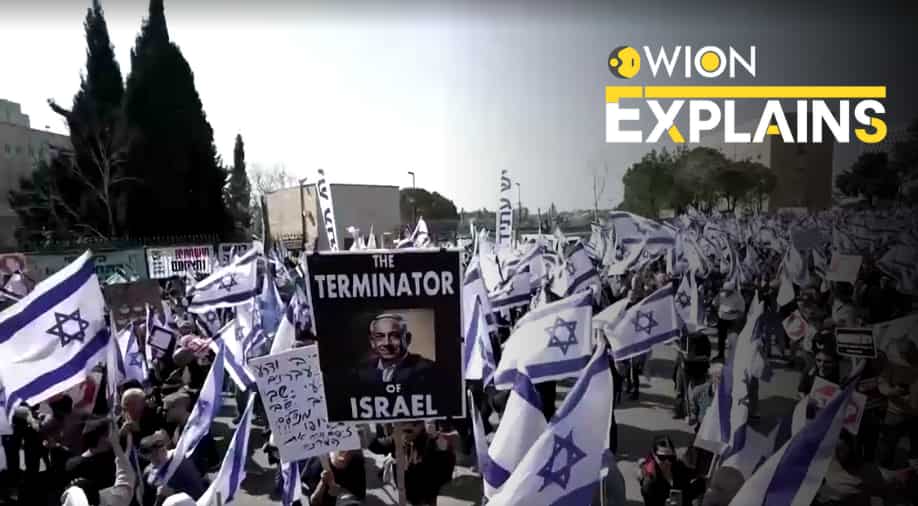
Tens of thousands of protesters gathered outside the Israeli parliament or the Knesset, on Monday (February 20) for a second straight week as lawmakers prepared to hold the first vote over the controversial plan proposed by Prime Minister Benjamin Netanyahu’s government. Over the weekend, mass demonstrations across the country against the proposed judicial overhaul entered their sixth week. In a statement, the Israeli PM accused the leaders of these protests of ‘trampling democracy’ and vowed that his government will move forward to vote on the proposed reforms.
On Monday, the first bill which seeks to amend the Basic Law would cement government control over judicial appointments and revoke the court’s ability to review Basic Laws, reported the Times of Israel. Since Israel does not have a written constitution and is governed by these Basic Laws, the separation of powers between the legislative and executive branches of government remains weak.The ruling government typically which holds a majority in the parliament, in this case, Netanyahu's party has the most power.
What we know so far
If passed, the controversial proposed judicial reforms would give the Israeli government greater control over the country’s judiciary, including the appointment of judges as well asweaken the Supreme Court. These proposed changes have also led to weeks of protest across the country. Several polls over the past weeks have shown that Israeli citizens including Netanyahu supporters either want the decision on the reforms to slow down or be shelved completely.

Critics of the judicial reforms have warned that the plans risk undermining the democratic checks and balances as it weakens the judiciary while granting additional powers to the executive. They also reportedly fear that the overhaul will allow Netanyahu to dodge the corruption charges against him, who has since denied any wrongdoing and called himself a victim of a biased judicial system.
Last week in a rare warning, Israeli President Isaac Herzog said that the country was on the brink of “constitutional and social collapse” and urged all sides to come together. On the other hand, on Sunday, the Israeli PM dismissed suggestions that the country’s democracy was under threat and said, “Israel was and will remain a strong and vibrant democracy.”
Israeli PM Netanyahu’s remarks
“They do not accept the outcome of the election, they do not accept the majority’s decision, they do not condemn calls to kill the prime minister and his family, they block roads and call for civil disobedience, they call without shame for a civil war and for blood in the streets, they threaten Knesset members aggressively,” said Netanyahu, ahead of his Likud Party’s weekly meeting, on Monday, as per local media reports.
)
Trump-Xi Summit: Trade, Taiwan and the red lines shaping US-China talks | Race To Power
)
US citizen injured in Illinois after ICE agents mistook him for fugitive, hospitalised
)
US judge questions Trump’s decision to ban CNN, MS NOW and Politico from White House
)
Afghan woman cyclist who disguised herself as a boy to escape Taliban, wins Asian Games medal
)
Italy hit by floods in the north, drought in the south
)
'There will be elections': Venezuela's interim leader Delcy Rodriguez makes big announcement at UN
)
Would you date an AI? South Korea’s My AI Partner: Strange Love sparks buzz on relationship and intimacy
)
'Arrogant parasites': Milei blasts UN over Falklands dispute, warns Argentina will ‘take matters into our own hands’
)
IIT Bombay CCTV footage emerges: Sahil Wakode seen looking at phone in examination hall
)
Cyclone Arnab: Landfall expected before midnight tomorrow as IMD issues orange alerts across six states
)
9 killed, several injured as tourist bus catches fire on Yamuna Expressway
)
NBA player Steven Adams shares hilarious GTA VI theory
)
WION Iconic Tourism Summit 2026: Union Minister Shekhawat on 'experiential travel', peace diplomacy
)
'AI got into my speech': Prince Harry jokes after teleprompter failure at event in New York
)
Scientists detect first radio signals directly from faraway planet
)
China to test supersonic jet that moves at Mach 2, double the speed of sound
)
WION Iconic Tourism Summit: 'Hanuman Ansh' Director on blockbuster success
)
'Partners rather than rivals': Xi Jinping's first message after landing in US for Trump summit
)
WION Iconic Tourism Summit: Is India's travel boom outrunning its airports, airlines and hotels?
)
IIT Bombay student suicide case: CCTV from the exam hall hours before suicide
)
2,000-foot tube, laser tests and more: China builds towns to expand nuclear arsenal, satellite images show
)
French court upholds decision to send PSG and Morocco footballer Hakimi to rape trial
)
WION Iconic Tourism Summit and Awards 2026: Key voices to discuss India’s tourism future
&im=FitAndFill=(700,400))
New OTT releases this week (September 21-27, 2026): Shaque: Trust No One, Hunkkaar, Don’t Be Shy- 5 new titles coming to Netflix, Prime Video and more
)
WATCH | China President Xi Jinping lands in US as Trump greets him ahead of high-stakes summit
)
Australian PM Anthony Albanese calls OpenAI AI incident 'unacceptable' after restricted data access
)
Claude Opus 5.5 is here: Anthropic claims it can finish a 680,000-line code migration in less than a day
)
'What kind of confession is this?': Pakistan PM Shehbaz Sharif’s 'terrorists would be roaming New York' remark goes viral, raises alarm online. Watch
)
WION Iconic Tourism Summit: How local tourism MSMEs must upskill for AI integration
)
Eight USS Abraham Lincoln sailors attempted suicide, Acting Navy Secretary says
)
Trump’s Board of Peace unveils $2.45bn Gaza plan,66 projects: But where’s the money?
)
EC appointment law: Why is the 2023 act controversial, and what happens next? WION explains
)
'Putin is patient zero': Zelensky slams Russian president at UNGA, accuses him of using fighters from 47 countries
&im=FitAndFill=(700,400))
National Film Awards 2026: Kartik Aaryan, Mammootty, Yami Gautam, Randeep Hooda and other key winners
)
El Niño 2026 heats up to become strongest in 1,000 years
)
Israeli envoy to US Yechiel Leiter’s son critically injured in West Bank ramming attack
&im=FitAndFill=(700,400))
Trump welcomes Xi Jinping in rare airport gesture: Photos from Chinese President's arrival in US
)
Xi-Trump meeting: China’s human rights red line and past protests explained
ALSO READ |Explained: Thousands protest in Israel against new government’s proposed legal reforms
He added, “The people exercised their right to vote in the elections and the people’s representatives will exercise their right to vote here in Israel’s Knesset. It’s called democracy. Today there will be a vote, and tomorrow I hope the path will be opened to dialogue.”
According to media reports, the Israeli PM’s statement was also made after a member of his party was prevented from taking her special-needs daughter to school. This comes as protesters took to the streets ahead of the first vote on the judicial overhaul andblockedmajor streets and even prevented lawmakers from leaving their homes.
“You talk above our heads in high terms of values, the rights of minorities and individuals, while they are trampling to dust the rights of a girl with special needs and the rights of an elected representative,” said Netanyahu, referring to the incident, as per the Jerusalem Post.
ALSO WATCH |Thousands take to streets in Jerusalem over judicial reform bills
He also accused the demonstrators of inciting violence and ignoring the will of the people who voted him and his government into powerand said, “Demonstrators who talk about democracy are themselves bringing about the end of democracy when they deny elected delegates the fundamental right in a democracy - to vote”.
Subsequently, Netanyahu also went on to criticise the attorney general who has reportedly barred him from speaking about the reforms due to his conflict of interest agreement, as he is facing charges of corruption. “This is what the new Israeli democracy looks like: Do not respect the majority, try to block votes, do not allow speech. So I say, enough with this theatre of the absurd.”
Protests in Jerusalem and Tel Aviv
Thousands of people poured into Jerusalemfrom across the country on Monday to join the demonstrations outside the parliament. So far, the police have arrested eight people for disorderly conduct and also worked to reroute traffic after protesters blocked the roads. “We are fighting for our children’s future, for our country’s future. We don’t intend to give up,” said opposition leader and former PM Yair Lapid addressing a meeting of his party in the Knesset while protests continued outside.
ALSO WATCH |Israel: Protests enter sixth week, protesters claim Israel's democracy at stake
Furthermore, while the Israeli PM assures that the country will remain a “vibrant democracy” the protesters say otherwise. “We’re here to demonstrate for the democracy. Without democracy there’s no state of Israel. And we’re going to fight till the end,” said Marcos Fainstein, a protester in Tel Aviv, to the Associated Press.Earlier today, demonstrators alsobriefly halted traffic on Tel Aviv’s main highway while hundredsacross the city wavedIsraeli flags.
Demonstrators block lawmakers' houses
According to local media reports, on Monday morning protestors gathered outside the homes of lawmakers from Netanyahu’s coalition, in a bid to stop them from reaching the Knesset and voting. This included Likud MK (Member of Knesset) Tally Gotliv from leaving her house with her daughter who is autistic to school. However, citing a video from the lawmaker’s building, Jerusalem Post claims that she was asked by the protesters to find someone else to do it because she isn’t leaving the house.
ALSO READ |Benjamin Netanyahu blames Iran for attacking an Israeli-linked tanker
This drew condemnation from the leader of the opposition who called it a “siege” at the Gotliv’s home and said “a mother of a girl with special needs, and the fact that they didn't allow her to take her daughter to school…This isn’t our way. This is not the way of the protest. I send Tally strength and a hug for her daughter,” reported the Jerusalem Post. At least four lawmakers are said to have face this hindrance including Education Minister Yoav Kisch, Legislation Committee Chairman MK Simcha Rothman, and Agriculture Minister Avi Dichter.
What happened in the Knesset on Monday?
The vote, on Mondaywas just the first of three readings required for parliamentary approval and the process is expected to take months. Notably, the Netanyahu government holds 64 of the Knesset’s 120 seats. The Legislation Committee Chairman Rothman presented the proposal to the Knesset amid the ongoing stormy debate inside the parliament while protests raged outside.
ALSO READ |Syria: At least 15 killed as Israeli missile strikes building in Damascus
According to a report by Times of Israel, as the plenum on Monday began several MKs from the opposition raised Israeli flags in protest. Subsequently, parliamentary ushers confiscated the flags and Knesset Speaker Amir Ohana ordered the opposition lawmakers’ removal. Reportedly, a number of observers in the viewer’s gallery also began banging loudly on the glass dividers until removed. Notably, prior to entering the parliament, several MKs left the building after the security said that they must have their bags searched before entering which also prompted some objections.
This was followed by anearly seven-hour debate after which the bill passed with a vote of63-47. Subsequently, oppositionlawmakers chanted “shame!” after the ruling coalition governmentpassed thebill through the initial reading at theKnesset, reported Times of Israel. The bills now would now needto return to the committee for revisions after which they will go through two more readings in the parliament before becoming law.
Notable reactions from the current and former Israeli PMs
After the vote, incumbent PMNetanyahu took to Twitter and wrote, "A great night and a great day".
On the other hand, former PM Lapid who also took to the microblogging platformsaid, "Members of the coalition — history will judge you for tonight. For the damage to democracy, for the damage to the economy, for the damage to security, for you tearing apart the nation of Israel and that you just don’t care.”
(With inputs from agencies)