Explained | How Tanzania’s Maasai are being 'forcefully relocated' for a 'game reserve'

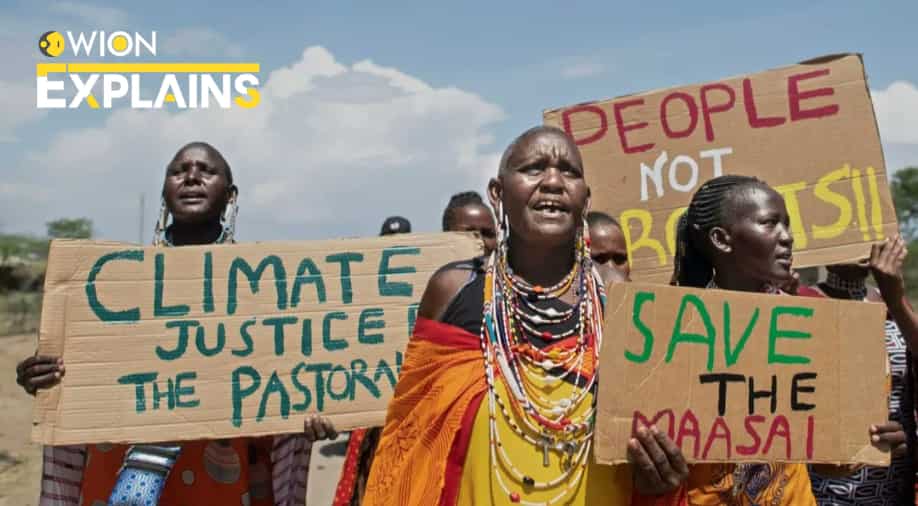
Maasai explainer
In the small village of Ololosokwan, adjacent to the UNESCO World Heritage site and Tanzania’s famous Serengeti National Park live the centuries-old Maasai people of East Africa who have for over a decade now been pushed out of their land for a “game reserve,” while the government says it is to help protect the environment.
Who are the Maasai people?
The pastoralist Maasai is said to be among one of the most vibrant indigenous societies on the continent who have lived and managed alongside other native communities for more than two centuries now in the Great Rift Valley located in Southern Kenya and northern Tanzania. The herders are known for their beaded jewellery and plaid shawls draped over their shoulders and wrapped around their waists.

They live in the Ngorongoro district after British colonial authorities in 1951 declared the Serengeti area a national park and relocated the communities within its borders. Since then, living in small clusters of bomas (traditional Maasai houses), the nearly 7,000 semi-nomadic pastoralist ethnic group of people are being forced to relive the woeful echoes of their colonial past.
Previous attempts at ‘forced’ evictions
The Tanzanian government plans to displace about 150,000 pastoralists for its conservation initiatives in two areas in the Ngorongoro district – Loliondo Game Controlled Area and Ngorongoro Conservation Area (NCA), reported Human Rights Watch (HRW). However, it was not even close to the first time that it has moved to do so.
)
Trump-Xi Summit: Trade, Taiwan and the red lines shaping US-China talks | Race To Power
)
Afghan woman cyclist who disguised herself as a boy to escape Taliban, wins Asian Games medal
)
Trump signs Greenland security deal with Denmark, paving way for two new US military bases
)
IND vs JPN T20I: How an overturned wide became point of difference between India's win and a tie
)
IIT Bombay CCTV footage emerges: Sahil Wakode seen looking at phone in examination hall
)
Cyclone Arnab: Landfall expected before midnight tomorrow as IMD issues orange alerts across six states
)
NBA player Steven Adams shares hilarious GTA VI theory
)
TMC revives impeachment push against CEC Gyanesh Kumar after report of internal dissent
)
WION Iconic Tourism Summit 2026: Union Minister Shekhawat on 'experiential travel', peace diplomacy
)
ICC plans T20I expansion and fewer ODIs in 2027–2031 FTP cycle: Report
)
WION Iconic Tourism Summit: Minister Kapil Mishra shares Delhi tourism future, invites industry to be partners
)
'AI got into my speech': Prince Harry jokes after teleprompter failure at event in New York
)
WION Iconic Tourism Summit: Seychelles envoy says India partnership is important for Seychelles
)
Scientists detect first radio signals directly from faraway planet
)
China to test supersonic jet that moves at Mach 2, double the speed of sound
)
Xi-Trump meeting: China’s human rights red line and past protests explained
)
Open AI, Anthropic CEO urges caution over rapid AI development at UN Security Council, call for 'extreme care'
)
Bomb scare in New York amid UNGA: Suspicious suitcase found near UN headquarters
)
WION Iconic Tourism Summit: Is India's travel boom outrunning its airports, airlines and hotels?
)
WION Iconic Tourism Summit and Awards 2026: Key voices to discuss India’s tourism future
)
Trump-Xi state dinner 2026: Who is invited? Full guest list of tech CEOs, business leaders and officials
)
American manufacturing is reshoring faster than its factory floors can absorb
&im=FitAndFill=(700,400))
New OTT releases this week (September 21-27, 2026): Shaque: Trust No One, Hunkkaar, Don’t Be Shy- 5 new titles coming to Netflix, Prime Video and more
)
WATCH | China President Xi Jinping lands in US as Trump greets him ahead of high-stakes summit
)
'What kind of confession is this?': Pakistan PM Shehbaz Sharif’s 'terrorists would be roaming New York' remark goes viral, raises alarm online. Watch
)
WION Iconic Tourism Summit: How local tourism MSMEs must upskill for AI integration
)
Elephants hide behind trees, stage surprise attack on poachers targeting rhinos in South Africa
)
'Putin is patient zero': Zelensky slams Russian president at UNGA, accuses him of using fighters from 47 countries
&im=FitAndFill=(700,400))
National Film Awards 2026: Kartik Aaryan, Mammootty, Yami Gautam, Randeep Hooda and other key winners
)
El Niño 2026 heats up to become strongest in 1,000 years
)
Israeli envoy to US Yechiel Leiter’s son critically injured in West Bank ramming attack
)
Anne Hathaway to run in supporting race for Nolan's epic
&im=FitAndFill=(700,400))
Trump welcomes Xi Jinping in rare airport gesture: Photos from Chinese President's arrival in US
)
From Gaddafi tearing up UN Charter to Trump’s ‘escalatorgate’: Most unforgettable UNGA moments
According to Joseph Oleshangay, a lawyer with the Tanzania-based Legal and Human Rights Centre,the government has made multiple attempts to push the Maasai people out of their lands since 2003. In 2017, government security forces allegedly burned 185 Maasai houses, a move which has been dubbed as a forced act of eviction by rights groups.
At the time, the government had claimed that the houses in question had been built inside the park, a claim which was also upheld in an East African court. Another incident of violence took place last year when the people from the Maasai community in Loliondo protested against the policedemarcating 1,500 square kilometres for the “game reserve”.
A report by The Guardian, citing eyewitnesses, said that the police opened fire, stole cattle, and destroyed property.
As per the HRW, security forces arbitrarily arrested and detained 10 community leaders and even fired teargas and rubber bullets. This clash also led to the death of one police officer and left over 30 Maasai, women, children, and older peopleinjured, while thousands fled to Kenya.
Speaking about the incident to Bloomberg, a man who was only referred to as ‘K’, recalled that some 200 police, military and park rangers faced off against around 500 locals at the village office. According to K, while officials were trying to push past the crowd, shots were fired. Meanwhile, the local men pulled out their wooden bows from their backs and unleashed a numberof arrows which hit an officer in the eye, who later died.
K said the officials had responded by firing into the crowd when he suddenly fell and was wounded by a gunshot before he passed out into the nearby forest. He has since fled Ololosokwan and had been living across the border in Kenya.
So-called quieter approach
This also came after the government opted for a quieter approach to the relocation, as per rights groups. In 2021, the Ngorongoro Conservation Area Authority, which manages the land, issued a 30-day eviction notice to 45 people in the area, which was in addition to 166 others who were identified as illegal “immigrants”.
The agency also ordered the destruction of over 100 homes, churches, schools, medical dispensaries, police stations, and administrative offices within the 30-day period claiming that they had been built without permits, reported The Guardian. The orders were suspended following protests from locals who say that the structures had been there for decades now.
A report by HRW,citing residents, said that since February 2022, the government had begun downsizing essential services in the area. This included health, education, and emergency services after the officials had grounded Flying Medical Services, while the area’s main hospital was downsized to a dispensary from a staff of 64 to two.
The Ngorongoro district authorities, in March 2022, sent two notices seen by The Guardian to six public schools ordering them to transfer some 200 million Tanzanian shillings ($ 84,744) in COVID-19 relief funds to the Handeni resettlement site.
Earlier this year, the local media reported that some 500 residents and 2,000 livestock have been moved to Msomera village in Handeni district, which is hundreds of kilometres away, since the beginning of the relocation back on June 16, 2022. Rights groups have alleged that this downsizing directly hinders the community’s ability to live there.
This was after the land demarcation exercise whichrestricted people’s access to water sources, and grazing sites, and even cut through some of the houses, reported HRW. “The government is trying to suffocate the communities and make the situation uncomfortable for them,” said human rights lawyer, Denis Moses Oleshangai, as quoted by The Guardian.
Earlier this year, William Ole Seki, a Maasai elder spoke to the United Kingdom-based newspaper and spoke about how the government has banned imports of building materials into the area, the region’s only hospital was under threat of closure, and two villages to the north which had no water for weeks.
Experts from the United Nations have called on the Tanzania government to halt forced evictions and relocation and urged them to work towards conservation with the local community. It is not just the locals, as officials from the European Union, UN, and international non-governmental organisations have also accused the government of pushing the Maasai off their lands.
What is all of this for?
Last year, Tanzania’s tourism ministry decided to convert 1,500 square kilometres around Ololosokwan from a “game-controlled area,” where residents are permitted to live, farm and graze livestock, to a “game reserve,” reported Bloomberg. The so-called game reserve would be turned into a wildlife habitat as well as used for safari tourism and people with the right licence can also hunt.
The price of the game reserve is being paid by the Maasai who as per the locals, UN Human Rights Council and the European Parliament,have been subjected to arbitrary arrests, torture and beatings, in addition to the aforementioned hindrances to their livelihoods. Notably, the plans for the so-called game reserve have been in the works for three decades now.
According to the UN, 82,000 Maasai risk being pushed out of the Ngorongoro Conservation Area and Loliondo reported Bloomberg. However, Tanzania’s Natural Resources and tourism ministry has asserted that Ololosokwan “has no settlements.”
Addressing the conservation efforts the government has alleged that the Maasai and their herds are expanding and now represent a threat to conservation in Ngorongoro and the wider Serengeti ecosystem.
The national park is home to several endangered species including the black rhinoceros, elephant, wild dog and cheetah. However, the Maasai assert that they live harmoniously with wildlife, which scientists have agreed with as nearly 300 researchers from around the world signed an open letter and called for a halt to eviction efforts.
Meanwhile, rights groups have said Tanzania is pushing Maasai out of the region in a bid to expand its lucrative tourism sector supposedly under the guise of conservation efforts. “It’s all about money. Dirty money,” Ole Seki told The Guardian.
In 2019, the tourism sector brought in $6.6 billion and made up 11 per cent of the country’s GDP. According to an analysis by HRW, satellite images of the region show in July 2022 about 90 homesteads and animal enclosures were burned within the demarcated area.
The UAE connection
A report by Bloomberg alleges that in 1992, the Ngorongoro district council granted a 10-year hunting permit to a man named Mohammed Abdulrahim Al Ali for areas including Ololosokwan and five other villages. He is currently said to be the chairman and owner of the Al Ali Group, a major property developer in the United Arab Emirates.
Citing the findings of a Tanzanian investigative reporter who has since been arrested, the media report says that millions of dollars in donations were also made from Dubai’s royal family to Tanzania’s ruling party. However, the UAE government has since denied these allegations and said it was “committed to preserving the rights of indigenous peoples”.
Maasai delegation to meet European leaders
Earlier this week, Alliance for Food Sovereignty in Africa (AFSA) said that a high-profile delegation of Maasai representatives will meet European governments, EU institutions and NGOs like Frankfurt Zoological Society (FZS), in May, for what they have described as the government’s “brutal campaign against Maasai in Tanzania.”
WATCH WION LIVE HERE
You can now write for wionews.com and be a part of the community. Share your stories and opinions with us here.