

&imwidth=800&imheight=600&format=webp&quality=medium "Hassabis becomes chair as day-to-day control of Google DeepMind shifts to California")
Google restructured the leadership of its AI laboratory on August 5. The org chart is the smaller part of what happened.
Demis Hassabis, who cofounded DeepMind in London in 2010, becomes chair of the lab and chief scientist of Alphabet. Koray Kavukcuoglu, formerly chief technology officer and chief AI architect, takes over day-to-day leadership as senior vice president. Jeff Dean, who joined Google in 1999 and served as its chief scientist, has left after 27 years to found an AI startup.
Kavukcuoglu works in Mountain View. Hassabis works in London. The distance between those two facts is roughly 6,000 miles, and inside the company it is being read as the point of the exercise.
What Staff See
Employees describe the reshuffle as a transfer of authority from London, where DeepMind was built, to Mountain View, where Google is headquartered.
That tension is not new. DeepMind spent years as a semi-autonomous research organisation with its own culture, its own hiring and a founder who guarded its independence. Its 2023 merger with Google Brain formally ended that separation, but the centre of gravity stayed in London for as long as the person running the lab did.
Trending Stories
&imwidth=180&imheight=135&format=webp&quality=medium)
Shreyas Iyer blames dew for West Indies' record run chase in 2nd T20I in Ranchi
&im=FitAndFill=(700,400)&imwidth=180&imheight=135&format=webp&quality=medium)
Happy Birthday Rekha: Watch these 7 evergreen Bollywood hits on Netflix, Prime Video and more
&imwidth=180&imheight=135&format=webp&quality=medium)
'I am not going to be watching it': JD Vance on livestream of Nidal Hasan's firing squad execution
&imwidth=180&imheight=135&format=webp&quality=medium)
UK navy hit by espionage scandal: Sailor accused of spying for Russia | Gravitas
&imwidth=180&imheight=135&format=webp&quality=medium)
Katie Zacharia likely to succeed Karoline Leavitt as Trump's White House press secretary
&imwidth=180&imheight=135&format=webp&quality=medium)
Delhi on high alert for CJP protest: Delhi police to use body cams to 'prove whether we did anything’; Pink Force, RAF, 35,000 personnel deployed
&imwidth=180&imheight=135&format=webp&quality=medium)
‘Never-ending flow of cheap labour’: JD Vance hits back at Indian-origin Congresswoman over US green card curbs for major tech companies
&imwidth=180&imheight=135&format=webp&quality=medium)
Panama president declares ‘major disaster’ after powerful 7.7-magnitude earthquake; over 80 aftershocks recorded
&imwidth=180&imheight=135&format=webp&quality=medium)
‘250? Cool.’: Shai Hope takes swipe at Shubman Gill’s Instagram caption after Ranchi T20I masterclass
&imwidth=180&imheight=135&format=webp&quality=medium)
‘Ruh Roh’: Top US official mocks ‘Indian market collapse’ claim after Trump’s IT curbs. But did it? | FACT CHECK
&im=FitAndFill=(700,400)&imwidth=180&imheight=135&format=webp&quality=medium)
Fastest-growing Asian economies in 2026: Who tops the chart? Where does India rank?
&imwidth=180&imheight=135&format=webp&quality=medium)
'I ended 8 wars': Trump slams Nobel Peace prize decision, claims award was his due
&imwidth=180&imheight=135&format=webp&quality=medium)
Dhurandhar: The Revenge album submitted for Grammy consideration; But what does it mean?
&imwidth=180&imheight=135&format=webp&quality=medium)
J&K Government orders major police reshuffle, transfers 100 officers across UT
&imwidth=180&imheight=135&format=webp&quality=medium)
New York protests erupt as Trump administration defends ICE shooting
&imwidth=180&imheight=135&format=webp&quality=medium)
Delhi protest: Metro curbs, train cancellations, traffic diversions as protesters seek CEC Gyanesh Kumar’s resignation
&imwidth=180&imheight=135&format=webp&quality=medium)
Powerful 7.7 magnitude earthquake strikes Panama, tsunami warning issued
&imwidth=180&imheight=135&format=webp&quality=medium)
Hurricane Isaias makes landfall in Florida as Category 2 storm with winds of 105mph, threatens Gulf Coast with life-threatening surge
&imwidth=180&imheight=135&format=webp&quality=medium)
Trump has a new 'enemy': Anyone who calls it 'artificial intelligence'. Here's what we wants instead
&imwidth=180&imheight=135&format=webp&quality=medium)
Adéla gives KATSEYE’s Lara Raj and Megan Skendiel a shout-out at Fonda Theatre in LA
&imwidth=180&imheight=135&format=webp&quality=medium)
'Modi is a dictator': Abhijeet Dipke claims govt 'scared' of youth, slams stringent measures ahead of CJP Jantar Mantar protest
&im=FitAndFill=(700,400)&imwidth=180&imheight=135&format=webp&quality=medium)
New Friday OTT releases (October 9, 2026): Reporting Live, Animals, Take Charge of My Heart- 6 new titles coming on Netflix, JioHotstar and more
&imwidth=180&imheight=135&format=webp&quality=medium)
Trump announces Russian diesel deal as Zelensky criticises move
&imwidth=180&imheight=135&format=webp&quality=medium)
‘Right to protest must be protected, but...’: Delhi Police reveals why it denied CJP permission for October 10 Jantar Mantar protest
&imwidth=180&imheight=135&format=webp&quality=medium)
Pakistan denies reports of PAF jets being used in attacks against Iran-backed Houthis in Yemen
&imwidth=180&imheight=135&format=webp&quality=medium)
Ella Langley’s Oklahoma show abruptly cancelled over safety concerns after threat report
&imwidth=180&imheight=135&format=webp&quality=medium)
New York ICE shooting sparks protests as Mamdani to call on Trump to halt ICE operations
&imwidth=180&imheight=135&format=webp&quality=medium)
All 22 Indian seafarers safe in attack on Panama-flagged tanker off UAE coast
&imwidth=180&imheight=135&format=webp&quality=medium)
Ryan Reynolds’ private messages reveal his blunt views on Justin Baldoni from Blake Lively’s legal case
&im=FitAndFill=(700,400)&imwidth=180&imheight=135&format=webp&quality=medium)
Rakul Preet Singh birthday special: 7 times the Ramayana actress served glamorous looks

Kamal Haasan slams Elon Musk over Starlink delay row: 'Indian people, will decide our own future - not Western'
&im=FitAndFill=(700,400)&imwidth=180&imheight=135&format=webp&quality=medium)
Food shortages, suicide attempts and more: USS Abraham Lincoln returns to US after 321 day deployment — What happened aboard the US carrier?
&imwidth=180&imheight=135&format=webp&quality=medium)
OpenAI shuts down Russian, Iranian influence operations using ChatGPT to spread propaganda
&imwidth=180&imheight=135&format=webp&quality=medium)
SC questions closure of 57 Delhi Metro stations, asks Centre to resume services in regulated manner
&imwidth=180&imheight=135&format=webp&quality=medium)
'Even Indira Gandhi didn't do this': Abhijeet Dipke, Saurav Das and Ashutosh Ranka detained from inside their flight | Watch video
&imwidth=180&imheight=135&format=webp&quality=medium)
US midterm elections 2026: What a blue wave or blue tsunami could mean for Trump
&imwidth=180&imheight=135&format=webp&quality=medium)
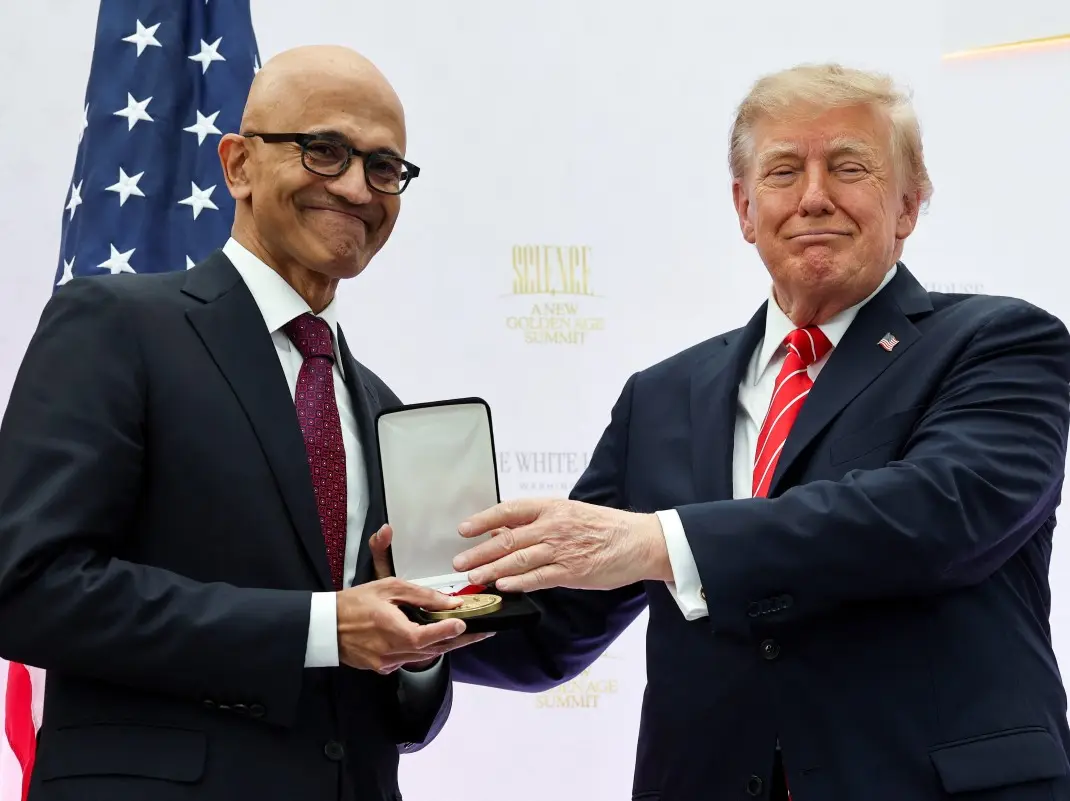
Trump honours Microsoft CEO Satya Nadella with top technology honour amid immigration scrutiny
It no longer does. The chair of a laboratory sets direction; the person running operations decides what ships and who builds it. Those roles now sit on different continents, and only one of them is on the same campus as Google's product organisation.
What Preceded It
Reporting on the months before the reset describes a laboratory under strain: low morale, a talent exodus, delayed models and missed internal deadlines.
Google must now rebuild coding and pre-training expertise after a run of senior departures — capabilities that are among the hardest in the field to replace, because the people who have done frontier pre-training at scale number in the low hundreds worldwide and are all employable elsewhere tomorrow.
Dean's exit is the clearest marker. He was at Google for 27 years, built much of the infrastructure the modern company runs on, and is leaving to start something of his own rather than to retire. Departures of that shape tend to say more about where the interesting work is perceived to be than about any individual grievance.
The Job Kavukcuoglu Has
The operational brief is release cadence.
Google's model releases this year have arrived at an uneven rhythm, and the gap between announcement and general availability has been a recurring complaint from developers. Gemini 3.7 Flash, released on August 13, came three weeks after 3.6 Flash with substantial benchmark gains — evidence that the underlying research is productive when it reaches shipping.
Turning that into something predictable is a management problem rather than a research one, which is a reasonable explanation for putting an operator in the seat and moving the founder to a role with a longer horizon.
Hassabis, for his part, gains room for long-term AGI strategy and scientific work, including Isomorphic Labs, the drug discovery company he also leads. That is not a demotion in any meaningful sense. It is a narrowing.
Why London Matters Here
The geography is not sentiment. It determines where a generation of AI researchers is trained and where the resulting companies get founded.
London built a genuine frontier AI cluster around DeepMind — the alumni network, the university pipeline, the investor base that understood the field early. That cluster exists because the decisions were made there. Britain has treated DeepMind as evidence that it can host frontier AI research rather than merely consume it, and the argument depends on the lab being more than a satellite office.
A laboratory whose operational authority sits in California, whose coding work is being rebuilt around Mountain View, and whose founder has moved to a strategy role is a different proposition for that argument.
The Wider Pattern
Google is the second major laboratory this year to concentrate decision-making closer to its commercial organisation, and the reasoning is the same in both cases: the competitive pressure has moved from research to shipping.
When the constraint was capability, it made sense to give researchers distance from the product cycle. When the constraint is cadence, price and serving speed — which is what this month's releases have been about — that distance becomes cost.
DeepMind's independence was always a bet that the research would be better if it were left alone. The bet paid off often enough to be worth defending. What changed is not the quality of the research. It is that the race is no longer being won there.
