
&imwidth=800&imheight=600&format=webp&quality=medium "What is Hayli Gubbi's volcanic ash cloud? Know how it forms, travels and affects the environment")
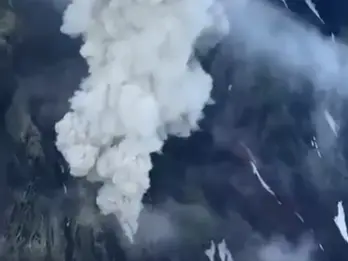
A high-altitude cloud of volcanic ash from Ethiopia, which drifted into the Indian region on Monday afternoon, is likely to move completely into China by Tuesday evening. The ash originated on Sunday from a rare eruption of the Hayli Gubbi volcano in the northeastern part of Ethiopia, near the Red Sea coastline. Travelling at altitudes commonly used by long-haul aircraft, the cloud poses risks such as reduced visibility and potential exposure to toxic gases like sulphur dioxide.
What is Hayli Gubbi's volcanic ash cloud?
It is a massive airborne cloud made of fine, sharp particles of rock, minerals and volcanic glass which are formed during a volcanic eruption, resulting from the magma inside shattering into microscopic pieces. Hot gases propel these materials upwards, and winds disperse them similarly to dust from a construction site, but on a large scale and at extremely high altitudes. It results in the ashes remaining suspended for days or even weeks, travelling great distances with atmospheric currents.

How does an ash cloud move?
All the trapped gases in a volcano expand violently after it erupts suddenly and release pressure from the rising magma. The mounting pressure results in an explosion, which breaks the magma into tiny particles and shoots them high into the atmosphere, forming what is known as an 'eruption plume'. Such a plume can reach astonishing heights of 15–20 kilometres above the surface of the Earth. Later, the ash cloud was carried along by powerful winds after reaching the upper layers, which can move across continents and multiple regions.
How Hayli Gubbi's volcanic ash cloud affects the environment
Trending Stories
)
Dharmendra Pradhan's 1997 paper leak protest surfaces amid calls for resignation
)
Trump announces 200% tariff on generic drugs: Here's what it means for 'Pharmacy of the World' India
)
He predicted COVID-19 and 2008 economic crisis, was labeled fearmonger. Now he has another dire warning
&im=FitAndFill=(700,400))
Meet top 5 batters with most runs in India vs Zimbabwe T20Is
)
'Is that a back-up Trump?' Mysterious look-alike standing behind Donald Trump baffles netizens
)
US-Iran war cost hits $37.5 billion as Hegseth seeks $67 billion more for Pentagon
)
ICC ODI Rankings: Joe Root jumps big, India trio close in on No. 1 spot
)
Sonam Wangchuk's connection with George Soros and Ford Foundation explained!
)
Trump blames AI for viral video of mystery objects thrown from White House window, WH says ‘maintenance’. Who's lying?
)
UP BTech gold medalist dies by suicide after failing in nearly 50 govt job attempts, leaves note for father
)
Salman Khan breaks silence on health concerns after viral Mumbai appearance
)
'George Soros playbook': Understanding the foreign funding network around Sonam Wangchuk
)
FBI arrests alleged $547mn medicare fraud fugitive after 3-year global manhunt
&im=FitAndFill=(700,400))
New OTT releases this week (July 20-26, 2026): Musafir Cafe, Adarsh Baal Vidyalaya, 72 Hours- 5 new titles coming on Netflix, Prime Video and more
)
IND vs ZIM, 1st T20I: When and where to watch live streaming in India?
)
'We acted immediately...': Indian PM Modi breaks silence on paper leaks as NEET protest, calls for Education Minister's resignation grows
)
Kaylee Hottle was unconscious: Shocking details from first responders revealed after teen star's death
)
'What is wrong...': Anna Hazare breaks silence on Sonam Wangchuk's protest, makes an appeal to Centre
)
FIFA 2026 | 'I am truly sorry': Argentina's Enzo Fernandez, who get red card in final, reacts to loss
&im=FitAndFill=(700,400))
Why US fighter jets use seamless bubble canopies compared to Russian jets
)
Student union leaders call off hunger strike at Jantar Mantar after civil society appeal, but protest continues
&im=FitAndFill=(700,400))
World's top 7 most liveable cities in 2026 — Check where India and Pakistan stand
)
'Guru is the...': Indian Education Minister Dharmendra Pradhan shares message on education amid calls for his resignation
)
'Don't waste...': CJI Surya Kant breaks silence on Delhi police brutality against protesting students
)
'This should not happen in a democracy': Shashi Tharoor slams detention of Rahul Gandhi, Priyanka Gandhi after protest outside PM Modi's residence
)
Maharashtra Bandh call on July 23: What all you need to know
&im=FitAndFill=(700,400))
Meet top 5 Indian batters with most T20I runs against Zimbabwe
One of the powerful impacts of the ash cloud is that it can pose a major hazard to jet engines, as it can melt and solidify on turbine blades, causing engine failure and disrupting air travel. The next impact is the rise of SO2 levels in the air, affecting higher altitude regions, such as the Himalayas and Nepal, as it can irritate the respiratory system.
It also makes the skies appear darker and hazier than usual in regions it passes over. In addition, the interaction between volcanic gases and moisture in the atmosphere could potentially lead to light acidic rainfall in affected regions.

