Someone painted over a Rembrandt and removed the turban from a man's head

&imwidth=600&imheight=450&format=webp&quality=medium "Someone painted over a Rembrandt and removed the turban from a man's head")
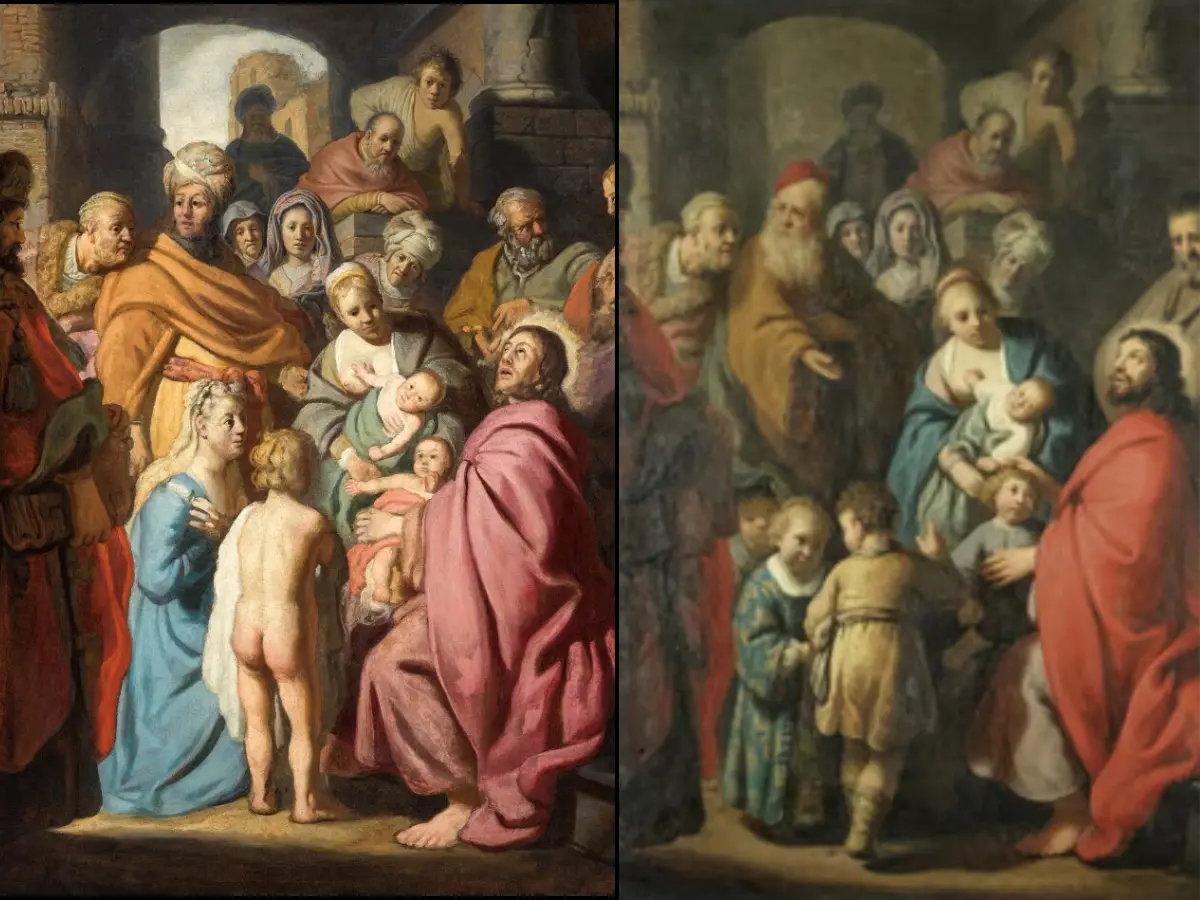
Rembrandt painting was found in 2014 and the original had a man with a turban, but the accessory was removed. Photograph: (Sotheby’s)
A painting found at a German auction in 2014 was painted by the acclaimed artist Rembrandt during the 17th century. Someone painted over his work and removed the turban from a man's head and put clothes on a child. It will be auctioned by Sotheby's on July 1.
A 17th-century painting is confirmed to have been the work of the famous artist Rembrandt and will now be auctioned by Sotheby’s in London on 1 July. The piece of art had layers of overpaint, which have now been removed, revealing some glaring details. Let The Little Children Come Unto Me was previously unconfirmed as a Rembrandt. The overpaint changed several things in the painting, including a man with a turban. The clothing accessory was painted over to show a traditional Dutch soft cap instead. A naked child was covered with clothes, another detail shows. “The original had a prominent, turbaned figure in the middle,” Alex Bell, the chair emeritus of Sotheby’s UK, told the Guardian.
The original artwork is a testimony to Rembrandt being a humanitarian and a liberal. The person who "amended or sanitised" the work reportedly misunderstood its message about tolerance. It shows adults and children being blessed by Jesus, who scolded his disciples for turning away parents who brought their kids to him, according to the gospel of Saint Luke. However, the painting goes beyond this interpretation.
Rembrandt painted it during the refugee influx into Holland
It shows a diverse crowd, including a man with a turban, along with Jewish and Christians. Rembrandt lived in 17th-century Leiden, Holland, where religious rivalry was rife at the time because of incoming refugees. Residents were not happy with this influx, with 10,000 refugees apparently settling in Leiden alone. But Rembrandt's painting shows that he backed religious tolerance and acceptance, according to art historian Andrew Graham-Dixon. He told The Guardian that the artist was closely connected to the Remonstrants, a group that promoted tolerance.
According to the historian, Leiden was witnessing a major humanitarian crisis in 1627. Hundreds of thousands of people came to the Dutch Republic as refugees at the height of the Thirty Years' War. There was large-scale opposition, but Rembrandt painted a crowd scene showing Christ welcoming children and families, which made the painting controversial. “What we can tell from this painting is that Rembrandt is on the side of humanitarian relief. So, this is more than just a painting, I think it’s a statement of Rembrandt’s moral position,” he said.
The painting was discovered in 2014 in a German auction. It was catalogued as an anonymous “Netherlandish 17th-century painting”. It is estimated to sell for $10 million to $15 million.
&im=FitAndFill=(700,400))
)
)
)
)
)
)
)
)
)
)
)
)
)
)
&im=FitAndFill=(700,400))
)
)
)
)
)
)
)
)
)
)
)
)
)
&im=FitAndFill=(700,400))

