
&imwidth=800&imheight=600&format=webp&quality=medium "National Engineering Day 2026: How is India's engineering changing as country moves towards Viksit Bharat 2047?")
When India marks its 100 years of independence by 2047, the country's growth will not be only assessed by how fast it grows, but how and what it builds for own and the world. The questions will hover around global technology cycles: whether India remains a consumer or becomes an architect of the systems the world depends on.
In terms of development in engineering and technology sectors, India is making a spectacular shift from basic software services and IT outsourcing toward advanced deep-tech, semiconductor manufacturing, and artificial intelligence. It is also engineering domestic data centres, sovereign AI systems, and semiconductor fabrication to control its own technological infrastructure.
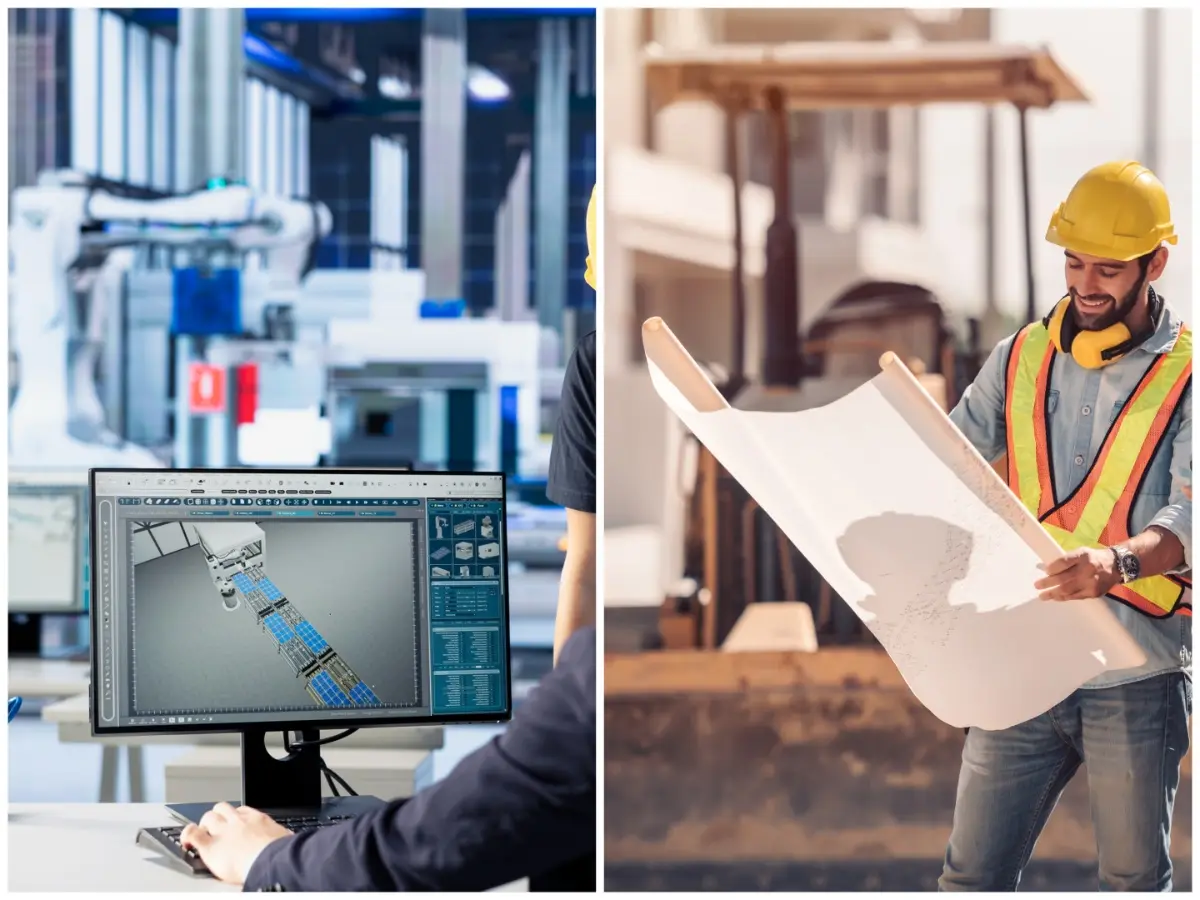
Civil and structural engineering now relies heavily on LiDAR, drone surveys, Building Information Modelling (BIM), and 3D terrain modelling to accelerate large-scale infrastructure delivery. The focus has also expanded to a full-stack model combining physical assets with advanced computing, quantum research, and green manufacturing (such as hydrogen and advanced battery R&D).

In the education sector, engineering and workforce training are moving toward outcome-based learning, automation, robotics, and artificial intelligence to close the country's technical skill gaps. Out of these, how can we miss about the engineering and technological advancement of ISRO? Currently, ISRO is shifting routine rocket and satellite manufacturing to the private sector so it can focus on advanced research, human spaceflight, and deep-space exploration.
India's engineering making fundamental transformation
In response to the changing engineering landscape, industry leaders say the profession itself is undergoing a quiet but fundamental transformation, one being driven as much by artificial intelligence and automation as by the scale of the country's ambitions for 2047, when India aims to become a fully developed nation.
Trending Stories
)
Did India risk its US trade deal despite softer stance at BRICS?
)
Pakistan puts Pak Rs 70 lakh bounty on UN terrorist Masood Azhar; move draws skepticism in Delhi
)
First naval drone battle? Ukraine says Sargan 3000 sank Russian unmanned boat
)
Practical Magic 2 breaks Spidey spell over North American box office
)
'Huge destructive power': North Korea calls its latest missile launches 'live-fire drill' even as US dismisses 'immediate threat'
)
‘Let’s go’: Newly declassified videos show dramatic rescue of US Air Force officers downed in Iran
)
Delhi’s balancing act: BRICS serves as a stage for West Asia diplomacy
&im=FitAndFill=(700,400))
Why European Meteor missiles use ramjet engines compared to standard US solid rockets
)
‘India did extremely well’: South African President Cyril Ramaphosa praises BRICS leadership
)
Iran, India agree to deepen humanitarian and political ties, President Pezeshkian says
)
‘Want to reset ties with India, have engagement based on mutual interests,’ says Bangladesh minister
)
Trump says Canada eager to reach a deal, it could come ‘fairly soon’ if Ottawa treats US farmers better
)
Turkish Airlines plane flies through a storm three times, triggering severe turbulence
&im=FitAndFill=(700,400))
Why Chinese PL-15 air-to-air missiles use dual-pulse motors compared to European interceptors
)
China thinned Himalayan troop presence in 2025, India defence report says; terms border situation 'stable'
)
800 million years old - Scientists discover 'fingerprints' of supercontinent Gondwana in ancient rocks
)
Russia proposes to build 360 kmph Ivolga FG trains in India: What happened on sidelines of BRICS
)
Israeli minister calls to strip Gaza film directors of citizenship
)
China discovers vast gold and silver 'mine' in the Pacific with unheard-of deposits
)
Russian drone hits Warsaw-bound train near Polish border, Zelensky accuses Moscow of ‘deliberate’ targeting
)
War is making Russia stronger? How Ukraine is shaping Moscow’s next generation of weapons
)
Plane carrying prominent figure crashes at Libya’s Misrata airport: Report
)
Veteran Bollywood actress Nafisa Ali shares health update as Stage 4 cancer progresses, starts targeted therapy
)
NEET-UG to move to computer-based test soon, NTA DG says ‘CBT is the future’
)
Woman removes all her clothes on American Airlines flight, performs 'indecent acts'; arrested
)
Liam Neeson sparks romance rumours after holding hands with Stella Stocker at TIFF 2026
&im=FitAndFill=(700,400))
New OTT releases this week (September 14-20, 2026): Lust Stories 3, Waiting Hai, Irumudi- 5 new titles coming on Netflix, Prime Video and more
)
Indian importers urge Bangladesh to lift export ban on 'Hilsa' fish ahead of Durga Puja
)
Video of Pakistani lawmaker struggling to read English tribute to Jinnah goes viral - WATCH
)
Did China give Iran intel before US base strike that killed 3 troops? Trump says, 'You’re right...'
)
Meghan Markle shares first glimpse of family life with Prince Harry and children in UK
)
Crude oil prices jump more than $107 per barrel following Houthi attacks on Saudi
)
Women's Asia Cup 2026: India denied trophy once again despite winning the title
)
Humans may lose control of AI: Anthropic CEO calls for slowdown, Altman, Musk back him
They noted that across sectors ranging from financial technology to semiconductors, renewable energy and industrial automation, engineers are being asked to do more than solve technical problems. They are increasingly expected to work alongside business teams, understand end-to-end systems, and take responsibility for outcomes rather than just outputs.
Shishir Saxena, Head of Solution Architecture - Record Keeping Platforms, Fidelity International, said, "The role of an engineer is evolving rapidly. It is increasingly not just about solving technical challenges, but about working closely with business teams to build solutions that create meaningful client outcomes. India’s engineering talent is uniquely positioned to do this at scale, contributing to global initiatives and helping solve complex challenges across markets.
AI, automation and advanced data capabilities are giving our engineering teams powerful new ways to experiment, work more efficiently and focus on the problems that matter most."
“As AI-generated code becomes increasingly prevalent, the volume of code being created is growing significantly. In this environment, the ability to comprehend, interpret and effectively review code written collaboratively by engineers and AI agents will become just as important as writing new code. The engineers of the future will need to excel not only at creation, but also at understanding, validating and integrating work across human and AI contributors. But technology is only one part of the equation. The real value comes from combining it with deep domain expertise, curiosity, collaboration and human judgment. As India looks towards 2047, I believe our engineers will play an important role in building capabilities that strengthen businesses, improve customer experiences and deliver sustainable, long-term value,” he added.
Ponni Carlin, Co-founder & COO, iVP Semi, said," The prototype is the easy part. Getting from a board that works on a bench to a product that can be built, tested and shipped the same way ten thousand times, that is where engineering in India is genuinely changing. The engineers who matter most to us now think about test coverage, documentation and sourcing while they are still drawing the schematic, not six months later. Automation and AI have absorbed much of the repetitive work, so judgement is what remains: how a product is qualified, where it is sourced, how it will perform in a customer's system."
“Viksit Bharat 2047 will not be built on prototypes. It will be built by engineers who can carry a design all the way to volume production and keep it there. That is the capability India is still building, and every engineer who acquires it makes the country a little less dependent on someone else's supply chain,” Carlin added.
Engineering challenge for generation capacity
Simarpreet Singh, Executive Director and CEO, Hartek Power, said, "India's journey towards Viksit Bharat 2047 is fundamentally an engineering journey. As the country scales renewable energy in India, strengthens its power infrastructure and builds a more resilient energy ecosystem, the role of engineers is moving well beyond conventional project execution. At Hartek Power, we see this transformation closely through our work as one of the leading solar EPC companies, alongside grid connectivity, smart grid solutions, and substation infrastructure, as well as emerging areas such as battery energy storage systems. With India targeting a significantly larger share of clean energy in its power mix, the engineering challenge is no longer simply about adding generation capacity. It is about ensuring that this capacity can be integrated into the grid efficiently, reliably and sustainably."
He noted that this is also changing the capabilities expected from the next generation of engineers and added that technical expertise is set to remain the foundation; however, engineers will increasingly need to understand digitalisation, automation, energy storage, data-driven decision-making and evolving smart grid system technologies.
“Most importantly, they will need the ability to look at infrastructure as an interconnected ecosystem rather than as individual projects. For India, scale will be equally important. The technologies that shape Viksit Bharat 2047 must be adapted to Indian requirements and deployed in a manner that is commercially viable, resilient and capable of serving a rapidly growing economy a responsibility that renewable energy companies and EPC companies in India increasingly share. National Engineers' Day is therefore an opportunity to recognise not only the contribution engineers have made to India's development, but also the responsibility they carry for shaping the future of solar energy and its infrastructure. The engineer of 2047 will not merely build infrastructure; they will help design the systems, technologies and solutions that enable a more sustainable, connected and developed India,” he added.
Sriram Lakshminarayanan, President of Honeywell Technology & Connected Solutions (HTCS), Honeywell Technologies said," As India advances towards Viksit Bharat 2047, engineers are evolving from technical problem-solvers to architects of innovation, business transformation and national progress. At Honeywell Technologies, where HTCS serves as our global engineering and technology powerhouse, we see this shift firsthand. Our teams work across the entire innovation lifecycle, from new product development and AI-powered R&D to deployment and lifecycle support, helping turn breakthrough ideas into real-world outcomes. What is particularly exciting today is that many of these innovations are being engineered in India for global impact."
He added that across smart buildings, industrial automation, energy transition and critical infrastructure, engineers are helping build solutions that are safer, more efficient and more sustainable. According to him, automation, AI and digital technologies are speeding up the pace of innovation, allowing engineers to tackle increasingly complex challenges at scale. As India progresses toward its 2047 vision, he believes engineers who blend deep domain expertise with digital, AI and systems-thinking skills will play a defining role in shaping a more resilient and self-reliant future.

