BINGO! 3I/ATLAS undergoes acid test near Sun: 'If it picks up extra...'

&imwidth=600&imheight=450&format=webp&quality=medium "BINGO! 3I/ATLAS undergoes acid test near Sun: 'If it picks up extra...'")
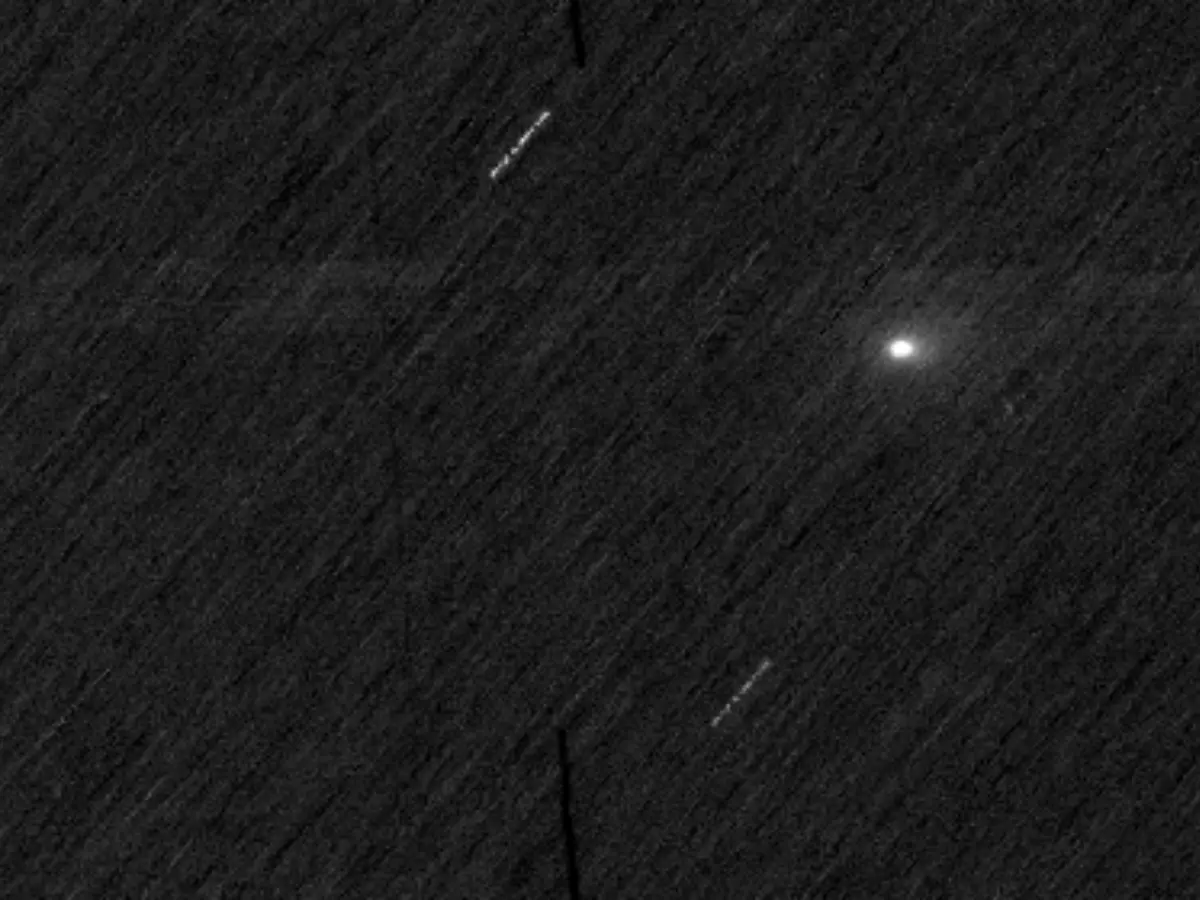
3I/ATLAS photo near Mars Photograph: (ESA)
Alien origins of interstellar comet 3I/ATLAS have intrigued yet another scientist, who says they will be watching it on October 29-30 to see if there is a change in its energy. A boost will be a clear signal that someone is driving it from the inside.
Interstellar comet 3I/ATLAS is the hottest topic of debate in scientific circles. While almost everyone agrees that it is a comet, some disagree. Harvard scientist Avi Loeb has been peddling the theory that it could be an alien spaceship coming to probe the solar system. Now Michio Kaku, professor of theoretical physics at the City College of New York, is also talking about it in quite an intriguing manner. He says the litmus test to surely know what 3I/ATLAS is merely days away. On October 29-30, the comet will reach its nearest point to the Sun. If during this time it picks up extra energy, that means someone is steering it. The science educator and host said in a recent interview with NEWSMAX, "Perhaps this is a visitor, an intelligent visitor from another solar system. This week, it turns out that the asteroid or comet will be whizzing around our sun. And if it picks up extra energy on its flyby, that would clinch it. That means there's extraterrestrial intelligence involved. So watch for it."
He added that starting October 30, they'll be tracking it to see whether it gets an extra boost of energy. "If so, it means we are being visited." Loeb has also talked about the same phenomenon that will seal the deal about the identity of 3I/ATLAS. When it goes around the Sun, they'll be watching for something called the Oberth effect, which means that "if you were to whip around the sun, you would pick up extra energy in the process." Loeb has been talking about this for weeks, saying that the interstellar comet could use the Sun's gravity to whip itself towards Earth. However, NASA and other space agencies have dismissed his claims, while agreeing that 3I/ATLAS is not a regular comet and displays several anomalies.
Also Read: 3I/ATLAS was spotted by NASA's TESS long before Atlas telescope. It saw no coma. Why?
Also Read: 3I/Atlas, 'first contact or existential threat'? Why some netizens are convinced something is wrong
Where is 3I/ATLAS now?
The interstellar visitor reached solar conjunction a few days ago and will reach perihelion on October 29. Solar conjunction occurs when a cosmic body moves to the opposite side of the Sun, in this case relative to Earth. Perihelion is when the object reaches its closest point to the Sun. Later, it is expected to continue on its journey and move out of the solar system, that is, if the "Black Swan" event does not happen.
Trending Stories
)
)
)
)
)
)
)
)
)
)
)
)
)
)
)
)
)
)
)
)
)
)
)
)
)
)
)
)
)
)
)
)
)
)
&im=FitAndFill=(700,400))
)
)
)
)
3I/ATLAS details and update
The alien comet is moving at a fascinating speed of 210,000 km/hour. It was officially discovered by the ATLAS observatory in Chile on July 1. When past data on other telescopes was scanned, precovery images were revealed by NASA's TESS telescope. It had spotted it in May and noticed it becoming extraordinarily bright. The comet did not have a clear tail for the longest time; however, a noticeable tail showed up a few weeks ago. It passed its nearest point to Mars in early October, and some orbiters captured some images. However, only one photo of 3I/ATLAS taken from Mars has been released so far. It poses no threat to Earth right now and will be 270 million kilometres away at its closest distance in December.