

&imwidth=800&imheight=600&format=webp&quality=medium "What is NASA’s ExoMiner++? How AI is scanning space data and helping to find new planets")
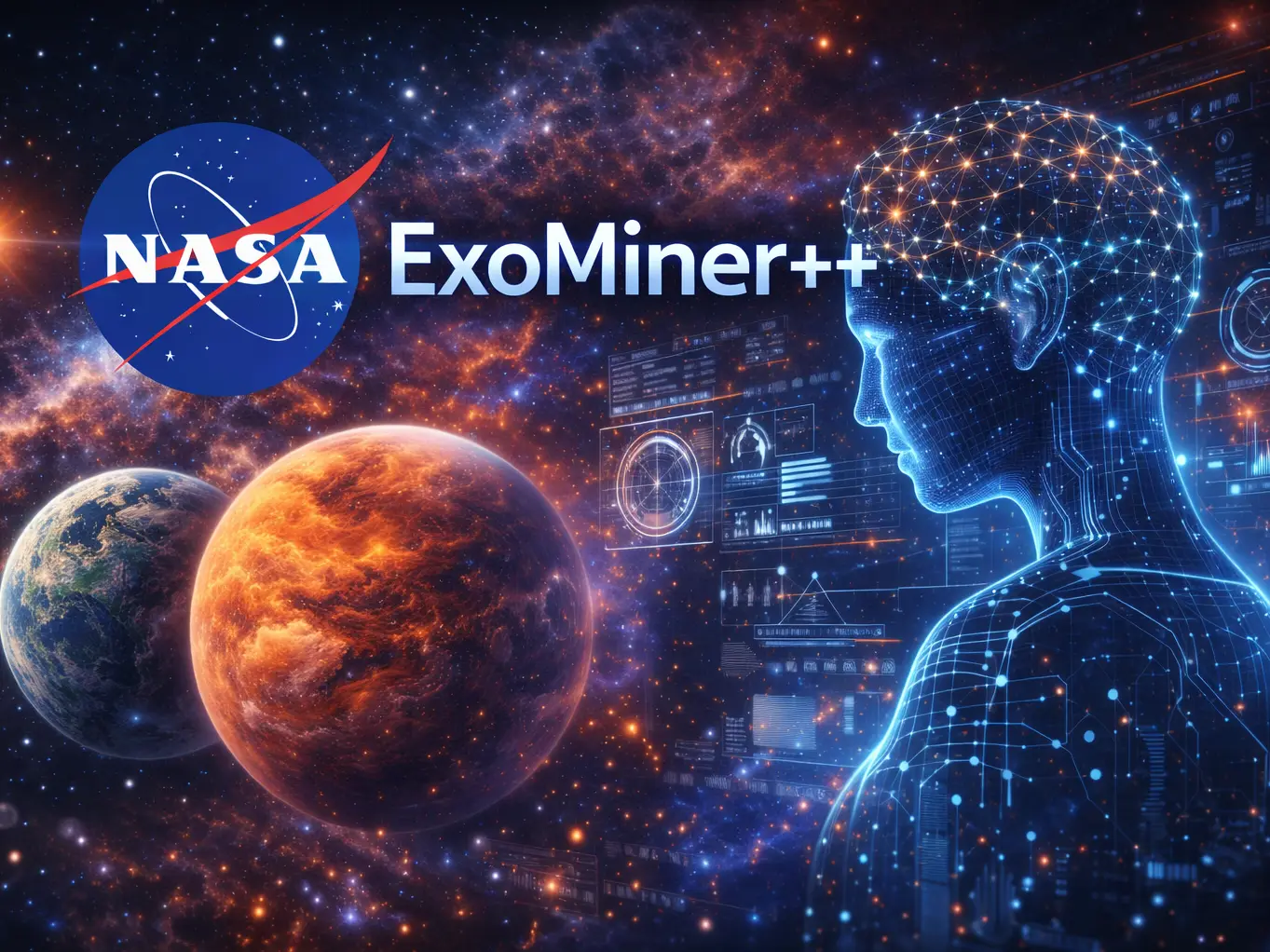
NASA is using artificial intelligence to speed up the search for planets beyond our solar system. The latest tool, called ExoMiner++, helps scientists study huge amounts of space data and identify possible new exoplanets more quickly and accurately.
Developed by researchers at NASA’s Ames Research Center, ExoMiner++ builds on earlier AI work and uses data from two major space missions Kepler and TESS.
What is ExoMiner++
ExoMiner++ is an AI-based software tool designed to analyse transit photometry data. This data comes from tiny dips in a star’s brightness when a planet passes in front of it, known as a transit.
According to NASA, the goal of the ExoMiner project is to automatically sort through hundreds of thousands of such signals and flag the ones that are most likely caused by planets. Many signals turn out to be noise or other space events, such as eclipsing binary stars.
The original ExoMiner, created in 2021, helped confirm 370 new exoplanets using Kepler data. The new version, ExoMiner++, has been trained using both Kepler and TESS data, making it more flexible and powerful.
Trending Stories
&imwidth=180&imheight=135&format=webp&quality=medium)
Other Mommy leads North American box Office as Verity, Resident Evil round out top four
&im=FitAndFill=(700,400)&imwidth=180&imheight=135&format=webp&quality=medium)
Navratri 2026: 9 days, 9 forms of Goddess Durga and 9 colours- Check the complete list
&im=FitAndFill=(700,400)&imwidth=180&imheight=135&format=webp&quality=medium)
Is sending robots to Mars easier than sending humans?
&imwidth=180&imheight=135&format=webp&quality=medium)
A watchdog rated 'ChatGPT for Teens' an unacceptable risk and says keep under-18s off it
&imwidth=180&imheight=135&format=webp&quality=medium)
1,500 drones illuminate Mumbai sky as Cordelia Cruises unveils second ship, Cordelia Sky
&imwidth=180&imheight=135&format=webp&quality=medium)
'Just coincidence': Police mistakes protester as AISA chief Neha Bora, arrests her from site
&imwidth=180&imheight=135&format=webp&quality=medium)
Anthropic's AI invented a murder witness and sent the fake tip to Philadelphia police
&imwidth=180&imheight=135&format=webp&quality=medium)
CJI Surya Kant declines INDIA bloc leaders’ request for meeting ahead of march to SC, asks them to file petition
&imwidth=180&imheight=135&format=webp&quality=medium)
Aamir Khan's niece, actress Zayn Marie shares injury pictures after being detained with Imran Khan at Mumbai protest
&imwidth=180&imheight=135&format=webp&quality=medium)
One Indian killed in Riyadh airport attack; 11 others injured : MEA
&imwidth=180&imheight=135&format=webp&quality=medium)
Imran Khan released hours after Mumbai Police detain him during CJP protest
&imwidth=180&imheight=135&format=webp&quality=medium)
Nathan Lyon completes 1,000 Test runs at No. 10 to script rare cricket feat
&imwidth=180&imheight=135&format=webp&quality=medium)
Top AI models flunked a test of inventing new AI research, so much for self-improving AI
&imwidth=180&imheight=135&format=webp&quality=medium)
Wasim Jaffer blames Ajit Agarkar-led selection panel for Virat Kohli’s Test retirement
&imwidth=180&imheight=135&format=webp&quality=medium)
'Ouch!!! That must hurt': Kangana Ranaut hails Kamal Haasan's sharp reply to Elon Musk over Starlink row
&imwidth=180&imheight=135&format=webp&quality=medium)
Sidhu Moose Wala’s younger brother wins hearts by recreating late singer’s signature move at Toronto Hologram Show
&imwidth=180&imheight=135&format=webp&quality=medium)
Meta's Muse AI could be a security nightmare for India's billion-plus users
&imwidth=180&imheight=135&format=webp&quality=medium)
UK school ditches technology, shifts from screen to pen and paper for learning
&imwidth=180&imheight=135&format=webp&quality=medium)
IND vs WI, 3rd T20I: Abhishek Sharma smashes 18-ball fifty, sets record for fastest to 2,000 T20I runs
&imwidth=180&imheight=135&format=webp&quality=medium)
Houthis claim Riyadh airport attacks, Aramco strikes; issue fresh warning to airlines, travellers and workers
&imwidth=180&imheight=135&format=webp&quality=medium)
Portugal Federation confirms Cristiano Ronaldo’s return to national team despite suspension
&im=FitAndFill=(700,400)&imwidth=180&imheight=135&format=webp&quality=medium)
New OTT releases this week (October 12-18, 2026): Sacrifice, Koffee with Karan S9, Roadies Rebirth- 6 titles coming on Netflix, JioHotstar and more
&imwidth=180&imheight=135&format=webp&quality=medium)
Microsoft's Nadella says treat every AI model as already hacked, and build an 'emergency brake'
&imwidth=180&imheight=135&format=webp&quality=medium)
Delhi protest: CJI Surya Kant declines to meet India Bloc leaders
&imwidth=180&imheight=135&format=webp&quality=medium)
Are Gold and Silver poised for a rebound soon?
&imwidth=180&imheight=135&format=webp&quality=medium)
China imposes first-ever sanctions on ministers from Taiwan allies: What this means
&imwidth=180&imheight=135&format=webp&quality=medium)
McSweeney reveals how studying Virat Kohli’s YouTube clips helped Australia A conquer India
&imwidth=180&imheight=135&format=webp&quality=medium)
Maharashtra appoints FDA commissioner Tukaram Mundhe as secretary of committee for MPSC overhaul amid stir
&imwidth=180&imheight=135&format=webp&quality=medium)
Iran: US accepted some conditions, Clarity needed on others
&imwidth=180&imheight=135&format=webp&quality=medium)
Nana Patekar's cause of death confirmed; here's what his postmortem report says
&imwidth=180&imheight=135&format=webp&quality=medium)
iPhone Duo price index: Tracking Apple’s latest pricing trends
&imwidth=180&imheight=135&format=webp&quality=medium)
'Say no to Muse': Meta has no control over its own moderation AI while it forces a security nightmare on everyone
&imwidth=180&imheight=135&format=webp&quality=medium)
Delhi wakes up to heavy rain, thunderstorms; yellow alert in place; temperature drops
How ExoMiner++ uses AI to find planets
ExoMiner++ uses machine learning to classify transit signals and decide whether they are likely to be planets. In an early test run using TESS data, the tool flagged around 7,000 targets as potential exoplanet candidates.
NASA scientists explain that an exoplanet candidate is not a confirmed planet. These signals still need follow-up observations from other telescopes. However, AI helps narrow down the list, saving scientists years of manual work.
Miguel Martinho, a co-investigator on the project at NASA Ames, said AI is ideal for this task because of the sheer volume of data involved. According to him, when there are hundreds of thousands of signals, deep learning tools become essential.
Data from Kepler and TESS
Kepler and TESS observe space in different ways. Kepler studied a small area of the sky in great detail, while TESS scans almost the entire sky, focusing on nearby stars.
Despite these differences, NASA says the data from both missions is compatible. This allows ExoMiner++ to learn from both datasets and deliver more reliable results. Project lead Hamed Valizadegan noted that combining data from the two missions allows strong scientific returns with limited resources.
What comes next
ExoMiner++ is open-source and available on GitHub. This means researchers around the world can download it, test it, and use it on public space data.
Kevin Murphy, NASA’s chief science data officer, said open-source tools help scientists reproduce results and explore data more deeply. He added that open data and shared code are key parts of modern scientific research.
NASA researchers are already working on the next version of ExoMiner++. In the future, the tool may not just analyse transit signals but also detect them directly from raw telescope data.
Jon Jenkins, an exoplanet scientist at NASA Ames, said NASA’s open science approach is improving both research and software. According to him, open-source science is one of the main reasons the field of exoplanet discovery is moving so fast.
As more space data becomes available, tools like ExoMiner++ are expected to play a central role in finding new worlds beyond Earth.
