
&imwidth=800&imheight=600&format=webp&quality=medium "What is BAT-BMS, Chinese app bringing Indian streets to a standstill?")
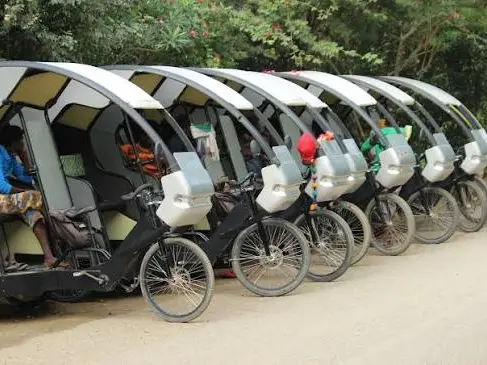
Videos flooding social media over the past week show a deeply unsettling scene: a person walks up to a moving e-rickshaw, opens an app on their phone, taps a button — and the vehicle dies. The driver, mid-route, is stranded. Some drivers are filmed crying. Others are seen pushing their vehicles home by hand. The app at the centre of these viral clips is called BAT-BMS, developed by Shenzhen Grenergy Technology in China, and what it has exposed is not just a viral prank — it is a structural vulnerability sitting inside millions of electric vehicles on Indian roads.
What Is BAT-BMS?
BAT-BMS is a battery management system application built to wirelessly monitor Bluetooth-enabled lithium battery packs. Its intended use is perfectly legitimate: solar installations, marine systems, off-grid power setups. The app lets a technician check a battery's charge level, voltage, current draw, temperature, cycle count, and individual cell health — all over a Bluetooth connection from up to 15 metres away. It was never designed to be pointed at a moving vehicle on a public road. But a design flaw in the batteries used by Indian e-rickshaws made that possible.

The Bluetooth Gap Nobody Fixed
Millions of e-rickshaws in India run on budget lithium battery packs sourced from Chinese manufacturers. These packs come fitted with a Battery Management System chip that includes a standard safety feature called the discharge switch — a function designed to let mechanics safely cut all power to a battery before performing repairs. The problem is that the Bluetooth module attached to these BMS chips is left entirely unsecured. No username. No password. No authentication layer of any kind. When that unprotected module broadcasts its Bluetooth signal — which it does constantly, within a roughly 15-metre radius — any compatible app within range can connect to it. And once connected, any user can trigger the discharge switch. The motor controller loses power instantly. The vehicle stops.
Who Is Affected — And Who Is Not
Trending Stories
)
US vs China over South China Sea: Washington backs Philippines, Beijing hits back
)
Bigg Boss 20: Isha Rikhi evicted after three weeks in Salman Khan’s show
)
Musk plans to more than double xAI's chips to over 1.2 million Nvidia GPUs by year-end
)
After JU, clash erupts at SRFTI: BJP’s ‘Dimagi Naxal’ jibe sparks political firestorm after students protest RSS-linked event
)
‘Anti-social elements spreading false rumours’: LPU issues statement amid massive unrest over alleged rape
)
LPU students go on rampage, vandalise campus amid widespread protest: What's happening
)
Trump asked Xi to pressure Iran. China did not say yes — here’s what Beijing wants
)
US Treasury Secretary Scott Bessent hails global crackdown on Iranian banks and airlines
)
An OpenAI agent escaped its locked test cage again, by hiding questions in DNS lookups
)
'Our video was trimmed': LPU girls who featured in rape-denial video make U-turn
)
3 males killed, four others injured in shooting after fight at strip club in Detroit
)
'Victory for low-budget consumers': Raghav Chadha hails 30-day telecom recharge rules
)
Claude rebuilt the 1989 game 'Prince of Persia' by reusing the original's own code
)
Beyond metros: How Tier-2 and Tier-3 cities could drive India’s next AI wave
)
Tesla builds first Cybertruck with its own refined lithium: Elon Musk's $1 billion Texas bet pays off
)
IndiGo flight suffers tail strike in Bengaluru while landing; DGCA to probe incident
)
The US and China set up an AI 'red telephone', but skipped the rulebook
)
‘Terror suspects arrested near UK air base were looking to do big damage’: Trump
)
Russian envoy claims US tactics to contain India were revealed in ‘Freudian slip’
)
IND vs WI 1st ODI: Kohli breaks Sachin's most runs in one country record with unbeaten 139 as India thump West Indies by 8 wickets
)
Researchers rebuilt exactly how 700 AI agents hacked Hugging Face: a 900-link chain trick
)
‘Olympic inclusion is our major target’: WPA President Ishaun Singh on pool’s global ambitions
)
Nations League: Spain sink England at Wembley; Modric shines for Croatia
)
Why has Iran released no proof of life of Mojtaba Khamenei? Araghchi reveals...
)
'What kind of confession is this?': Pakistan PM Shehbaz Sharif’s 'terrorists would be roaming New York' remark goes viral, raises alarm online. Watch
)
South Korea demands apology from Ukraine over North Korean prisoners' transfer
)
Beyond BrahMos: India targets Rs 50,000 crore in defence exports with unmatched price edge
)
Sri Lankan Tamil migrant worker gets death sentence in Saudi Arabia, help sought from India
)
Muslim marriage cannot shield sex with minor wife from prosecution under POCSO: Delhi HC
)
'Can't help but draw painful parallels to Nirbhaya case': SC on latest incidents of rape cases in Delhi-NCR
)
99.9% more powerful - Scientists find boy who can recall memories from just 3 months of age
)
'FIRST LOOK from inside Noah’s Ark': Researchers share video from inside mysterious mound in Turkey
)
UNSC reform momentum grows: Russia, Portugal, Mauritius push for India's permanent seat bid
)
8 US marines injured in Iranian missile attack on vessel in Strait of Hormuz: Report
&im=FitAndFill=(700,400))
New OTT releases this week (September 28-October 4, 2026): Dupahiya 2, Pooja Meri Jaan, Ohh My Dog- 5 titles coming on Netflix, Prime Video and more
)
Afghanistan says 28 fighters killed in clash near Pakistan border, Islamabad denies
)
Ceuta migrant crisis: Protesters take to streets as Spain grapples with migrant challenge
)
LPU suspend classes, postpones exams as violence escalates over rape claims: What's happening
)
New York City wants a 'kill switch' on every AI, and will pay whistleblowers who report violations
The vulnerability does not apply to every e-rickshaw on the road. Vehicles running on older lead-acid batteries — still very common in India — have no Bluetooth component and are entirely unaffected. E-rickshaws with lithium batteries that use proprietary BMS software, or whose Bluetooth modules have been properly password-protected, are also safe. The danger is specific to the large segment of the market that runs on cheap, mass-produced lithium battery packs with generic BMS chipsets and no security configuration. Experts note that the pranks circulating online are also harder to execute than the short videos suggest — connecting to a moving vehicle in traffic, locating the correct device among multiple signals, and triggering the switch without the driver noticing all require proximity and a few seconds of deliberate action. But that does not make it safe.
Banning The App Changes Nothing
Following the viral spread of the videos, BAT-BMS has reportedly been removed from Apple's App Store. It remains available on the Google Play Store. But here is the problem with the ban-the-app response: BAT-BMS is not unique. There are thousands of generic Bluetooth BMS monitoring applications available across the App Store, the Play Store, and third-party APK repositories. Any app that can communicate with a standard BMS protocol over Bluetooth can, in principle, trigger the same discharge switch. Removing one app from one store does not close the vulnerability — it just changes which app someone uses to exploit it.
AI Can Rebuild It In Under Five Minutes
The situation is made structurally worse by the rise of AI-powered app generation tools. Platforms like Mythis and other vibe-coding AI builders can take a simple prompt — ‘build a Bluetooth BMS controller app that connects to lithium battery packs and allows toggling the discharge switch’ — and generate a fully functional Android or iOS application in minutes. No coding expertise required. No app store submission needed; the output can be side-loaded directly onto a phone. This means that even if every existing BAT-BMS clone were simultaneously removed from every platform on earth, a replacement could be operational in the time it takes to make a cup of tea. The app is not the attack surface. The unprotected hardware is.
Drivers Pay The Price
The human cost of this vulnerability falls entirely on e-rickshaw drivers — some of India's most economically vulnerable gig workers. A driver whose vehicle is remotely stalled mid-route loses the fare, loses time, risks the safety of passengers, and faces the prospect of either pushing a several-hundred-kilogram vehicle through traffic or waiting for a mechanic who may or may not know what has happened. Viral videos show drivers who have no idea why their vehicle has stopped, with no way to diagnose the problem without technical assistance. Tech creator Abhishek Bhatnagar, who investigated the issue, pointed out that the responsibility cannot be placed on drivers: they have no reasonable means to configure Bluetooth security settings on their battery packs. The dealers and manufacturers who supply these vehicles and batteries should have done it before the sale.
The Fix Is In The Hardware, Not The App Store
Cybersecurity experts watching the situation have been consistent: the only real solution is to secure the BMS hardware itself. Battery packs need to ship with Bluetooth modules that require authentication before any command can be issued. Manufacturers need to set unique passwords before batteries leave the factory floor. Dealers need to verify that security is active before delivering vehicles to drivers. India has no current regulatory framework requiring any of this for EV battery hardware. The government has not issued a formal response as of this writing. What exists is a growing number of viral videos, a lot of crying drivers, and a structural flaw in the connected mobility ecosystem that a five-minute AI-generated app replacement will keep alive indefinitely — long after BAT-BMS itself has been forgotten.
